

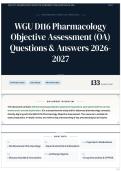
WGU D116 PHARMACOLOGY OBJECTIVE ASSESSMENT (OA) QUESTIONS & ANS… EXAM
P R O F E S S I O N A L P R A C T I C E M AT E R I A L S
WGU D116 Pharmacology
Objective Assessment (OA)
Questions & Answers 2026-
2027
Verified Answers Exam Ready With Rationales
133 QUESTIONS
DOCUMENT OVERVIEW
This document contains 133 pharmacology objective assessment questions, each paired with its correct
answer and a concise explanation. It is a comprehensive study aid for advanced pharmacology concepts,
directly aligning with the WGU D116 Pharmacology Objective Assessment. This resource is suitable for
exam preparation, in-depth review, and reinforcing understanding of key pharmacological principles.
CONTENTS
01 02 03 • Psychiatric Medications
• Cardiovascular Pharmacology • Neurotransmitters & Receptors
04 05 • Antifungal Agents 06
• Glucocorticoids & Interactions • Drug Interactions & CYP450
Page 1
, 07 08 09
• Reproductive & Other Agents • Antibiotics & Antimicrobials • General Pharmacology Concepts
10 • Vitamins & Minerals 11
• Diabetes Mellitus Management
E XA M Q U EST I O N S
Q1 QUESTION 1 OF 133
doxazosin
CORRECT ANSWER
Cardura, Cardura XL
alpha blocker
potent and selective post-junctional alpha-1-adrenergic blocker.
This action blocks alpha 1 receptors in vascular smooth muscle & bladder/prostate.
causes vasodilation of arterioles and veins and relaxation of smooth muscle in the bladder neck/prostate (to
improve urinary flow in BPH) results in a decrease in systemic blood pressure.
For: HTN, enlarged prostate in BPH by relaxing blood vessels.
-start at 1mg daily for HTN
-for BPH, 1 mg at bedtime and maintenance 4-8mg once daily
BLACK BOX: first-dose phenomenon. significant orthostatic hypotension or syncope - esp after 1st dose or
dose increases.
& risk of intraoperative floppy iris syndrome (IFIS) during cataract surgery.
decreases standing and supine blood pressure so monitor BP & HR.
dont give if pt has allergy to:
quinolones, alfuzosin, prozosin, tamulosin, or terazosin.
dont take if pregnant/breastfeeding, stomach/intestine problems.
dont take with sildenafil, tadalafil, or vardenafil.
dont give to pts with heart failure or elderly. dizziness, lightheadedness/fainting may occur. dont give with
hepatic impairment (extensively metabolized by liver)
drug interactions with other antihypertensives or PDE5 inhibitors (sildenafil) or CYP3A4 inhibitors
(ketoconazole, ritonavir) bc it will increase levels of doxazosin.
usual dose is 2mg-16 mg taken once a day or slow release 4-8mg once a day.
clinical pearls: not first line for HTN but can be useful if pt has HTN & BPH.
good option for older men who need help with BP and urinary flow.
pt should be educated to rise slowly from sitting/lying. remind pt about eye surgery risk! must inform
opthalmologist if they've ever taken this med.
avoid alcohol & hot showers. dont stop abruptly. report s/s of low BP, fainting.
DOXAZOSIN: DILATES VESSELS & DECONGESTS THE PROSTATE
Page 2
, Q2 QUESTION 2 OF 133
a 1 & 2, b 1 & 2 receptor actions
CORRECT ANSWER
a1: vasoconstriction. increases BP. can cause reflex bradycardia.
a2: CNS inhibition of NE release. clonidine works here and lowers BP.
b1: increases heart rate and contractility. NE activates B1 but not B2.
b2: NE has minimal activity. epineprhine effects this more - bronchodilation.
Q3 QUESTION 3 OF 133
epinephrine (adrenaline)
CORRECT ANSWER
sympathomimetic agent. nonselective alpha & beta adrenergic agonist.
-->alpha 1 agonist = vasoconstriction. increases BP & decreases mucosal edema
-->beta 1 agonist = ^HR,^CO
-->beta 2 agonist = bronchodilation, decreased mediator release from mast cells
emergency uses: anaphylaxis(0.3-0.5mg IM q5-15 min.. kids 0.01mg/kg IM - max 0.3 mg), cardiac arrest like VF,
PEA, aystole(1 mg q3-5 min), severe asthma/bronchospasm, croup(0.5 ml of 2.25% solution in 3 ml ns) onset is
rapid..monitor for rebound), septic shock.
other uses: local anesthesia adjunt bc vasoconstriction prolongs effects, control bleeding, bradycardia if
unresponsive to atropine
caution in CV disease, hyperthyroid, DM - can ^ BS, MAOI (HTN crisis)
interactions:
-BB (esp non selective) HTN
-MAOI/TCA: HTN crisis
-anesthetics:arrhythmias
**1:1,000 for IM & 1:10,000 IV concentrations
**IM injection into lateral thigh for faster absorption than deltoid
epi pen: carry two. hold for up to 10 seconds. outer thigh. 911. check exp. date. store at room temp.
Q4 QUESTION 4 OF 133
Page 3
, Losartan (Cozaar)
CORRECT ANSWER
ARB
25-100 mg/day
category X!! teratogenic
HTN - adults & peds >6 yrs
diabetic nephropathy: slows progression in type 2 dm
stroke risk reduction - in pts with HTN + LVH
commonly used in HF WITH REDUCED EF, proteinuria (non-diabetic), post-MI (if ACEI intolerant)
blocks antiotensin II receptors
prevents vasoconstriction & aldosterone release. decreases BP, afterload, and sodium & water rentention
*less cough/angioedema than ACEI because no bradykinin accumulation
can be used alone or with diuretics/ccbs.
monitor BP, serum creatinine & K+ (baseline & within 1-2 weeks of starting). monitor eGFR for renal function
decline esp. in CKD
**expect a small bump in CR initially but dont worry unless it rises >30% or GFR plummets
contraindications: pregnancy, bilateral renal artery stenosis, hyperkalemia, severe hepatic impairment,
dehydrated/volume depleted
s/e: hypotension, dizzy, ^CR,^K+, n/d, h/a, fatigue, rare rash/back pain
can use ACEI but have higher risk of cough & angioedema
drug interactions:
-K+supplements/K+sparing diuretics -- ^ K+
-NSAIDs.. decrease losartan & ^ renal toxicity risk
-lithium ^ lithium toxicity
-diuretics: may ^ hypotension
-RAAS inhibitors (ACEI, aliskiren)..avoid dual therapy (^K+ & renal dysfunction)
start low!! 25 mg in elderly, volume-depleted, CKD
-preferred in diabetic nephropathy for renal protection
-good ACEI alternative if pts have cough/angioedema h/o
-monitor K+ closely esp. with CKD/K+sparing
**avoid in pregnant pts!
**orthostatic precautions during initiation or dose changes
*may take 3-6 weeks for full effect
if K+ levels are higher.. avoid bananas, salt substitutes, leafy greens
Q5 QUESTION 5 OF 133
Page 4
P R O F E S S I O N A L P R A C T I C E M AT E R I A L S
WGU D116 Pharmacology
Objective Assessment (OA)
Questions & Answers 2026-
2027
Verified Answers Exam Ready With Rationales
133 QUESTIONS
DOCUMENT OVERVIEW
This document contains 133 pharmacology objective assessment questions, each paired with its correct
answer and a concise explanation. It is a comprehensive study aid for advanced pharmacology concepts,
directly aligning with the WGU D116 Pharmacology Objective Assessment. This resource is suitable for
exam preparation, in-depth review, and reinforcing understanding of key pharmacological principles.
CONTENTS
01 02 03 • Psychiatric Medications
• Cardiovascular Pharmacology • Neurotransmitters & Receptors
04 05 • Antifungal Agents 06
• Glucocorticoids & Interactions • Drug Interactions & CYP450
Page 1
, 07 08 09
• Reproductive & Other Agents • Antibiotics & Antimicrobials • General Pharmacology Concepts
10 • Vitamins & Minerals 11
• Diabetes Mellitus Management
E XA M Q U EST I O N S
Q1 QUESTION 1 OF 133
doxazosin
CORRECT ANSWER
Cardura, Cardura XL
alpha blocker
potent and selective post-junctional alpha-1-adrenergic blocker.
This action blocks alpha 1 receptors in vascular smooth muscle & bladder/prostate.
causes vasodilation of arterioles and veins and relaxation of smooth muscle in the bladder neck/prostate (to
improve urinary flow in BPH) results in a decrease in systemic blood pressure.
For: HTN, enlarged prostate in BPH by relaxing blood vessels.
-start at 1mg daily for HTN
-for BPH, 1 mg at bedtime and maintenance 4-8mg once daily
BLACK BOX: first-dose phenomenon. significant orthostatic hypotension or syncope - esp after 1st dose or
dose increases.
& risk of intraoperative floppy iris syndrome (IFIS) during cataract surgery.
decreases standing and supine blood pressure so monitor BP & HR.
dont give if pt has allergy to:
quinolones, alfuzosin, prozosin, tamulosin, or terazosin.
dont take if pregnant/breastfeeding, stomach/intestine problems.
dont take with sildenafil, tadalafil, or vardenafil.
dont give to pts with heart failure or elderly. dizziness, lightheadedness/fainting may occur. dont give with
hepatic impairment (extensively metabolized by liver)
drug interactions with other antihypertensives or PDE5 inhibitors (sildenafil) or CYP3A4 inhibitors
(ketoconazole, ritonavir) bc it will increase levels of doxazosin.
usual dose is 2mg-16 mg taken once a day or slow release 4-8mg once a day.
clinical pearls: not first line for HTN but can be useful if pt has HTN & BPH.
good option for older men who need help with BP and urinary flow.
pt should be educated to rise slowly from sitting/lying. remind pt about eye surgery risk! must inform
opthalmologist if they've ever taken this med.
avoid alcohol & hot showers. dont stop abruptly. report s/s of low BP, fainting.
DOXAZOSIN: DILATES VESSELS & DECONGESTS THE PROSTATE
Page 2
, Q2 QUESTION 2 OF 133
a 1 & 2, b 1 & 2 receptor actions
CORRECT ANSWER
a1: vasoconstriction. increases BP. can cause reflex bradycardia.
a2: CNS inhibition of NE release. clonidine works here and lowers BP.
b1: increases heart rate and contractility. NE activates B1 but not B2.
b2: NE has minimal activity. epineprhine effects this more - bronchodilation.
Q3 QUESTION 3 OF 133
epinephrine (adrenaline)
CORRECT ANSWER
sympathomimetic agent. nonselective alpha & beta adrenergic agonist.
-->alpha 1 agonist = vasoconstriction. increases BP & decreases mucosal edema
-->beta 1 agonist = ^HR,^CO
-->beta 2 agonist = bronchodilation, decreased mediator release from mast cells
emergency uses: anaphylaxis(0.3-0.5mg IM q5-15 min.. kids 0.01mg/kg IM - max 0.3 mg), cardiac arrest like VF,
PEA, aystole(1 mg q3-5 min), severe asthma/bronchospasm, croup(0.5 ml of 2.25% solution in 3 ml ns) onset is
rapid..monitor for rebound), septic shock.
other uses: local anesthesia adjunt bc vasoconstriction prolongs effects, control bleeding, bradycardia if
unresponsive to atropine
caution in CV disease, hyperthyroid, DM - can ^ BS, MAOI (HTN crisis)
interactions:
-BB (esp non selective) HTN
-MAOI/TCA: HTN crisis
-anesthetics:arrhythmias
**1:1,000 for IM & 1:10,000 IV concentrations
**IM injection into lateral thigh for faster absorption than deltoid
epi pen: carry two. hold for up to 10 seconds. outer thigh. 911. check exp. date. store at room temp.
Q4 QUESTION 4 OF 133
Page 3
, Losartan (Cozaar)
CORRECT ANSWER
ARB
25-100 mg/day
category X!! teratogenic
HTN - adults & peds >6 yrs
diabetic nephropathy: slows progression in type 2 dm
stroke risk reduction - in pts with HTN + LVH
commonly used in HF WITH REDUCED EF, proteinuria (non-diabetic), post-MI (if ACEI intolerant)
blocks antiotensin II receptors
prevents vasoconstriction & aldosterone release. decreases BP, afterload, and sodium & water rentention
*less cough/angioedema than ACEI because no bradykinin accumulation
can be used alone or with diuretics/ccbs.
monitor BP, serum creatinine & K+ (baseline & within 1-2 weeks of starting). monitor eGFR for renal function
decline esp. in CKD
**expect a small bump in CR initially but dont worry unless it rises >30% or GFR plummets
contraindications: pregnancy, bilateral renal artery stenosis, hyperkalemia, severe hepatic impairment,
dehydrated/volume depleted
s/e: hypotension, dizzy, ^CR,^K+, n/d, h/a, fatigue, rare rash/back pain
can use ACEI but have higher risk of cough & angioedema
drug interactions:
-K+supplements/K+sparing diuretics -- ^ K+
-NSAIDs.. decrease losartan & ^ renal toxicity risk
-lithium ^ lithium toxicity
-diuretics: may ^ hypotension
-RAAS inhibitors (ACEI, aliskiren)..avoid dual therapy (^K+ & renal dysfunction)
start low!! 25 mg in elderly, volume-depleted, CKD
-preferred in diabetic nephropathy for renal protection
-good ACEI alternative if pts have cough/angioedema h/o
-monitor K+ closely esp. with CKD/K+sparing
**avoid in pregnant pts!
**orthostatic precautions during initiation or dose changes
*may take 3-6 weeks for full effect
if K+ levels are higher.. avoid bananas, salt substitutes, leafy greens
Q5 QUESTION 5 OF 133
Page 4


