

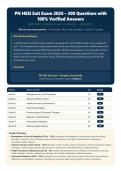
PN HESI Exit Exam 2026 – 300 Questions with
100% Verified Answers
With NGN – Complete Exam – Graded A+ – 2026/2027
300 real exam-style questions · Full rationales · Why wrong explanations · 2026/2027 updated
Dear Nursing Colleague,
I used this exact set of 300 practice questions to prepare for my PN HESI Exit Exam, and I passed with
an A+. This comprehensive study guide contains actual exam-style questions with verified answers and
detailed rationales, including NGN (Next Generation NCLEX) style questions. I am sharing this with you
so you can achieve the same success. Each question includes a thorough explanation of the correct
answer and why the other options are wrong. Study these questions carefully, and you will be fully
prepared for your exam.
Good luck!
PN HESI Exit Exam – Complete Study Guide
Verified Solutions | 2026/2027 Update | Graded A+
Section Topics Covered Qs Weight
Section 1 Management of Care & Delegation 35 12%
Section 2 Safety & Infection Control 30 10%
Section 3 Health Promotion & Maintenance 25 8%
Section 4 Psychosocial Integrity 30 10%
Section 5 Pharmacological & Parenteral Therapies 40 13%
Section 6 Reduction of Risk Potential 35 12%
Section 7 Physiological Adaptation 45 15%
Section 8 Medical-Surgical Nursing 60 20%
Content Overview
Management of Care & Delegation (35 Qs - 12%): Assignment and delegation, client advocacy, ethical and legal
principles, continuity of care, informed consent, advance directives, client rights, interdisciplinary collaboration,
prioritization (ABCs, Maslow).
Safety & Infection Control (30 Qs - 10%): Standard, contact, droplet, airborne precautions; infection prevention; isolation
techniques; medical/surgical asepsis; falls prevention; restraints; fire safety (RACE, PASS); incident reporting.
Health Promotion & Maintenance (25 Qs - 8%): Growth and development across lifespan, immunizations, screening,
health education, nutrition, prenatal care, well-baby care, lifestyle modifications, disease prevention.
Psychosocial Integrity (30 Qs - 10%): Therapeutic communication, grief and loss, stress and coping, anxiety disorders,
depression, suicidal ideation, dementia, schizophrenia, substance abuse, family dynamics, cultural competence.
, Pharmacological & Parenteral Therapies (40 Qs - 13%): Medication administration, dosage calculation, adverse effects,
side effects, contraindications, drug interactions, high-alert medications, pain management, IV therapy, blood transfusion.
Reduction of Risk Potential (35 Qs - 12%): Electrolyte imbalances, acid-base imbalances, ABG interpretation, risk
identification, diagnostic tests, early warning signs, post-op complications, fall risk, DVT prevention.
Physiological Adaptation (45 Qs - 15%): Cardiovascular, respiratory, neurological, renal, gastrointestinal, endocrine,
hematological, integumentary pathophysiology; shock; sepsis; wound healing; pressure injuries.
Medical-Surgical Nursing (60 Qs - 20%): Med-surg conditions (CHF, COPD, DM, MI, CVA, pneumonia, DVT, PE, cirrhosis,
pancreatitis, cancer), pre-op/post-op care; NGN case studies; clinical judgment; prioritization.
Section 1: Management of Care & Delegation (35 questions)
Q1. A charge nurse is assigning clients on a medical-surgical unit. Which client should be assigned to
the RN rather than the LPN?
A A client post-op day 2 requiring a simple dressing change
B A client requiring a straight catheterization for a post-void residual
C A client with new-onset confusion and a blood pressure of 90/60
D A client receiving a continuous tube feeding
E A client with a colostomy requiring pouch change
Correct answer: C. A client with new-onset confusion and a blood pressure of 90/60
Rationale: New-onset confusion and hypotension indicate a potential change in condition (e.g., sepsis, stroke). The
RN must assess unstable clients. LPNs can perform stable, predictable tasks like dressing changes, catheterizations,
and tube feedings.
Why wrong:
A: Simple dressing changes on a stable post-op client can be delegated to an LPN.
B: Straight catheterization is a stable, predictable task for LPNs.
D: Continuous tube feeding on a stable client can be managed by an LPN.
E: Colostomy pouch changes are within LPN scope for stable clients.
Reference: HESI PN Exit Exam V4 · Evolve HESI · Saunders NCLEX-PN · NGN Test Plan.
,Q2. A charge nurse is assigning rooms for four clients. Which client should be placed in a private
room?
A Client with pneumonia
B Client with MRSA
C Client with a diabetic foot ulcer
D Client with COPD
E Client with urinary tract infection
Correct answer: B. Client with MRSA
Rationale: MRSA requires contact isolation. A private room is essential to prevent transmission to other clients.
While pneumonia may require droplet precautions, MRSA is the priority for a single room assignment.
Why wrong:
A: Pneumonia requires droplet precautions, but a private room is not always required.
C: Diabetic foot ulcers require standard precautions.
D: COPD does not require isolation precautions.
E: UTI requires standard precautions.
Reference: HESI PN Exit Exam V4 · Evolve HESI · Saunders NCLEX-PN · NGN Test Plan.
Q3. A nurse is delegating tasks to an assistive personnel (AP). Which task is appropriate to delegate?
A Assess a postoperative incision
B Teach a client how to use a walker
C Obtain a capillary blood glucose level
D Evaluate a client's pain level
E Change a sterile wound dressing
Correct answer: C. Obtain a capillary blood glucose level
Rationale: APs can perform capillary blood glucose testing. Assessment, teaching, and evaluation all require
nursing judgment. Sterile dressing changes require sterile technique and assessment, which are RN/LPN
responsibilities.
Why wrong:
A: Assessment requires RN-level clinical judgment.
B: Teaching requires RN-level education.
D: Evaluation of pain requires RN-level clinical judgment.
E: Sterile dressing changes require sterile technique and assessment.
Reference: HESI PN Exit Exam V4 · Evolve HESI · Saunders NCLEX-PN · NGN Test Plan.
, Q4. A nurse is caring for a client who just signed a DNR order. The family member says, "I don't care
what the paper says; you will do CPR if I see him stop breathing." What is the nurse's priority
response?
A "I will have to follow the DNR order, as the client has the right to make that decision."
B "I understand you are upset, but you need to leave the room."
C "Let's call for an ethics committee meeting right now."
D "Okay, I will do CPR if you insist."
E "This must be very difficult for you. Let me call the provider to talk with you."
Correct answer: A. "I will have to follow the DNR order, as the client has the right to make that decision."
Rationale: The client's autonomous decision (DNR) supersedes the family's wishes. The nurse must advocate for
the client's choice and explain the legal and ethical obligation to follow the DNR order.
Why wrong:
B: Asking the family to leave is dismissive.
C: An ethics committee is not necessary for a clear DNR order.
D: Following the family's wishes violates the client's autonomy.
E: While empathetic, the nurse must also uphold the DNR order.
Reference: HESI PN Exit Exam V4 · Evolve HESI · Saunders NCLEX-PN · NGN Test Plan.
Q5. A nurse is caring for four clients. Which client should be seen first?
A Client with COPD and SpO₂ 89% on 2L nasal cannula
B Client post-appendectomy day 2 with temperature 38.3°C (101°F)
C Client with heart failure and 3+ pitting edema
D Client with new onset confusion and bounding pulse
E Client with diabetes and blood glucose 180 mg/dL
Correct answer: D. Client with new onset confusion and bounding pulse
Rationale: New onset confusion with bounding pulse suggests hypercapnia or fluid overload affecting cerebral
perfusion. This is a change in neurological status, which is always the priority. Option A is expected in COPD
patients (target SpO₂ 88-92%).
Why wrong:
A: SpO₂ 89% is expected in COPD patients (target 88-92%).
B: Low-grade fever is expected post-operatively.
C: 3+ pitting edema is a chronic finding in heart failure.
E: Blood glucose 180 mg/dL is elevated but not immediately life-threatening.
Reference: HESI PN Exit Exam V4 · Evolve HESI · Saunders NCLEX-PN · NGN Test Plan.
100% Verified Answers
With NGN – Complete Exam – Graded A+ – 2026/2027
300 real exam-style questions · Full rationales · Why wrong explanations · 2026/2027 updated
Dear Nursing Colleague,
I used this exact set of 300 practice questions to prepare for my PN HESI Exit Exam, and I passed with
an A+. This comprehensive study guide contains actual exam-style questions with verified answers and
detailed rationales, including NGN (Next Generation NCLEX) style questions. I am sharing this with you
so you can achieve the same success. Each question includes a thorough explanation of the correct
answer and why the other options are wrong. Study these questions carefully, and you will be fully
prepared for your exam.
Good luck!
PN HESI Exit Exam – Complete Study Guide
Verified Solutions | 2026/2027 Update | Graded A+
Section Topics Covered Qs Weight
Section 1 Management of Care & Delegation 35 12%
Section 2 Safety & Infection Control 30 10%
Section 3 Health Promotion & Maintenance 25 8%
Section 4 Psychosocial Integrity 30 10%
Section 5 Pharmacological & Parenteral Therapies 40 13%
Section 6 Reduction of Risk Potential 35 12%
Section 7 Physiological Adaptation 45 15%
Section 8 Medical-Surgical Nursing 60 20%
Content Overview
Management of Care & Delegation (35 Qs - 12%): Assignment and delegation, client advocacy, ethical and legal
principles, continuity of care, informed consent, advance directives, client rights, interdisciplinary collaboration,
prioritization (ABCs, Maslow).
Safety & Infection Control (30 Qs - 10%): Standard, contact, droplet, airborne precautions; infection prevention; isolation
techniques; medical/surgical asepsis; falls prevention; restraints; fire safety (RACE, PASS); incident reporting.
Health Promotion & Maintenance (25 Qs - 8%): Growth and development across lifespan, immunizations, screening,
health education, nutrition, prenatal care, well-baby care, lifestyle modifications, disease prevention.
Psychosocial Integrity (30 Qs - 10%): Therapeutic communication, grief and loss, stress and coping, anxiety disorders,
depression, suicidal ideation, dementia, schizophrenia, substance abuse, family dynamics, cultural competence.
, Pharmacological & Parenteral Therapies (40 Qs - 13%): Medication administration, dosage calculation, adverse effects,
side effects, contraindications, drug interactions, high-alert medications, pain management, IV therapy, blood transfusion.
Reduction of Risk Potential (35 Qs - 12%): Electrolyte imbalances, acid-base imbalances, ABG interpretation, risk
identification, diagnostic tests, early warning signs, post-op complications, fall risk, DVT prevention.
Physiological Adaptation (45 Qs - 15%): Cardiovascular, respiratory, neurological, renal, gastrointestinal, endocrine,
hematological, integumentary pathophysiology; shock; sepsis; wound healing; pressure injuries.
Medical-Surgical Nursing (60 Qs - 20%): Med-surg conditions (CHF, COPD, DM, MI, CVA, pneumonia, DVT, PE, cirrhosis,
pancreatitis, cancer), pre-op/post-op care; NGN case studies; clinical judgment; prioritization.
Section 1: Management of Care & Delegation (35 questions)
Q1. A charge nurse is assigning clients on a medical-surgical unit. Which client should be assigned to
the RN rather than the LPN?
A A client post-op day 2 requiring a simple dressing change
B A client requiring a straight catheterization for a post-void residual
C A client with new-onset confusion and a blood pressure of 90/60
D A client receiving a continuous tube feeding
E A client with a colostomy requiring pouch change
Correct answer: C. A client with new-onset confusion and a blood pressure of 90/60
Rationale: New-onset confusion and hypotension indicate a potential change in condition (e.g., sepsis, stroke). The
RN must assess unstable clients. LPNs can perform stable, predictable tasks like dressing changes, catheterizations,
and tube feedings.
Why wrong:
A: Simple dressing changes on a stable post-op client can be delegated to an LPN.
B: Straight catheterization is a stable, predictable task for LPNs.
D: Continuous tube feeding on a stable client can be managed by an LPN.
E: Colostomy pouch changes are within LPN scope for stable clients.
Reference: HESI PN Exit Exam V4 · Evolve HESI · Saunders NCLEX-PN · NGN Test Plan.
,Q2. A charge nurse is assigning rooms for four clients. Which client should be placed in a private
room?
A Client with pneumonia
B Client with MRSA
C Client with a diabetic foot ulcer
D Client with COPD
E Client with urinary tract infection
Correct answer: B. Client with MRSA
Rationale: MRSA requires contact isolation. A private room is essential to prevent transmission to other clients.
While pneumonia may require droplet precautions, MRSA is the priority for a single room assignment.
Why wrong:
A: Pneumonia requires droplet precautions, but a private room is not always required.
C: Diabetic foot ulcers require standard precautions.
D: COPD does not require isolation precautions.
E: UTI requires standard precautions.
Reference: HESI PN Exit Exam V4 · Evolve HESI · Saunders NCLEX-PN · NGN Test Plan.
Q3. A nurse is delegating tasks to an assistive personnel (AP). Which task is appropriate to delegate?
A Assess a postoperative incision
B Teach a client how to use a walker
C Obtain a capillary blood glucose level
D Evaluate a client's pain level
E Change a sterile wound dressing
Correct answer: C. Obtain a capillary blood glucose level
Rationale: APs can perform capillary blood glucose testing. Assessment, teaching, and evaluation all require
nursing judgment. Sterile dressing changes require sterile technique and assessment, which are RN/LPN
responsibilities.
Why wrong:
A: Assessment requires RN-level clinical judgment.
B: Teaching requires RN-level education.
D: Evaluation of pain requires RN-level clinical judgment.
E: Sterile dressing changes require sterile technique and assessment.
Reference: HESI PN Exit Exam V4 · Evolve HESI · Saunders NCLEX-PN · NGN Test Plan.
, Q4. A nurse is caring for a client who just signed a DNR order. The family member says, "I don't care
what the paper says; you will do CPR if I see him stop breathing." What is the nurse's priority
response?
A "I will have to follow the DNR order, as the client has the right to make that decision."
B "I understand you are upset, but you need to leave the room."
C "Let's call for an ethics committee meeting right now."
D "Okay, I will do CPR if you insist."
E "This must be very difficult for you. Let me call the provider to talk with you."
Correct answer: A. "I will have to follow the DNR order, as the client has the right to make that decision."
Rationale: The client's autonomous decision (DNR) supersedes the family's wishes. The nurse must advocate for
the client's choice and explain the legal and ethical obligation to follow the DNR order.
Why wrong:
B: Asking the family to leave is dismissive.
C: An ethics committee is not necessary for a clear DNR order.
D: Following the family's wishes violates the client's autonomy.
E: While empathetic, the nurse must also uphold the DNR order.
Reference: HESI PN Exit Exam V4 · Evolve HESI · Saunders NCLEX-PN · NGN Test Plan.
Q5. A nurse is caring for four clients. Which client should be seen first?
A Client with COPD and SpO₂ 89% on 2L nasal cannula
B Client post-appendectomy day 2 with temperature 38.3°C (101°F)
C Client with heart failure and 3+ pitting edema
D Client with new onset confusion and bounding pulse
E Client with diabetes and blood glucose 180 mg/dL
Correct answer: D. Client with new onset confusion and bounding pulse
Rationale: New onset confusion with bounding pulse suggests hypercapnia or fluid overload affecting cerebral
perfusion. This is a change in neurological status, which is always the priority. Option A is expected in COPD
patients (target SpO₂ 88-92%).
Why wrong:
A: SpO₂ 89% is expected in COPD patients (target 88-92%).
B: Low-grade fever is expected post-operatively.
C: 3+ pitting edema is a chronic finding in heart failure.
E: Blood glucose 180 mg/dL is elevated but not immediately life-threatening.
Reference: HESI PN Exit Exam V4 · Evolve HESI · Saunders NCLEX-PN · NGN Test Plan.


