
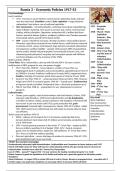
Russia 3 – Economic Policies 1917-53
Core knowledge
Lenin’s policies
1917 - Decrees on Land, Workers Control and to nationalise banks and take
over the state bank. Vesenkha created. State capitalism = large industries
nationalised, land reform, use of well-paid specialists Key dates
War Communism – full nationalisation, rationing, forced grain requisitioning, 1917 – Economic
hyper-inflation, bartering, free access to services (e.g. trams), end of private decrees
trading, military discipline. Opposition: production fell, 6 million died from 1918 – March = State
famine, spread of disease (typhus, smallpox), political crisis (Tambov peasants Capitalism
& Kronstadt sailors), growth of the black market Summer = War
NEP – Causes: rebuild the economy, develop socialism, retain political power. Communism
Measures: agriculture returned to free market forces; small factories returned 1921 = New Economic
to private control, money reintroduced, large factories remained nationalised. Policy
Consequences: political stability – popular with peasants (80% of population), 1923 – Scissors Crisis
famine ended, initially industrial growth, but eventually Scissors Crisis, and 1928 – First 5 Year Plan
industrial growth plateaued, inequality and corruption spread with NEPmen. and the start of
Led to key debates over the economy of the 1920s voluntary
Stalin’s policies 1928-41 Collectivisation
5 Year Plans. Aims: industrialise; catch up with GB and USA in 10 years; remove 1929 – forced
inefficiencies of NEP; prepare for war; win power struggle Collectivisation
First 5 Year Plan 1928-32 – heavy industry, creation of new cities e.g. 1930 – ‘Dizzy with
Magnitogorsk (lack of sanitation and accommodation, population grew from 25 Success’
to 250000 in 3 years); Problems: inefficiency & waste (40%), targetmania from 1933 – Second 5 Year
Gosplan, shortage of consumer goods (shoe queue in Moscow of over 1000) Plan
Second 5 Year Plan 1933-37 – communications (Moscow Metro 1935, Moscow- 1938 – Third 5 Year
Volga Canal 1397) & consumer goods; 1934-36 = ‘3 good years’, Stakhanovism Plan
to improve morale and effort, Dnieprostroi Dam = electricity production up x5 1941 - WWII
Third 5 Year Plan 1938-41 – preparation for war. Absenteeism & internal 1946 - 4th Five Year
passports Plan
Collectivisation 1951 - 5th Five Year
Causes: grain supplies, need to feed workers and fund industry. Events: 1928 Plan
voluntary collectivisation, 1929 forced collectivisation and de-Kulakisation Key words
(1.5million to labour camps), peasant resistance and slaughter of livestock (did State Capitalism
not recover to pre-war levels until 1953), grain production fell, grain War Communism
procurement remained high. Consequences: famine 1932-33 (5 million + died), New Economic Policy
1941 100% Soviet farms collectivised, but still reliant on private plots for food. Vesenkha
Less efficient. Collectivisation
Stalin’s post-war policies 1945-53 De-Kulakisation
WWII = reliance on US imports for 1/5 of calories needed by Red Army; Stakhanov
harvests declined, food rations fell, 25 million were homeless, production only Gosplan
2/3 of 1940 levels.
1945 = fastest growing economy in the world. 4 th 5 Year Plan – output up 80%,
focus on military spending (1/4 of budget 1952), 12% = food & consumer
goods, slow to rebuild homes, wages low, still inefficient. 5 th 5 Year Plan (1951-
55) = focus on Cold War military spending
Post-war agriculture – severe shortages of workers & resources 1946-49, 1952
grain production back to pre-war levels
‘WOW’ the examiner knowledge
Preobrazhensky advocated rapid industrialisation. Ordzhonikidze was Commissar for Heavy Industry until 1937.
March 1930 Stalin wrote his ‘Dizzy with Success’ article blaming activists who got carried away for excesses of
collectivisation. Activists were called the ‘Twenty Five Thousanders’
Law of 7/8ths – passed 7th August 1932 = 10 year sentence for stealing ‘socialised property’ (i.e. food)
Robert Conquest argued the liquidation of the Kulaks and famine was a genocide against the Ukrainian people -
Holodomor
Alexei Stakhanov - in August 1935 he mined 102 tons of coal in 6 hours. Became a propaganda hero – rewarded with 1
months wages, new apartment, telephone, to encourage others to increase efforts (all fixed)
Core knowledge
Lenin’s policies
1917 - Decrees on Land, Workers Control and to nationalise banks and take
over the state bank. Vesenkha created. State capitalism = large industries
nationalised, land reform, use of well-paid specialists Key dates
War Communism – full nationalisation, rationing, forced grain requisitioning, 1917 – Economic
hyper-inflation, bartering, free access to services (e.g. trams), end of private decrees
trading, military discipline. Opposition: production fell, 6 million died from 1918 – March = State
famine, spread of disease (typhus, smallpox), political crisis (Tambov peasants Capitalism
& Kronstadt sailors), growth of the black market Summer = War
NEP – Causes: rebuild the economy, develop socialism, retain political power. Communism
Measures: agriculture returned to free market forces; small factories returned 1921 = New Economic
to private control, money reintroduced, large factories remained nationalised. Policy
Consequences: political stability – popular with peasants (80% of population), 1923 – Scissors Crisis
famine ended, initially industrial growth, but eventually Scissors Crisis, and 1928 – First 5 Year Plan
industrial growth plateaued, inequality and corruption spread with NEPmen. and the start of
Led to key debates over the economy of the 1920s voluntary
Stalin’s policies 1928-41 Collectivisation
5 Year Plans. Aims: industrialise; catch up with GB and USA in 10 years; remove 1929 – forced
inefficiencies of NEP; prepare for war; win power struggle Collectivisation
First 5 Year Plan 1928-32 – heavy industry, creation of new cities e.g. 1930 – ‘Dizzy with
Magnitogorsk (lack of sanitation and accommodation, population grew from 25 Success’
to 250000 in 3 years); Problems: inefficiency & waste (40%), targetmania from 1933 – Second 5 Year
Gosplan, shortage of consumer goods (shoe queue in Moscow of over 1000) Plan
Second 5 Year Plan 1933-37 – communications (Moscow Metro 1935, Moscow- 1938 – Third 5 Year
Volga Canal 1397) & consumer goods; 1934-36 = ‘3 good years’, Stakhanovism Plan
to improve morale and effort, Dnieprostroi Dam = electricity production up x5 1941 - WWII
Third 5 Year Plan 1938-41 – preparation for war. Absenteeism & internal 1946 - 4th Five Year
passports Plan
Collectivisation 1951 - 5th Five Year
Causes: grain supplies, need to feed workers and fund industry. Events: 1928 Plan
voluntary collectivisation, 1929 forced collectivisation and de-Kulakisation Key words
(1.5million to labour camps), peasant resistance and slaughter of livestock (did State Capitalism
not recover to pre-war levels until 1953), grain production fell, grain War Communism
procurement remained high. Consequences: famine 1932-33 (5 million + died), New Economic Policy
1941 100% Soviet farms collectivised, but still reliant on private plots for food. Vesenkha
Less efficient. Collectivisation
Stalin’s post-war policies 1945-53 De-Kulakisation
WWII = reliance on US imports for 1/5 of calories needed by Red Army; Stakhanov
harvests declined, food rations fell, 25 million were homeless, production only Gosplan
2/3 of 1940 levels.
1945 = fastest growing economy in the world. 4 th 5 Year Plan – output up 80%,
focus on military spending (1/4 of budget 1952), 12% = food & consumer
goods, slow to rebuild homes, wages low, still inefficient. 5 th 5 Year Plan (1951-
55) = focus on Cold War military spending
Post-war agriculture – severe shortages of workers & resources 1946-49, 1952
grain production back to pre-war levels
‘WOW’ the examiner knowledge
Preobrazhensky advocated rapid industrialisation. Ordzhonikidze was Commissar for Heavy Industry until 1937.
March 1930 Stalin wrote his ‘Dizzy with Success’ article blaming activists who got carried away for excesses of
collectivisation. Activists were called the ‘Twenty Five Thousanders’
Law of 7/8ths – passed 7th August 1932 = 10 year sentence for stealing ‘socialised property’ (i.e. food)
Robert Conquest argued the liquidation of the Kulaks and famine was a genocide against the Ukrainian people -
Holodomor
Alexei Stakhanov - in August 1935 he mined 102 tons of coal in 6 hours. Became a propaganda hero – rewarded with 1
months wages, new apartment, telephone, to encourage others to increase efforts (all fixed)


