

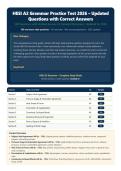
HESI A2 Grammar Practice Test 2026 – Updated
Questions with Correct Answers
300 Questions with Verified Answers & Detailed Rationales | Updated for 2026
300 real exam-style questions · Full rationales · Why wrong explanations · 2026 updated
Dear Colleague,
This comprehensive study guide contains 300 high-yield practice questions designed to mirror the
actual HESI A2 Grammar Exam. I have meticulously cross-referenced multiple trusted platforms—
including Stuvia, Docsity, Educato, and other top student resources—to compile the most current and
challenging questions. Each question includes a thorough explanation of the correct answer and why
the other options are wrong. Study these questions carefully, and you will be fully prepared for your
exam.
Good luck!
HESI A2 Grammar – Complete Study Guide
Verified Solutions | 2026 Updated | Graded A+
Section Topics Covered Qs Weight
Section 1 Subject-Verb Agreement 40 13%
Section 2 Pronoun Usage & Antecedent Agreement 40 13%
Section 3 Verb Tenses & Forms 40 13%
Section 4 Punctuation & Capitalization 40 13%
Section 5 Commonly Confused Words 40 13%
Section 6 Sentence Structure & Fragments 40 13%
Section 7 Parts of Speech & Modifiers 40 13%
Section 8 Spelling & Word Usage 20 7%
Content Overview
Subject-Verb Agreement (40 Qs - 13%): Singular/plural subjects, indefinite pronouns, collective nouns, compound
subjects, intervening phrases.
Pronoun Usage & Antecedent Agreement (40 Qs - 13%): Subject/object pronouns, possessive pronouns, reflexive
pronouns, pronoun-antecedent agreement, unclear reference.
Verb Tenses & Forms (40 Qs - 13%): Past, present, future tenses, perfect tenses, irregular verbs, active vs passive voice,
verb consistency.
Punctuation & Capitalization (40 Qs - 13%): Apostrophes, commas, semicolons, colons, quotation marks, capitalization
rules.
Commonly Confused Words (40 Qs - 13%): To/too/two, their/there/they're, your/you're, its/it's, affect/effect, who/whom,
lie/lay, sit/set.
, Sentence Structure & Fragments (40 Qs - 13%): Complete sentences, run-ons, comma splices, dependent/independent
clauses, misplaced modifiers.
Parts of Speech & Modifiers (40 Qs - 13%): Nouns, verbs, adjectives, adverbs, prepositions, conjunctions, interjections,
adjective/adverb usage.
Spelling & Word Usage (20 Qs - 7%): Correct spelling of commonly misspelled words, homophones, word choice in
context.
Section 1: Subject-Verb Agreement (40 questions)
Q1. Which sentence is grammatically correct?
A The patient, along with her family members, are waiting.
B The patient, along with her family members, is waiting.
C The patient, along with her family members, were waiting.
D The patient, along with her family members, have been waiting.
Correct answer: B. The patient, along with her family members, is waiting.
Rationale: The subject is "patient" (singular), not "family members." Phrases between the subject and verb are
distractors. The singular verb "is waiting" agrees with "patient."
Why wrong:
A: The patient, along with her family members, are waiting. is incorrect
C: The patient, along with her family members, were waiting. is incorrect
D: The patient, along with her family members, have been waiting. is incorrect
Reference: HESI A2 Grammar Study Guide · Elsevier HESI Admission Assessment Exam Review, 6th Edition.
Q2. Which sentence is grammatically correct?
A Each of the nurses check the chart daily.
B Each of the nurses checks the chart daily.
C Each of the nurses checking the chart daily.
D Each of the nurses have checked the chart daily.
Correct answer: B. Each of the nurses checks the chart daily.
Rationale: "Each" is always singular and requires a singular verb. "Checks" is the correct singular verb form.
Why wrong:
A: Each of the nurses check the chart daily. is incorrect
C: Each of the nurses checking the chart daily. is incorrect
D: Each of the nurses have checked the chart daily. is incorrect
Reference: HESI A2 Grammar Study Guide · Elsevier HESI Admission Assessment Exam Review, 6th Edition.
,Q3. Which sentence is grammatically correct?
A The team are playing well tonight.
B The team is playing well tonight.
C The team were playing well tonight.
D The team have been playing well tonight.
Correct answer: B. The team is playing well tonight.
Rationale: Collective nouns (team, staff, committee) take singular verbs when the group acts as one unit. "Team is
playing" is correct.
Why wrong:
A: The team are playing well tonight. is incorrect
C: The team were playing well tonight. is incorrect
D: The team have been playing well tonight. is incorrect
Reference: HESI A2 Grammar Study Guide · Elsevier HESI Admission Assessment Exam Review, 6th Edition.
Q4. Which sentence is grammatically correct?
A Neither the nurse nor the doctors is available.
B Neither the nurse nor the doctors are available.
C Neither the nurse nor the doctors was available.
D Neither the nurse nor the doctors have been available.
Correct answer: B. Neither the nurse nor the doctors are available.
Rationale: With "neither...nor," the verb agrees with the nearest subject. "Doctors" is plural, so "are" is correct.
Why wrong:
A: Neither the nurse nor the doctors is available. is incorrect
C: Neither the nurse nor the doctors was available. is incorrect
D: Neither the nurse nor the doctors have been available. is incorrect
Reference: HESI A2 Grammar Study Guide · Elsevier HESI Admission Assessment Exam Review, 6th Edition.
Q5. Which sentence is grammatically correct?
A The news are on at six o'clock.
B The news is on at six o'clock.
C The news were on at six o'clock.
D The news have been on at six o'clock.
Correct answer: B. The news is on at six o'clock.
Rationale: "News" is a singular noun despite ending in "s." It takes a singular verb: "The news is..."
Why wrong:
A: The news are on at six o'clock. is incorrect
C: The news were on at six o'clock. is incorrect
D: The news have been on at six o'clock. is incorrect
Reference: HESI A2 Grammar Study Guide · Elsevier HESI Admission Assessment Exam Review, 6th Edition.
, Q6. Which sentence is grammatically correct?
A Mathematics are my favorite subject.
B Mathematics is my favorite subject.
C Mathematics were my favorite subject.
D Mathematics have been my favorite subject.
Correct answer: B. Mathematics is my favorite subject.
Rationale: "Mathematics" is a singular noun when referring to the subject. It takes a singular verb.
Why wrong:
A: Mathematics are my favorite subject. is incorrect
C: Mathematics were my favorite subject. is incorrect
D: Mathematics have been my favorite subject. is incorrect
Reference: HESI A2 Grammar Study Guide · Elsevier HESI Admission Assessment Exam Review, 6th Edition.
Q7. Which sentence is grammatically correct?
A The scissors is on the table.
B The scissors are on the table.
C The scissors was on the table.
D The scissors has been on the table.
Correct answer: B. The scissors are on the table.
Rationale: Plural nouns like "scissors" (with two blades) take plural verbs. "Are" is correct.
Why wrong:
A: The scissors is on the table. is incorrect
C: The scissors was on the table. is incorrect
D: The scissors has been on the table. is incorrect
Reference: HESI A2 Grammar Study Guide · Elsevier HESI Admission Assessment Exam Review, 6th Edition.
Q8. Which sentence is grammatically correct?
A Each of the students have a textbook.
B Each of the students has a textbook.
C Each of the students are having a textbook.
D Each of the students have been having a textbook.
Correct answer: B. Each of the students has a textbook.
Rationale: "Each" is always singular and requires a singular verb. "Has" is the correct singular form.
Why wrong:
A: Each of the students have a textbook. is incorrect
C: Each of the students are having a textbook. is incorrect
D: Each of the students have been having a textbook. is incorrect
Reference: HESI A2 Grammar Study Guide · Elsevier HESI Admission Assessment Exam Review, 6th Edition.
Questions with Correct Answers
300 Questions with Verified Answers & Detailed Rationales | Updated for 2026
300 real exam-style questions · Full rationales · Why wrong explanations · 2026 updated
Dear Colleague,
This comprehensive study guide contains 300 high-yield practice questions designed to mirror the
actual HESI A2 Grammar Exam. I have meticulously cross-referenced multiple trusted platforms—
including Stuvia, Docsity, Educato, and other top student resources—to compile the most current and
challenging questions. Each question includes a thorough explanation of the correct answer and why
the other options are wrong. Study these questions carefully, and you will be fully prepared for your
exam.
Good luck!
HESI A2 Grammar – Complete Study Guide
Verified Solutions | 2026 Updated | Graded A+
Section Topics Covered Qs Weight
Section 1 Subject-Verb Agreement 40 13%
Section 2 Pronoun Usage & Antecedent Agreement 40 13%
Section 3 Verb Tenses & Forms 40 13%
Section 4 Punctuation & Capitalization 40 13%
Section 5 Commonly Confused Words 40 13%
Section 6 Sentence Structure & Fragments 40 13%
Section 7 Parts of Speech & Modifiers 40 13%
Section 8 Spelling & Word Usage 20 7%
Content Overview
Subject-Verb Agreement (40 Qs - 13%): Singular/plural subjects, indefinite pronouns, collective nouns, compound
subjects, intervening phrases.
Pronoun Usage & Antecedent Agreement (40 Qs - 13%): Subject/object pronouns, possessive pronouns, reflexive
pronouns, pronoun-antecedent agreement, unclear reference.
Verb Tenses & Forms (40 Qs - 13%): Past, present, future tenses, perfect tenses, irregular verbs, active vs passive voice,
verb consistency.
Punctuation & Capitalization (40 Qs - 13%): Apostrophes, commas, semicolons, colons, quotation marks, capitalization
rules.
Commonly Confused Words (40 Qs - 13%): To/too/two, their/there/they're, your/you're, its/it's, affect/effect, who/whom,
lie/lay, sit/set.
, Sentence Structure & Fragments (40 Qs - 13%): Complete sentences, run-ons, comma splices, dependent/independent
clauses, misplaced modifiers.
Parts of Speech & Modifiers (40 Qs - 13%): Nouns, verbs, adjectives, adverbs, prepositions, conjunctions, interjections,
adjective/adverb usage.
Spelling & Word Usage (20 Qs - 7%): Correct spelling of commonly misspelled words, homophones, word choice in
context.
Section 1: Subject-Verb Agreement (40 questions)
Q1. Which sentence is grammatically correct?
A The patient, along with her family members, are waiting.
B The patient, along with her family members, is waiting.
C The patient, along with her family members, were waiting.
D The patient, along with her family members, have been waiting.
Correct answer: B. The patient, along with her family members, is waiting.
Rationale: The subject is "patient" (singular), not "family members." Phrases between the subject and verb are
distractors. The singular verb "is waiting" agrees with "patient."
Why wrong:
A: The patient, along with her family members, are waiting. is incorrect
C: The patient, along with her family members, were waiting. is incorrect
D: The patient, along with her family members, have been waiting. is incorrect
Reference: HESI A2 Grammar Study Guide · Elsevier HESI Admission Assessment Exam Review, 6th Edition.
Q2. Which sentence is grammatically correct?
A Each of the nurses check the chart daily.
B Each of the nurses checks the chart daily.
C Each of the nurses checking the chart daily.
D Each of the nurses have checked the chart daily.
Correct answer: B. Each of the nurses checks the chart daily.
Rationale: "Each" is always singular and requires a singular verb. "Checks" is the correct singular verb form.
Why wrong:
A: Each of the nurses check the chart daily. is incorrect
C: Each of the nurses checking the chart daily. is incorrect
D: Each of the nurses have checked the chart daily. is incorrect
Reference: HESI A2 Grammar Study Guide · Elsevier HESI Admission Assessment Exam Review, 6th Edition.
,Q3. Which sentence is grammatically correct?
A The team are playing well tonight.
B The team is playing well tonight.
C The team were playing well tonight.
D The team have been playing well tonight.
Correct answer: B. The team is playing well tonight.
Rationale: Collective nouns (team, staff, committee) take singular verbs when the group acts as one unit. "Team is
playing" is correct.
Why wrong:
A: The team are playing well tonight. is incorrect
C: The team were playing well tonight. is incorrect
D: The team have been playing well tonight. is incorrect
Reference: HESI A2 Grammar Study Guide · Elsevier HESI Admission Assessment Exam Review, 6th Edition.
Q4. Which sentence is grammatically correct?
A Neither the nurse nor the doctors is available.
B Neither the nurse nor the doctors are available.
C Neither the nurse nor the doctors was available.
D Neither the nurse nor the doctors have been available.
Correct answer: B. Neither the nurse nor the doctors are available.
Rationale: With "neither...nor," the verb agrees with the nearest subject. "Doctors" is plural, so "are" is correct.
Why wrong:
A: Neither the nurse nor the doctors is available. is incorrect
C: Neither the nurse nor the doctors was available. is incorrect
D: Neither the nurse nor the doctors have been available. is incorrect
Reference: HESI A2 Grammar Study Guide · Elsevier HESI Admission Assessment Exam Review, 6th Edition.
Q5. Which sentence is grammatically correct?
A The news are on at six o'clock.
B The news is on at six o'clock.
C The news were on at six o'clock.
D The news have been on at six o'clock.
Correct answer: B. The news is on at six o'clock.
Rationale: "News" is a singular noun despite ending in "s." It takes a singular verb: "The news is..."
Why wrong:
A: The news are on at six o'clock. is incorrect
C: The news were on at six o'clock. is incorrect
D: The news have been on at six o'clock. is incorrect
Reference: HESI A2 Grammar Study Guide · Elsevier HESI Admission Assessment Exam Review, 6th Edition.
, Q6. Which sentence is grammatically correct?
A Mathematics are my favorite subject.
B Mathematics is my favorite subject.
C Mathematics were my favorite subject.
D Mathematics have been my favorite subject.
Correct answer: B. Mathematics is my favorite subject.
Rationale: "Mathematics" is a singular noun when referring to the subject. It takes a singular verb.
Why wrong:
A: Mathematics are my favorite subject. is incorrect
C: Mathematics were my favorite subject. is incorrect
D: Mathematics have been my favorite subject. is incorrect
Reference: HESI A2 Grammar Study Guide · Elsevier HESI Admission Assessment Exam Review, 6th Edition.
Q7. Which sentence is grammatically correct?
A The scissors is on the table.
B The scissors are on the table.
C The scissors was on the table.
D The scissors has been on the table.
Correct answer: B. The scissors are on the table.
Rationale: Plural nouns like "scissors" (with two blades) take plural verbs. "Are" is correct.
Why wrong:
A: The scissors is on the table. is incorrect
C: The scissors was on the table. is incorrect
D: The scissors has been on the table. is incorrect
Reference: HESI A2 Grammar Study Guide · Elsevier HESI Admission Assessment Exam Review, 6th Edition.
Q8. Which sentence is grammatically correct?
A Each of the students have a textbook.
B Each of the students has a textbook.
C Each of the students are having a textbook.
D Each of the students have been having a textbook.
Correct answer: B. Each of the students has a textbook.
Rationale: "Each" is always singular and requires a singular verb. "Has" is the correct singular form.
Why wrong:
A: Each of the students have a textbook. is incorrect
C: Each of the students are having a textbook. is incorrect
D: Each of the students have been having a textbook. is incorrect
Reference: HESI A2 Grammar Study Guide · Elsevier HESI Admission Assessment Exam Review, 6th Edition.


