

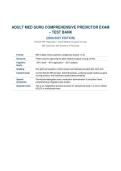
ADULT MED SURG COMPREHENSIVE PREDICTOR EXAM
– TEST BANK
(2026/2027 EDITION)
NCLEX-RN Preparation • Adult Medical-Surgical Nursing
500 Questions with Answers & Rationale
Format: 500 multiple-choice questions (single best answer, A–D).
Structure: Fifteen sections spanning the adult medical-surgical nursing content.
Cognitive ~30% recall • ~50% application • ~20% analysis.
levels:
Grading: One point per question; correct answer and rationale provided after each item.
Content basis: Current NCLEX-RN test plan, AACN Essentials, evidence-based medical-surgical
nursing practice, and healthcare quality/safety standards.
Special Prioritization/delegation items; medication administration & calculation items;
inclusions: comprehensive integrated case studies.
Important note: This is an independent practice test bank for educational study; it is not an official
NCLEX or institutional exam.
, Section 1: Cardiovascular Disorders (45 questions)
Q1: A client with an acute MI has chest pain unrelieved by sublingual nitroglycerin. Which is the priority
nursing action?
A. Notify the provider and prepare for further treatment [CORRECT]
B. Give oral fluids
C. Administer a second unrelated drug
D. Reassure and observe
Correct Answer: A
Rationale: A is correct: unrelieved chest pain suggests ongoing ischemia requiring provider notification. B, C, and
D are unsafe.
Q2: Which lab value is most specific for myocardial infarction?
A. Normal troponin
B. Elevated high-sensitivity troponin [CORRECT]
C. Low CK-MB always
D. Low BNP
Correct Answer: B
Rationale: A is correct: elevated troponin indicates myocardial damage. B, C, and D are incorrect.
Q3: Which is a priority for a client with an acute STEMI?
A. Wait for symptoms to resolve
B. Give a large meal
C. Rapid reperfusion (PCI or fibrinolytic) [CORRECT]
D. Have the client exercise
Correct Answer: C
Rationale: A is correct: rapid reperfusion is the priority in STEMI. B, C, and D are unsafe.
Q4: Which is a sign of left-sided heart failure?
A. Jugular venous distention only
B. Peripheral edema only
C. Ascites
D. Crackles, dyspnea, and pulmonary congestion [CORRECT]
Correct Answer: D
Rationale: A is correct: left-heart failure causes pulmonary congestion. B, C, and D are more right-sided.
Q5: Which is a sign of right-sided heart failure?
A. Peripheral edema, jugular venous distention, and hepatomegaly [CORRECT]
B. Crackles
C. Pulmonary edema
D. Wheezing
Correct Answer: A
Rationale: A is correct: right-heart failure causes peripheral edema, JVD, and hepatomegaly. B, C, and D are
left-sided.
Q6: Which medication is a first-line for heart failure with reduced ejection fraction?
A. An NSAID
B. An ACE inhibitor or ARB [CORRECT]
C. A decongestant
D. A high-dose stimulant
Correct Answer: B
Rationale: A is correct: ACE inhibitors/ARBs are guideline-directed for HFrEF. B, C, and D are incorrect.
Adult Med Surg Comprehensive Predictor Exam Test Bank (2026/2027) Page 2
, Q7: Which is a complication to monitor in a client on digoxin?
A. Hypoglycemia
B. Hypernatremia
C. Digoxin toxicity (GI, visual, and rhythm changes) [CORRECT]
D. No complications
Correct Answer: C
Rationale: A is correct: digoxin toxicity causes GI, visual, and rhythm changes. B, C, and D are incorrect.
Q8: Which lab is important to monitor with digoxin?
A. Glucose
B. Calcium
C. Platelets
D. Serum potassium and digoxin level [CORRECT]
Correct Answer: D
Rationale: A is correct: monitor potassium and digoxin level. B, C, and D are incorrect.
Q9: Which is a priority assessment for a client with hypertension?
A. Blood pressure and signs of target-organ damage [CORRECT]
B. Only temperature
C. Only appetite
D. No assessment
Correct Answer: A
Rationale: A is correct: assess blood pressure and target-organ damage. B, C, and D are incorrect.
Q10: Which is a hypertensive emergency?
A. Mildly elevated blood pressure
B. Severely elevated blood pressure with end-organ damage [CORRECT]
C. Normal blood pressure
D. Low blood pressure
Correct Answer: B
Rationale: A is correct: a hypertensive emergency has end-organ damage. B, C, and D are incorrect.
Q11: Which rhythm is 'shockable' by an AED?
A. Asystole
B. Pulseless electrical activity
C. Ventricular fibrillation [CORRECT]
D. Normal sinus rhythm
Correct Answer: C
Rationale: A is correct: V-fib is shockable. B and C are not; D is a normal rhythm.
Q12: Which is a priority in a client in cardiogenic shock?
A. Give oral fluids
B. Stand the client up
C. Apply a tourniquet
D. Support perfusion and notify the provider [CORRECT]
Correct Answer: D
Rationale: A is correct: cardiogenic shock requires perfusion support and provider notification. B, C, and D are
incorrect.
Q13: Which is the antidote for heparin overdose?
A. Protamine sulfate [CORRECT]
B. Vitamin K
C. Naloxone
D. Flumazenil
Correct Answer: A
Rationale: A is correct: protamine reverses heparin. B reverses warfarin; C opioids; D benzodiazepines.
Adult Med Surg Comprehensive Predictor Exam Test Bank (2026/2027) Page 3
, Q14: Which is the antidote for warfarin toxicity?
A. Protamine sulfate
B. Vitamin K [CORRECT]
C. Naloxone
D. Flumazenil
Correct Answer: B
Rationale: A is correct: vitamin K reverses warfarin. B, C, and D are incorrect.
Q15: Which lab value indicates excessive anticoagulation on warfarin?
A. INR of 2.0
B. Normal INR
C. INR of 5.0 [CORRECT]
D. Low INR
Correct Answer: C
Rationale: A is correct: an INR of 5.0 indicates excessive anticoagulation. B, C, and D are in range.
Q16: Which is a priority for a client with a dysrhythmia?
A. Ignore the rhythm
B. Only observe
C. No assessment
D. Monitor for hemodynamic compromise [CORRECT]
Correct Answer: D
Rationale: A is correct: assess for hemodynamic compromise. B, C, and D are incorrect.
Q17: Which is a sign of deep vein thrombosis?
A. Unilateral calf pain, swelling, and warmth [CORRECT]
B. Bilateral chest pain
C. No symptoms
D. Headache
Correct Answer: A
Rationale: A is correct: DVT causes unilateral calf pain, swelling, and warmth. B, C, and D are incorrect.
Q18: Which is a priority intervention for a client with a pulmonary embolism?
A. Give oral fluids
B. Oxygen and anticoagulation as ordered [CORRECT]
C. Have the client walk
D. No intervention
Correct Answer: B
Rationale: A is correct: PE requires oxygen and anticoagulation. B, C, and D are unsafe.
Q19: Which is a sign of peripheral arterial disease?
A. Warm, pink feet
B. Strong pulses
C. Intermittent claudication [CORRECT]
D. No symptoms
Correct Answer: C
Rationale: A is correct: intermittent claudication is a PAD sign. B, C, and D are not.
Q20: Which is a priority teaching for a client on an anticoagulant?
A. Take aspirin freely
B. Skip doses
C. Ignore bleeding
D. Report unusual bleeding and avoid injury [CORRECT]
Correct Answer: D
Rationale: A is correct: report bleeding and avoid injury. B, C, and D are unsafe.
Adult Med Surg Comprehensive Predictor Exam Test Bank (2026/2027) Page 4
– TEST BANK
(2026/2027 EDITION)
NCLEX-RN Preparation • Adult Medical-Surgical Nursing
500 Questions with Answers & Rationale
Format: 500 multiple-choice questions (single best answer, A–D).
Structure: Fifteen sections spanning the adult medical-surgical nursing content.
Cognitive ~30% recall • ~50% application • ~20% analysis.
levels:
Grading: One point per question; correct answer and rationale provided after each item.
Content basis: Current NCLEX-RN test plan, AACN Essentials, evidence-based medical-surgical
nursing practice, and healthcare quality/safety standards.
Special Prioritization/delegation items; medication administration & calculation items;
inclusions: comprehensive integrated case studies.
Important note: This is an independent practice test bank for educational study; it is not an official
NCLEX or institutional exam.
, Section 1: Cardiovascular Disorders (45 questions)
Q1: A client with an acute MI has chest pain unrelieved by sublingual nitroglycerin. Which is the priority
nursing action?
A. Notify the provider and prepare for further treatment [CORRECT]
B. Give oral fluids
C. Administer a second unrelated drug
D. Reassure and observe
Correct Answer: A
Rationale: A is correct: unrelieved chest pain suggests ongoing ischemia requiring provider notification. B, C, and
D are unsafe.
Q2: Which lab value is most specific for myocardial infarction?
A. Normal troponin
B. Elevated high-sensitivity troponin [CORRECT]
C. Low CK-MB always
D. Low BNP
Correct Answer: B
Rationale: A is correct: elevated troponin indicates myocardial damage. B, C, and D are incorrect.
Q3: Which is a priority for a client with an acute STEMI?
A. Wait for symptoms to resolve
B. Give a large meal
C. Rapid reperfusion (PCI or fibrinolytic) [CORRECT]
D. Have the client exercise
Correct Answer: C
Rationale: A is correct: rapid reperfusion is the priority in STEMI. B, C, and D are unsafe.
Q4: Which is a sign of left-sided heart failure?
A. Jugular venous distention only
B. Peripheral edema only
C. Ascites
D. Crackles, dyspnea, and pulmonary congestion [CORRECT]
Correct Answer: D
Rationale: A is correct: left-heart failure causes pulmonary congestion. B, C, and D are more right-sided.
Q5: Which is a sign of right-sided heart failure?
A. Peripheral edema, jugular venous distention, and hepatomegaly [CORRECT]
B. Crackles
C. Pulmonary edema
D. Wheezing
Correct Answer: A
Rationale: A is correct: right-heart failure causes peripheral edema, JVD, and hepatomegaly. B, C, and D are
left-sided.
Q6: Which medication is a first-line for heart failure with reduced ejection fraction?
A. An NSAID
B. An ACE inhibitor or ARB [CORRECT]
C. A decongestant
D. A high-dose stimulant
Correct Answer: B
Rationale: A is correct: ACE inhibitors/ARBs are guideline-directed for HFrEF. B, C, and D are incorrect.
Adult Med Surg Comprehensive Predictor Exam Test Bank (2026/2027) Page 2
, Q7: Which is a complication to monitor in a client on digoxin?
A. Hypoglycemia
B. Hypernatremia
C. Digoxin toxicity (GI, visual, and rhythm changes) [CORRECT]
D. No complications
Correct Answer: C
Rationale: A is correct: digoxin toxicity causes GI, visual, and rhythm changes. B, C, and D are incorrect.
Q8: Which lab is important to monitor with digoxin?
A. Glucose
B. Calcium
C. Platelets
D. Serum potassium and digoxin level [CORRECT]
Correct Answer: D
Rationale: A is correct: monitor potassium and digoxin level. B, C, and D are incorrect.
Q9: Which is a priority assessment for a client with hypertension?
A. Blood pressure and signs of target-organ damage [CORRECT]
B. Only temperature
C. Only appetite
D. No assessment
Correct Answer: A
Rationale: A is correct: assess blood pressure and target-organ damage. B, C, and D are incorrect.
Q10: Which is a hypertensive emergency?
A. Mildly elevated blood pressure
B. Severely elevated blood pressure with end-organ damage [CORRECT]
C. Normal blood pressure
D. Low blood pressure
Correct Answer: B
Rationale: A is correct: a hypertensive emergency has end-organ damage. B, C, and D are incorrect.
Q11: Which rhythm is 'shockable' by an AED?
A. Asystole
B. Pulseless electrical activity
C. Ventricular fibrillation [CORRECT]
D. Normal sinus rhythm
Correct Answer: C
Rationale: A is correct: V-fib is shockable. B and C are not; D is a normal rhythm.
Q12: Which is a priority in a client in cardiogenic shock?
A. Give oral fluids
B. Stand the client up
C. Apply a tourniquet
D. Support perfusion and notify the provider [CORRECT]
Correct Answer: D
Rationale: A is correct: cardiogenic shock requires perfusion support and provider notification. B, C, and D are
incorrect.
Q13: Which is the antidote for heparin overdose?
A. Protamine sulfate [CORRECT]
B. Vitamin K
C. Naloxone
D. Flumazenil
Correct Answer: A
Rationale: A is correct: protamine reverses heparin. B reverses warfarin; C opioids; D benzodiazepines.
Adult Med Surg Comprehensive Predictor Exam Test Bank (2026/2027) Page 3
, Q14: Which is the antidote for warfarin toxicity?
A. Protamine sulfate
B. Vitamin K [CORRECT]
C. Naloxone
D. Flumazenil
Correct Answer: B
Rationale: A is correct: vitamin K reverses warfarin. B, C, and D are incorrect.
Q15: Which lab value indicates excessive anticoagulation on warfarin?
A. INR of 2.0
B. Normal INR
C. INR of 5.0 [CORRECT]
D. Low INR
Correct Answer: C
Rationale: A is correct: an INR of 5.0 indicates excessive anticoagulation. B, C, and D are in range.
Q16: Which is a priority for a client with a dysrhythmia?
A. Ignore the rhythm
B. Only observe
C. No assessment
D. Monitor for hemodynamic compromise [CORRECT]
Correct Answer: D
Rationale: A is correct: assess for hemodynamic compromise. B, C, and D are incorrect.
Q17: Which is a sign of deep vein thrombosis?
A. Unilateral calf pain, swelling, and warmth [CORRECT]
B. Bilateral chest pain
C. No symptoms
D. Headache
Correct Answer: A
Rationale: A is correct: DVT causes unilateral calf pain, swelling, and warmth. B, C, and D are incorrect.
Q18: Which is a priority intervention for a client with a pulmonary embolism?
A. Give oral fluids
B. Oxygen and anticoagulation as ordered [CORRECT]
C. Have the client walk
D. No intervention
Correct Answer: B
Rationale: A is correct: PE requires oxygen and anticoagulation. B, C, and D are unsafe.
Q19: Which is a sign of peripheral arterial disease?
A. Warm, pink feet
B. Strong pulses
C. Intermittent claudication [CORRECT]
D. No symptoms
Correct Answer: C
Rationale: A is correct: intermittent claudication is a PAD sign. B, C, and D are not.
Q20: Which is a priority teaching for a client on an anticoagulant?
A. Take aspirin freely
B. Skip doses
C. Ignore bleeding
D. Report unusual bleeding and avoid injury [CORRECT]
Correct Answer: D
Rationale: A is correct: report bleeding and avoid injury. B, C, and D are unsafe.
Adult Med Surg Comprehensive Predictor Exam Test Bank (2026/2027) Page 4


