
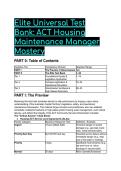
Elite Universal Test
Bank: ACT Housing
Maintenance Manager
Mastery
PART 0: Table of Contents
Cognitive Tier Competency Domain Question Range
PART I The Preview: Critical Axioms N/A
PART II The Elite Test Bank 1–30
Tier 1 Foundational Syntax & 1–15
Legislative Application
Tier 2 Complex Application & 16–25
Operational Simulation
Tier 3 Grandmaster Synthesis & 26–30
High-Stakes Resolution
PART I: The Preview
Mastering this test bank translates directly to elite performance by forging a razor-sharp
understanding of the Australian Capital Territory's legislative, safety, and operational
maintenance frameworks. This material forges scholars and practitioners who can establish
immediate, bulletproof authority in high-stakes public housing asset management, avert critical
failures, and defend the integrity of the ACT Community Services Directorate's mandate.
The "Critical Axioms" Cheat Sheet:
● Housing ACT Service Level Agreements (SLAs):
Priority Category Maximum Response Time Definition / Example
Urgent 4 hours (Make Safe) Imminent danger or severe
damage (e.g., gas leak, burst
main, solely blocked toilet).
Priority Next Day By 6:00 PM next day Essential service failure without
immediate danger (e.g., total
loss of hot water or heating).
Priority 5 days Significant inconvenience (e.g.,
tap won't turn on, minor
blockage in second toilet).
Normal 20 days Minor cosmetic/functional
,Priority Category Maximum Response Time Definition / Example
defect (e.g., loose door handle,
slow tap leak).
● The Urgent Repair Threshold: Under the ACT Residential Tenancies Act 1997, if a
lessor fails to act promptly on a statutory urgent repair, a tenant may self-authorize repairs
up to a maximum cost of 5% of their annual rent. Do not confuse this with the Victorian
$2,500 flat cap.
● The WHS Certification Mandate: All trades and maintenance personnel operating in the
ACT must possess the 11084NAT (Asbestos Awareness) and 10830NAT (Crystalline
Silica Exposure Prevention) competencies. Online delivery of 11084NAT is strictly
prohibited.
● The Electrical Compliance Anchor: A Certificate of Electrical Safety (CES) must be
lodged with Access Canberra within 14 days of testing the work. Any ceiling insulation
upgrade demands an attached Insulation Installation Electrical Safety Inspection Report
(iiESIR).
● The Minimum Insulation Standard: Rental properties with existing ceiling insulation
possessing an R-value below R2.0 MUST be upgraded to a minimum of R5.0. The
installer must hold Energy Efficiency Council (EEC) certification.
● The Access Imperative: Routine inspections require 1 week's written notice (maximum 2
per year, plus initial and final inspections). Entry is forbidden on Sundays, public holidays,
or outside 8:00 AM – 6:00 PM unless explicitly responding to an urgent repair or with
express tenant consent.
PART II: THE ELITE TEST BANK
Tier 1: Foundational Syntax & Application
Q1: A tenant contacts the Housing ACT maintenance line at 7:00 PM on a Sunday to report that
their only toilet is completely blocked and overflowing into the hallway. Based on the principles
of the Housing ACT Service Level Agreements, which action is the MOST ACCURATE? A)
Issue a 1-week notice of entry to the tenant and schedule a plumber for the following Monday
morning to respect statutory entry hours. B) Classify the issue as a Priority repair, providing a
5-day SLA to clear the blockage and sanitize the area. C) Immediately dispatch an emergency
plumber to attend the property within 4 hours to make the situation safe and restore the
essential service. D) Advise the tenant to organize the repair themselves up to the flat value of
$2,500 and submit the receipt for reimbursement.
● The Answer: C (Immediately dispatch an emergency plumber to attend the property
within 4 hours to make the situation safe and restore the essential service.)
● Distractor Analysis:
○ A is incorrect: A 1-week notice applies strictly to non-urgent repairs or routine
inspections. Urgent repairs override standard restricted entry hours
(Sundays/nights).
○ B is incorrect: A 5-day Priority SLA is applicable to non-critical defects (e.g., a
dripping tap or a minor blockage in a second toilet). A blocked primary toilet is a
statutory urgent repair.
○ D is incorrect: The $2,500 fixed limit is a Victorian statutory rule. The ACT
legislation limits self-authorized urgent repairs to 5% of the annual rent, and this
, right is only activated after the lessor fails to respond promptly.
The Mentor's Analysis: The ACT Residential Tenancies Act 1997 and Housing ACT policies
provide a hard-coded list of urgent repairs. A blocked or broken lavatory system—especially
when it is the sole facility—represents a critical biohazard and loss of essential service. You do
not defer or delay; you dispatch to make safe within 4 hours. Professional/Academic Intuition:
Classify by consequence. If a failure removes basic human sanitation, compromises
security, or risks immediate structural damage, it is unequivocally an urgent repair.
Q2: A contractor is hired to renovate a bathroom in a Housing ACT property built in 1985. The
contractor presents a generic online asbestos awareness certificate obtained in 2021. Based on
the principles of WorkSafe ACT Compliance, which conclusion is the MOST ACCURATE? A)
The contractor is fully compliant, as online certificates obtained after 2017 are recognized by
WorkSafe ACT. B) The contractor must immediately complete the CPCCDE3014A unit to safely
remove non-friable asbestos from the property before commencing the renovation. C) The
contractor is non-compliant and must complete the face-to-face 11084NAT Course in Asbestos
Awareness before commencing any work on the site. D) The contractor may proceed with the
renovation provided they wear a P2/P3 respirator and log their online certificate in the site safety
register.
● The Answer: C (The contractor is non-compliant and must complete the face-to-face
11084NAT Course in Asbestos Awareness before commencing any work on the site.)
● Distractor Analysis:
○ A is incorrect: WorkSafe ACT does not permit online, webinar, or face-to-screen
delivery of the 11084NAT course; it is strictly a face-to-face requirement.
○ B is incorrect: CPCCDE3014A is a specialized unit for licensed asbestos removal.
The contractor is hired for general renovation, requiring foundational awareness
(11084NAT), not necessarily a removal license unless they are specifically
contracted to abate identified ACM.
○ D is incorrect: PPE is a lower-tier control measure and does not substitute for
legislative training mandates. Allowing an uncertified worker on site exposes the
Directorate to severe compliance breaches.
The Mentor's Analysis: WorkSafe ACT has drawn a strict line regarding asbestos exposure.
The 11084NAT course is a non-negotiable prerequisite for all construction and maintenance
personnel operating in the ACT, ensuring they can identify and report ACMs. It must be
delivered face-to-face. Professional/Academic Intuition: Safety syntax is binary. Without
verified, face-to-face 11084NAT certification, the contractor does not step foot on the site.
Q3: A Housing Maintenance Manager is reviewing the tenancy profile of a property where the
tenant has repeatedly denied entry for non-urgent structural repairs. Based on the principles of
the Standard Residential Tenancy Terms in the ACT, what is the FIRST step the manager must
take to lawfully secure access? A) Issue an immediate eviction notice for breach of the tenancy
agreement and deploy contractors. B) Provide 24 hours' written notice and enter the property
using a master key during standard business hours. C) Issue a formal 1-week written notice
detailing the time, date, and specific purpose of the entry for the non-urgent repairs. D) Apply
directly to the ACT Civil and Administrative Tribunal (ACAT) for an emergency access and
rectification order.
● The Answer: C (Issue a formal 1-week written notice detailing the time, date, and specific
purpose of the entry for the non-urgent repairs.)
● Distractor Analysis:
○ A is incorrect: Eviction is a disproportionate, terminal action that requires ACAT
authorization. It is never the first procedural step for a standard maintenance
Bank: ACT Housing
Maintenance Manager
Mastery
PART 0: Table of Contents
Cognitive Tier Competency Domain Question Range
PART I The Preview: Critical Axioms N/A
PART II The Elite Test Bank 1–30
Tier 1 Foundational Syntax & 1–15
Legislative Application
Tier 2 Complex Application & 16–25
Operational Simulation
Tier 3 Grandmaster Synthesis & 26–30
High-Stakes Resolution
PART I: The Preview
Mastering this test bank translates directly to elite performance by forging a razor-sharp
understanding of the Australian Capital Territory's legislative, safety, and operational
maintenance frameworks. This material forges scholars and practitioners who can establish
immediate, bulletproof authority in high-stakes public housing asset management, avert critical
failures, and defend the integrity of the ACT Community Services Directorate's mandate.
The "Critical Axioms" Cheat Sheet:
● Housing ACT Service Level Agreements (SLAs):
Priority Category Maximum Response Time Definition / Example
Urgent 4 hours (Make Safe) Imminent danger or severe
damage (e.g., gas leak, burst
main, solely blocked toilet).
Priority Next Day By 6:00 PM next day Essential service failure without
immediate danger (e.g., total
loss of hot water or heating).
Priority 5 days Significant inconvenience (e.g.,
tap won't turn on, minor
blockage in second toilet).
Normal 20 days Minor cosmetic/functional
,Priority Category Maximum Response Time Definition / Example
defect (e.g., loose door handle,
slow tap leak).
● The Urgent Repair Threshold: Under the ACT Residential Tenancies Act 1997, if a
lessor fails to act promptly on a statutory urgent repair, a tenant may self-authorize repairs
up to a maximum cost of 5% of their annual rent. Do not confuse this with the Victorian
$2,500 flat cap.
● The WHS Certification Mandate: All trades and maintenance personnel operating in the
ACT must possess the 11084NAT (Asbestos Awareness) and 10830NAT (Crystalline
Silica Exposure Prevention) competencies. Online delivery of 11084NAT is strictly
prohibited.
● The Electrical Compliance Anchor: A Certificate of Electrical Safety (CES) must be
lodged with Access Canberra within 14 days of testing the work. Any ceiling insulation
upgrade demands an attached Insulation Installation Electrical Safety Inspection Report
(iiESIR).
● The Minimum Insulation Standard: Rental properties with existing ceiling insulation
possessing an R-value below R2.0 MUST be upgraded to a minimum of R5.0. The
installer must hold Energy Efficiency Council (EEC) certification.
● The Access Imperative: Routine inspections require 1 week's written notice (maximum 2
per year, plus initial and final inspections). Entry is forbidden on Sundays, public holidays,
or outside 8:00 AM – 6:00 PM unless explicitly responding to an urgent repair or with
express tenant consent.
PART II: THE ELITE TEST BANK
Tier 1: Foundational Syntax & Application
Q1: A tenant contacts the Housing ACT maintenance line at 7:00 PM on a Sunday to report that
their only toilet is completely blocked and overflowing into the hallway. Based on the principles
of the Housing ACT Service Level Agreements, which action is the MOST ACCURATE? A)
Issue a 1-week notice of entry to the tenant and schedule a plumber for the following Monday
morning to respect statutory entry hours. B) Classify the issue as a Priority repair, providing a
5-day SLA to clear the blockage and sanitize the area. C) Immediately dispatch an emergency
plumber to attend the property within 4 hours to make the situation safe and restore the
essential service. D) Advise the tenant to organize the repair themselves up to the flat value of
$2,500 and submit the receipt for reimbursement.
● The Answer: C (Immediately dispatch an emergency plumber to attend the property
within 4 hours to make the situation safe and restore the essential service.)
● Distractor Analysis:
○ A is incorrect: A 1-week notice applies strictly to non-urgent repairs or routine
inspections. Urgent repairs override standard restricted entry hours
(Sundays/nights).
○ B is incorrect: A 5-day Priority SLA is applicable to non-critical defects (e.g., a
dripping tap or a minor blockage in a second toilet). A blocked primary toilet is a
statutory urgent repair.
○ D is incorrect: The $2,500 fixed limit is a Victorian statutory rule. The ACT
legislation limits self-authorized urgent repairs to 5% of the annual rent, and this
, right is only activated after the lessor fails to respond promptly.
The Mentor's Analysis: The ACT Residential Tenancies Act 1997 and Housing ACT policies
provide a hard-coded list of urgent repairs. A blocked or broken lavatory system—especially
when it is the sole facility—represents a critical biohazard and loss of essential service. You do
not defer or delay; you dispatch to make safe within 4 hours. Professional/Academic Intuition:
Classify by consequence. If a failure removes basic human sanitation, compromises
security, or risks immediate structural damage, it is unequivocally an urgent repair.
Q2: A contractor is hired to renovate a bathroom in a Housing ACT property built in 1985. The
contractor presents a generic online asbestos awareness certificate obtained in 2021. Based on
the principles of WorkSafe ACT Compliance, which conclusion is the MOST ACCURATE? A)
The contractor is fully compliant, as online certificates obtained after 2017 are recognized by
WorkSafe ACT. B) The contractor must immediately complete the CPCCDE3014A unit to safely
remove non-friable asbestos from the property before commencing the renovation. C) The
contractor is non-compliant and must complete the face-to-face 11084NAT Course in Asbestos
Awareness before commencing any work on the site. D) The contractor may proceed with the
renovation provided they wear a P2/P3 respirator and log their online certificate in the site safety
register.
● The Answer: C (The contractor is non-compliant and must complete the face-to-face
11084NAT Course in Asbestos Awareness before commencing any work on the site.)
● Distractor Analysis:
○ A is incorrect: WorkSafe ACT does not permit online, webinar, or face-to-screen
delivery of the 11084NAT course; it is strictly a face-to-face requirement.
○ B is incorrect: CPCCDE3014A is a specialized unit for licensed asbestos removal.
The contractor is hired for general renovation, requiring foundational awareness
(11084NAT), not necessarily a removal license unless they are specifically
contracted to abate identified ACM.
○ D is incorrect: PPE is a lower-tier control measure and does not substitute for
legislative training mandates. Allowing an uncertified worker on site exposes the
Directorate to severe compliance breaches.
The Mentor's Analysis: WorkSafe ACT has drawn a strict line regarding asbestos exposure.
The 11084NAT course is a non-negotiable prerequisite for all construction and maintenance
personnel operating in the ACT, ensuring they can identify and report ACMs. It must be
delivered face-to-face. Professional/Academic Intuition: Safety syntax is binary. Without
verified, face-to-face 11084NAT certification, the contractor does not step foot on the site.
Q3: A Housing Maintenance Manager is reviewing the tenancy profile of a property where the
tenant has repeatedly denied entry for non-urgent structural repairs. Based on the principles of
the Standard Residential Tenancy Terms in the ACT, what is the FIRST step the manager must
take to lawfully secure access? A) Issue an immediate eviction notice for breach of the tenancy
agreement and deploy contractors. B) Provide 24 hours' written notice and enter the property
using a master key during standard business hours. C) Issue a formal 1-week written notice
detailing the time, date, and specific purpose of the entry for the non-urgent repairs. D) Apply
directly to the ACT Civil and Administrative Tribunal (ACAT) for an emergency access and
rectification order.
● The Answer: C (Issue a formal 1-week written notice detailing the time, date, and specific
purpose of the entry for the non-urgent repairs.)
● Distractor Analysis:
○ A is incorrect: Eviction is a disproportionate, terminal action that requires ACAT
authorization. It is never the first procedural step for a standard maintenance


