

Comprehensive Chemistry Notes: Atomic Structure, Bonding, and Reaction
Study online at https://quizlet.com/_jn4zeh
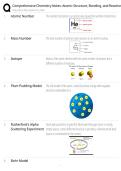
1. Atomic Number The number of protons in an atom (also equals the number of electrons).
2. Mass Number The total number of protons and neutrons in an atom's nucleus.
3. Isotope Atoms of the same element with the same number of protons but a
different number of neutrons.
4. Plum Pudding Model The old model of the atom: a ball of positive charge with negative
electrons embedded in it.
5. Rutherford's Alpha Fired alpha particles at gold foil. Most went through (atom is mostly
Scattering Experiment empty space), some deflected (nucleus is positive), a few bounced back
(mass is concentrated in the center).
6. Bohr Model
, Comprehensive Chemistry Notes: Atomic Structure, Bonding, and Reaction
Study online at https://quizlet.com/_jn4zeh
Discovered that electrons orbit the nucleus at specific distances (in
shells).
7. Chadwick's Discovery Discovered the neutron in the nucleus.
8. Simple Distillation Separates a liquid from a solution (e.g., pure water from saltwater) by
boiling and condensing.
9. Fractional Distillation Separates a mixture of liquids with different boiling points.
10. Chromatography Separates mixtures of soluble substances (e.g., ink/dyes).
Study online at https://quizlet.com/_jn4zeh
1. Atomic Number The number of protons in an atom (also equals the number of electrons).
2. Mass Number The total number of protons and neutrons in an atom's nucleus.
3. Isotope Atoms of the same element with the same number of protons but a
different number of neutrons.
4. Plum Pudding Model The old model of the atom: a ball of positive charge with negative
electrons embedded in it.
5. Rutherford's Alpha Fired alpha particles at gold foil. Most went through (atom is mostly
Scattering Experiment empty space), some deflected (nucleus is positive), a few bounced back
(mass is concentrated in the center).
6. Bohr Model
, Comprehensive Chemistry Notes: Atomic Structure, Bonding, and Reaction
Study online at https://quizlet.com/_jn4zeh
Discovered that electrons orbit the nucleus at specific distances (in
shells).
7. Chadwick's Discovery Discovered the neutron in the nucleus.
8. Simple Distillation Separates a liquid from a solution (e.g., pure water from saltwater) by
boiling and condensing.
9. Fractional Distillation Separates a mixture of liquids with different boiling points.
10. Chromatography Separates mixtures of soluble substances (e.g., ink/dyes).


