
D673 WGU
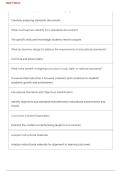
What is the first step teachers must take in aligning curricula to standards?
Carefully analyzing standards documents.
What must teachers identify from standards documents?
The specific skills and knowledge students need to acquire.
What do teachers design to address the requirements of educational standards?
Curricula and lesson plans.
What is the benefit of aligning curricula to local, state, or national standards?
It ensures that instruction is focused, coherent, and conducive to students'
academic growth and achievement.
Educational Standards and Objectives Identification
Identify objectives and standards that determine educational achievements and
results.
Curriculum Content Examination
Examine the content currently being taught in a curriculum.
Analyze Instructional Materials
Analyze instructional materials for alignment to learning outcomes.
,D673 WGU
Current Subject Area Research
Research current subject area content knowledge.
What is the primary aim of social studies as an interdisciplinary field?
To develop students' understanding of the world and their place within it.
Name a significant historical event that students learn about in social studies.
The American Revolution.
Who is a notable historical figure often studied in elementary social studies?
Harriet Tubman.
What basic skills does geography education introduce to elementary students?
Basic map skills and the significance of physical features.
How do physical features like mountains and rivers impact human settlements?
They shape where and how people live.
What does sociology help young learners understand?
Social structures and relationships, including family roles and community functions.
What is the focus of civics education in social studies?
Teaching students about government, laws, and their effects on the population.
,D673 WGU
Why is teaching social studies fundamental in elementary education?
It fosters well-rounded, informed, and engaged citizens.
What skills do students develop through social studies education?
Critical thinking skills and appreciation of diverse perspectives.
What essential traits does social studies education aim to cultivate in students?
Informed decision-making and active participation in society.
How many themes has the National Council for the Social Studies developed for
social studies education?
10 themes.
What is the purpose of the themes developed by the National Council for the
Social Studies?
To shape curricula and standards in social studies.
What areas does social studies encompass in elementary education?
Geography, history, civics, and cultural studies.
How does social studies education prepare students for the future?
By equipping them with knowledge and skills to navigate and contribute to their
communities.
, D673 WGU
Culture
Learning about different family traditions and holidays
Time, Continuity, and Change
Understanding the concept of past, present, and future with personal timelines
People, Places, and Environment
Identifying basic geographical features like rivers and mountains on a map
Individual Development and Identity
Discussing personal characteristics and favorite activities
Individuals, Groups, and Institutions
Learning about family roles and classroom rules
Power, Authority, and Governance
Understanding the purpose of classroom rules and the role of a teacher
Production, Distribution, and Consumption
Learning about basic needs and wants and how families obtain them
Science, Technology, and Society
Recognizing simple tools and their uses, like a pencil or a clock


