

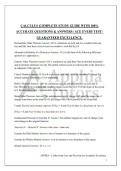
CALCULUS |COMPLETE STUDY GUIDE WITH 100%
ACCURATE QUESTIONS & ANSWERS | ACE EVERY TEST |
GUARANTEED EXCELLENCE.
Intermediate Value Theorem Answer: If f is continuous on [a,b] and k is a number between
f(a) and f(b), then there exists at least one number c such that f(c)=k
Alternative Definition of a Derivative Answer: f '(x) is the limit of the following difference
quotient as x approaches c
Extreme Value Theorem Answer: If f is continuous on [a,b] then f has an absolute maximum
and an absolute minimum on [a,b]. The global extrema occur at critical points in the interval or
at endpoints of the interval.
Critical Number Answer: If f'(c)=0 or does not exist, and c is in the domain of f, then c is a
critical number. (Derivative is 0 or undefined)
Rolle's Theorem Answer: Let f be continuous on [a,b] and differentiable on (a,b) and if
f(a)=f(b) then there is at least one number c on (a,b) such that f'(c)=0 (If the slope of the secant
is 0, the derivative must = 0 somewhere in the interval).
Mean Value Theorem Answer: The instantaneous rate of change will equal the mean rate of
change somewhere in the interval. Or, the tangent line will be parallel to the secant line.
Combo Test for local extrema Answer: If f'(c) = 0 and f"(c)<0, there is a local max on f at x=c.
If f'(c) = 0 and f"(c)>0, there is a local min on f at x=c.
Fundamental Theorem of Calculus #1 Answer: The definite integral of a rate of change is the
total change in the original function.
-ln(cosx)+C = ln(secx)+C Answer: hint: tanu = sinu/cosu
Formula for Disk Method Answer: Axis of rotation is a boundary of the region.
Formula for Washer Method Answer: Axis of rotation is not a boundary of the region.
Identity function Answer: D: (-∞,+∞)
APPHIA – Crafted with Care and Precision for Academic Excellence.
1
, R: (-∞,+∞)
Squaring function Answer: D: (-∞,+∞)
R: (o,+∞)
Cubing function Answer: D: (-∞,+∞)
R: (-∞,+∞)
Reciprocal function Answer: D: (-∞,+∞) x can't be zero
R: (-∞,+∞) y can't be zero
Square root function Answer: D: (0,+∞)
R: (0,+∞)
Exponential function Answer: D: (-∞,+∞)
R: (0,+∞)
Natural log function Answer: D: (0,+∞)
R: (-∞,+∞)
Sine function Answer: D: (-∞,+∞)
R: [-1,1]
Cosine function Answer: D: (-∞,+∞)
R: [-1,1]
Absolute value function Answer: D: (-∞,+∞)
R: [0,+∞)
Logistic function Answer: D: (-∞,+∞)
R: (0, 1)
APPHIA – Crafted with Care and Precision for Academic Excellence.
2
ACCURATE QUESTIONS & ANSWERS | ACE EVERY TEST |
GUARANTEED EXCELLENCE.
Intermediate Value Theorem Answer: If f is continuous on [a,b] and k is a number between
f(a) and f(b), then there exists at least one number c such that f(c)=k
Alternative Definition of a Derivative Answer: f '(x) is the limit of the following difference
quotient as x approaches c
Extreme Value Theorem Answer: If f is continuous on [a,b] then f has an absolute maximum
and an absolute minimum on [a,b]. The global extrema occur at critical points in the interval or
at endpoints of the interval.
Critical Number Answer: If f'(c)=0 or does not exist, and c is in the domain of f, then c is a
critical number. (Derivative is 0 or undefined)
Rolle's Theorem Answer: Let f be continuous on [a,b] and differentiable on (a,b) and if
f(a)=f(b) then there is at least one number c on (a,b) such that f'(c)=0 (If the slope of the secant
is 0, the derivative must = 0 somewhere in the interval).
Mean Value Theorem Answer: The instantaneous rate of change will equal the mean rate of
change somewhere in the interval. Or, the tangent line will be parallel to the secant line.
Combo Test for local extrema Answer: If f'(c) = 0 and f"(c)<0, there is a local max on f at x=c.
If f'(c) = 0 and f"(c)>0, there is a local min on f at x=c.
Fundamental Theorem of Calculus #1 Answer: The definite integral of a rate of change is the
total change in the original function.
-ln(cosx)+C = ln(secx)+C Answer: hint: tanu = sinu/cosu
Formula for Disk Method Answer: Axis of rotation is a boundary of the region.
Formula for Washer Method Answer: Axis of rotation is not a boundary of the region.
Identity function Answer: D: (-∞,+∞)
APPHIA – Crafted with Care and Precision for Academic Excellence.
1
, R: (-∞,+∞)
Squaring function Answer: D: (-∞,+∞)
R: (o,+∞)
Cubing function Answer: D: (-∞,+∞)
R: (-∞,+∞)
Reciprocal function Answer: D: (-∞,+∞) x can't be zero
R: (-∞,+∞) y can't be zero
Square root function Answer: D: (0,+∞)
R: (0,+∞)
Exponential function Answer: D: (-∞,+∞)
R: (0,+∞)
Natural log function Answer: D: (0,+∞)
R: (-∞,+∞)
Sine function Answer: D: (-∞,+∞)
R: [-1,1]
Cosine function Answer: D: (-∞,+∞)
R: [-1,1]
Absolute value function Answer: D: (-∞,+∞)
R: [0,+∞)
Logistic function Answer: D: (-∞,+∞)
R: (0, 1)
APPHIA – Crafted with Care and Precision for Academic Excellence.
2


