

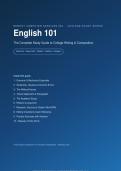
R E B O OT C O M PU T E R S E RVI C ES I N C . · C O L L E G E ST U DY S E R I ES
English 101
The Complete Study Guide to College Writing & Composition
Grammar · Essay Craft · Citation · Practice + Answers
Inside this guide
1 · Grammar & Mechanics Essentials
2 · Sentences, Clauses & Common Errors
3 · The Writing Process
4 · Thesis Statements & Paragraphs
5 · The Academic Essay
6 · Rhetoric & Argument
7 · Research, Sources & Citation (MLA/APA)
8 · Editing Checklist & Quick Reference
9 · Practice Exercises with Answers
10 · Glossary of Key Terms
A self-study companion for first-year composition · rebootcs.com
, 1 · Grammar & Mechanics Essentials
Clear writing rests on control of the sentence. This section covers the parts of speech and punctuation you must handle
automatically so your ideas — not your errors — get the reader's attention.
The Eight Parts of Speech
Part Role Example
Noun Person, place, thing, idea student, city, freedom
Pronoun Replaces a noun she, it, they, which
Verb Action or state of being writes, is, becomes
Adjective Describes a noun bright, difficult
Adverb Describes a verb/adjective quickly, very
Preposition Shows relationship in, on, between
Conjunction Joins words/clauses and, but, because
Interjection Expresses emotion oh, wow
Punctuation That Trips Students Up
Comma: use before a coordinating conjunction (FANBOYS: for, and, nor, but, or, yet, so) joining two independent
clauses, after introductory phrases, and to separate items in a list.
Semicolon: joins two closely related independent clauses without a conjunction. The lab closed early; we finished at
home.
Colon: introduces a list, explanation, or quotation after a complete sentence.
Apostrophe: shows possession (the student's essay) or contraction (it's = it is). Note: its = possessive, it's = it is.
Top confusions: your/you're · there/their/they're · affect (verb) / effect (noun) · than (comparison) / then (time).
© Reboot Computer Services Inc. · Created by Mario Washington · Page 2 of 12
English 101
The Complete Study Guide to College Writing & Composition
Grammar · Essay Craft · Citation · Practice + Answers
Inside this guide
1 · Grammar & Mechanics Essentials
2 · Sentences, Clauses & Common Errors
3 · The Writing Process
4 · Thesis Statements & Paragraphs
5 · The Academic Essay
6 · Rhetoric & Argument
7 · Research, Sources & Citation (MLA/APA)
8 · Editing Checklist & Quick Reference
9 · Practice Exercises with Answers
10 · Glossary of Key Terms
A self-study companion for first-year composition · rebootcs.com
, 1 · Grammar & Mechanics Essentials
Clear writing rests on control of the sentence. This section covers the parts of speech and punctuation you must handle
automatically so your ideas — not your errors — get the reader's attention.
The Eight Parts of Speech
Part Role Example
Noun Person, place, thing, idea student, city, freedom
Pronoun Replaces a noun she, it, they, which
Verb Action or state of being writes, is, becomes
Adjective Describes a noun bright, difficult
Adverb Describes a verb/adjective quickly, very
Preposition Shows relationship in, on, between
Conjunction Joins words/clauses and, but, because
Interjection Expresses emotion oh, wow
Punctuation That Trips Students Up
Comma: use before a coordinating conjunction (FANBOYS: for, and, nor, but, or, yet, so) joining two independent
clauses, after introductory phrases, and to separate items in a list.
Semicolon: joins two closely related independent clauses without a conjunction. The lab closed early; we finished at
home.
Colon: introduces a list, explanation, or quotation after a complete sentence.
Apostrophe: shows possession (the student's essay) or contraction (it's = it is). Note: its = possessive, it's = it is.
Top confusions: your/you're · there/their/they're · affect (verb) / effect (noun) · than (comparison) / then (time).
© Reboot Computer Services Inc. · Created by Mario Washington · Page 2 of 12


