

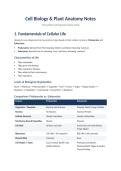
Cell Biology & Plant Anatomy Notes
Transcribed and Organized Study Guide
1. Fundamentals of Cellular Life
Organisms are categorized into two primary types based on their cellular structure: Prokaryotes and
Eukaryotes.
Prokaryotes: Derived from Pro (meaning 'before') and Karyo (meaning 'nucleus').
Eukaryotes: Derived from Eu (meaning 'true') and Karyo (meaning 'nucleus').
Characteristics of Life
They metabolize.
They grow and develop.
They respond to stimulus.
They adapt to their environment.
They reproduce.
Levels of Biological Organization
Atom → Molecule → Macromodule → Organelle → Cell → Tissue → Organ → Organ System →
Organism → Population → Community → Ecosystem → Biosphere
Comparison: Prokaryotes vs. Eukaryotes
Feature Prokaryotes Eukaryotes
Organisms / Examples Bacteria and Archaea Animals, Plants, Fungi, Protists
Nucleus No Nucleus Nucleus Present
Cellular Structure Mostly Unicellular Mostly Multicellular
Membrane-Bound Organelles Absent Present
Cell Wall All have cell walls Some have cell walls (Plants,
Fungi, Algae)
Ribosomes 70S (30S / 50S subunits) 80S (40S / 60S subunits)
Plasmid DNA Common Rare
Cell Shapes / Types Cocci (round), Bacilli (rod), Protozoa (unicellular),
Spirilla (helical) Photosynthetic (algae & plants),
Tissue-forming
Transcribed and Organized Study Guide
1. Fundamentals of Cellular Life
Organisms are categorized into two primary types based on their cellular structure: Prokaryotes and
Eukaryotes.
Prokaryotes: Derived from Pro (meaning 'before') and Karyo (meaning 'nucleus').
Eukaryotes: Derived from Eu (meaning 'true') and Karyo (meaning 'nucleus').
Characteristics of Life
They metabolize.
They grow and develop.
They respond to stimulus.
They adapt to their environment.
They reproduce.
Levels of Biological Organization
Atom → Molecule → Macromodule → Organelle → Cell → Tissue → Organ → Organ System →
Organism → Population → Community → Ecosystem → Biosphere
Comparison: Prokaryotes vs. Eukaryotes
Feature Prokaryotes Eukaryotes
Organisms / Examples Bacteria and Archaea Animals, Plants, Fungi, Protists
Nucleus No Nucleus Nucleus Present
Cellular Structure Mostly Unicellular Mostly Multicellular
Membrane-Bound Organelles Absent Present
Cell Wall All have cell walls Some have cell walls (Plants,
Fungi, Algae)
Ribosomes 70S (30S / 50S subunits) 80S (40S / 60S subunits)
Plasmid DNA Common Rare
Cell Shapes / Types Cocci (round), Bacilli (rod), Protozoa (unicellular),
Spirilla (helical) Photosynthetic (algae & plants),
Tissue-forming


