

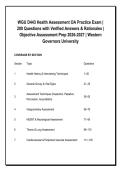
WGU D443 Health Assessment OA Practice Exam |
200 Questions with Verified Answers & Rationales |
Objective Assessment Prep 2026-2027 | Western
Governors University
COVERAGE BY SECTION
Section Topic Questions
1 Health History & Interviewing Techniques 1–20
2 General Survey & Vital Signs 21–35
Assessment Techniques (Inspection, Palpation,
3 36–55
Percussion, Auscultation)
4 Integumentary Assessment 56–70
5 HEENT & Neurological Assessment 71–95
6 Thorax & Lung Assessment 96–110
7 Cardiovascular & Peripheral Vascular Assessment 111–135
,Section Topic Questions
8 Abdominal Assessment 136–155
9 Musculoskeletal Assessment 156–170
10 Comprehensive Review & Clinical Judgment 171–200
Total Questions: 200 | Course: D443 – Health Assessment | Institution: Western
Governors University (WGU)
Section 1: Health History & Interviewing Techniques (Questions 1–20)
1. A nurse is preparing to conduct a health history interview with a patient who
speaks limited English. What is the most appropriate action to ensure accurate
communication?
a) Speak slowly and loudly to the patient
b) Ask the patient's family member to interpret
c) Skip the verbal history and rely on the medical record
d) Arrange for a certified medical interpreter
A certified medical interpreter ensures accurate, confidential communication and complies
with legal and ethical standards. Family members may filter information, omit details, or
breach privacy. Speaking slowly or loudly does not improve understanding, and skipping the
verbal history would result in incomplete data collection .
,2. A patient reports a headache during the health history interview. The nurse
documents this as which type of data?
a) Objective data
b) Subjective data
c) Assessment finding
d) Diagnostic finding
A headache is a symptom reported by the patient and is therefore subjective data. The
nurse cannot directly observe or measure a headache; it relies on the patient's description.
Pain, nausea, and dizziness are also subjective data .
3. During the health history interview, the nurse asks the patient, "Can you tell me
more about the pain you are experiencing?" This is an example of which type of
questioning?
a) Closed-ended question
b) Leading question
c) Open-ended question
d) Direct question
Open-ended questions encourage the patient to provide detailed information in their own
words. They begin with "what," "how," or "could you tell me about." Closed-ended questions
elicit yes/no or short answers and are used to clarify specific details .
4. A patient tells the nurse, "I've been feeling really tired lately." What is the nurse's
best response to gather more information?
, a) "You should rest more."
b) "It's probably just stress."
c) "Tell me more about your fatigue."
d) "Do you have trouble sleeping?"
Asking "Tell me more about your fatigue" is an open-ended question that encourages the
patient to elaborate. This approach yields richer information than asking a yes/no question
or making an assumption .
5. The nurse is interviewing a patient who is very anxious and distracted. Which
strategy should the nurse use to improve the effectiveness of the interview?
a) Rush through the interview to reduce anxiety
b) Conduct the interview in a loud, busy area
c) Provide a calm, private environment and use therapeutic communication
techniques
d) Avoid asking questions about sensitive topics
A calm, private environment and therapeutic communication techniques (active listening,
empathy, open-ended questions) help reduce patient anxiety and improve information
gathering. Rushing or avoiding topics does not address the patient's anxiety .
6. A patient states, "I don't know why I'm here. My wife made me come." What is the
nurse's most appropriate response to establish a therapeutic relationship?
a) "It sounds like you are not sure why you are here. Let's talk about what brought
you in today."
b) "Your wife is probably worried about you."
200 Questions with Verified Answers & Rationales |
Objective Assessment Prep 2026-2027 | Western
Governors University
COVERAGE BY SECTION
Section Topic Questions
1 Health History & Interviewing Techniques 1–20
2 General Survey & Vital Signs 21–35
Assessment Techniques (Inspection, Palpation,
3 36–55
Percussion, Auscultation)
4 Integumentary Assessment 56–70
5 HEENT & Neurological Assessment 71–95
6 Thorax & Lung Assessment 96–110
7 Cardiovascular & Peripheral Vascular Assessment 111–135
,Section Topic Questions
8 Abdominal Assessment 136–155
9 Musculoskeletal Assessment 156–170
10 Comprehensive Review & Clinical Judgment 171–200
Total Questions: 200 | Course: D443 – Health Assessment | Institution: Western
Governors University (WGU)
Section 1: Health History & Interviewing Techniques (Questions 1–20)
1. A nurse is preparing to conduct a health history interview with a patient who
speaks limited English. What is the most appropriate action to ensure accurate
communication?
a) Speak slowly and loudly to the patient
b) Ask the patient's family member to interpret
c) Skip the verbal history and rely on the medical record
d) Arrange for a certified medical interpreter
A certified medical interpreter ensures accurate, confidential communication and complies
with legal and ethical standards. Family members may filter information, omit details, or
breach privacy. Speaking slowly or loudly does not improve understanding, and skipping the
verbal history would result in incomplete data collection .
,2. A patient reports a headache during the health history interview. The nurse
documents this as which type of data?
a) Objective data
b) Subjective data
c) Assessment finding
d) Diagnostic finding
A headache is a symptom reported by the patient and is therefore subjective data. The
nurse cannot directly observe or measure a headache; it relies on the patient's description.
Pain, nausea, and dizziness are also subjective data .
3. During the health history interview, the nurse asks the patient, "Can you tell me
more about the pain you are experiencing?" This is an example of which type of
questioning?
a) Closed-ended question
b) Leading question
c) Open-ended question
d) Direct question
Open-ended questions encourage the patient to provide detailed information in their own
words. They begin with "what," "how," or "could you tell me about." Closed-ended questions
elicit yes/no or short answers and are used to clarify specific details .
4. A patient tells the nurse, "I've been feeling really tired lately." What is the nurse's
best response to gather more information?
, a) "You should rest more."
b) "It's probably just stress."
c) "Tell me more about your fatigue."
d) "Do you have trouble sleeping?"
Asking "Tell me more about your fatigue" is an open-ended question that encourages the
patient to elaborate. This approach yields richer information than asking a yes/no question
or making an assumption .
5. The nurse is interviewing a patient who is very anxious and distracted. Which
strategy should the nurse use to improve the effectiveness of the interview?
a) Rush through the interview to reduce anxiety
b) Conduct the interview in a loud, busy area
c) Provide a calm, private environment and use therapeutic communication
techniques
d) Avoid asking questions about sensitive topics
A calm, private environment and therapeutic communication techniques (active listening,
empathy, open-ended questions) help reduce patient anxiety and improve information
gathering. Rushing or avoiding topics does not address the patient's anxiety .
6. A patient states, "I don't know why I'm here. My wife made me come." What is the
nurse's most appropriate response to establish a therapeutic relationship?
a) "It sounds like you are not sure why you are here. Let's talk about what brought
you in today."
b) "Your wife is probably worried about you."


