

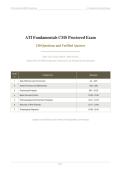
ATI Fundamentals CMS Proctored Exam 210 Questions and Verified Answers
ATI Fundamentals CMS Proctored Exam
210 Questions and Verified Answers
2026 | 2027 Latest Edition | 100% Correct
Aligned with ATI CMS Fundamentals Competencies and Nursing Education Standards
Sectio
Content Area Questions
n
1 Safe, Effective Care Environment Q1 - Q45
2 Health Promotion and Maintenance Q46 - Q80
3 Psychosocial Integrity Q81 - Q105
4 Basic Care and Comfort Q106 - Q140
5 Pharmacological and Parenteral Therapies Q141 - Q170
6 Reduction of Risk Potential Q171 - Q195
7 Physiological Adaptation Q196 - Q210
Cognitive Level Distribution: 25% Recall | 55% Application | 20% Analysis
Page 1
,ATI Fundamentals CMS Proctored Exam 210 Questions and Verified Answers
Section 1: Safe, Effective Care Environment (Management of Care and Safety/Infection
Control)
Q1: A nurse is reviewing the medical record of a client who is scheduled for an elective surgery. The client's advance
directive states they do not want resuscitative efforts. Which of the following actions should the nurse take?
A. A. Document the advance directive in the client's medical record and ensure it is accessible to the surgical team
[CORRECT]
B. B. Request that the client reconsider the advance directive before proceeding with surgery
C. C. Notify the surgeon that the client has declined resuscitation and ask the surgeon to cancel the procedure
D. D. Explain to the client that advance directives do not apply in the surgical setting
Correct Answer: A
Rationale: The nurse must ensure the advance directive is documented and accessible to all members of the healthcare team, including
the surgical team. Advance directives are legal documents that communicate a client's wishes regarding treatment and must be honored in
all care settings, including surgery. Requesting the client reconsider their directive (B) violates the principle of patient self-determination.
Canceling the procedure (C) is not warranted because an advance directive does not preclude surgical intervention. Stating that advance
directives do not apply in surgery (D) is incorrect and violates the Patient Self-Determination Act (PSDA).
Q2: A nurse on a medical-surgical unit is delegating tasks to a licensed practical nurse (LPN) and an unlicensed assistive
personnel (UAP). Which of the following tasks should the nurse delegate to the UAP?
A. A. Measuring a client's intake and output [CORRECT]
B. B. Administering an oral medication to a stable client
C. C. Performing an initial admission assessment on a new client
D. D. Evaluating a client's response to a blood transfusion
Correct Answer: A
Rationale: Measuring intake and output is within the scope of practice for a UAP because it involves routine, repetitive tasks that do not
require nursing judgment. Administering medications (B) requires nursing education and licensure and is appropriate for an LPN under
RN supervision. Performing an initial admission assessment (C) and evaluating a client's response to a blood transfusion (D) both require
RN-level assessment, analysis, and clinical judgment and cannot be delegated. The Five Rights of Delegation require the right task be
assigned to the right person.
Q3: A nurse is caring for a client who reports pain at a level of 6 on a 0-10 scale. The nurse administers an analgesic but
does not document the intervention or reassess the client's pain. Which of the following legal terms describes this situation?
A. A. Negligence [CORRECT]
B. B. Malpractice
C. C. Assault
D. D. Battery
Correct Answer: A
Rationale: Negligence is the failure to act as a reasonable, prudent nurse would under similar circumstances, resulting in harm or
potential harm to the client. Failing to document medication administration and failing to reassess pain after giving an analgesic
constitutes a breach of the standard of care. Malpractice (B) is a subtype of negligence that involves professional misconduct; however,
negligence is the broader and more accurate term for an omission of care. Assault (C) involves threatening or causing fear of harm, and
battery (D) involves unwanted touching, neither of which applies here.
Q4: A nurse receives a hand-off report on four clients. Which of the following clients should the nurse assess first?
A. A. A client who is 1 day postoperative following a cholecystectomy and reports abdominal tenderness at the incision site
Page 2
,ATI Fundamentals CMS Proctored Exam 210 Questions and Verified Answers
B. B. A client who has type 2 diabetes mellitus and a blood glucose level of 210 mg/dL
C. C. A client who was admitted with pneumonia and has a new onset of confusion and restlessness [CORRECT]
D. D. A client who has chronic heart failure and reports mild ankle edema that is unchanged from yesterday
Correct Answer: C
Rationale: The nurse should prioritize the client with pneumonia who has new-onset confusion and restlessness. New confusion in an
older adult with pneumonia may indicate hypoxia or sepsis, both of which are life-threatening and require immediate intervention using
the ABC (Airway, Breathing, Circulation) approach and Maslow's hierarchy of needs. Abdominal tenderness post-cholecystectomy (A) is
an expected finding. A blood glucose of 210 mg/dL (B) is elevated but not an acute emergency. Unchanged mild ankle edema (D) is a
chronic finding that is not the priority.
Q5: A nurse is preparing to administer a medication to a client. Which of the following actions implements the Three
Checks of medication administration?
A. A. Checking the medication label when removing it from the dispensing system, when preparing the dose, and when
returning it to storage
B. B. Verifying the client's identity using two identifiers, scanning the medication barcode, and confirming the route with
the client
C. C. Comparing the medication label against the medication administration record (MAR) when retrieving, preparing, and
administering the medication [CORRECT]
D. D. Asking the client about allergies, checking the MAR for previous doses, and documenting the administration time
Correct Answer: C
Rationale: The Three Checks of medication administration require the nurse to compare the medication label with the MAR at three
points: when retrieving the medication from storage, when preparing the dose, and when returning it to storage or at the bedside prior to
administration. This system ensures accuracy and prevents medication errors. Options A and B describe components of the Six Rights but
not the Three Checks. Option D describes good nursing practice elements but does not constitute the Three Checks verification process.
Q6: A nurse is caring for a client who has active tuberculosis (TB). Which type of transmission-based precautions should
the nurse implement?
A. A. Contact precautions
B. B. Droplet precautions
C. C. Airborne precautions [CORRECT]
D. D. Standard precautions only
Correct Answer: C
Rationale: Airborne precautions are required for clients with active tuberculosis because TB is transmitted via small airborne droplet
nuclei (particles smaller than 5 microns) that remain suspended in the air and can travel long distances. The nurse should place the client
in a negative-pressure airborne infection isolation room (AIIR) and wear an N95 respirator. Contact precautions (A) are used for
infections transmitted by direct or indirect contact (e.g., MRSA). Droplet precautions (B) are for infections transmitted by large
respiratory droplets (e.g., influenza). Standard precautions (D) are used for all clients but are not sufficient alone for TB.
Q7: A nurse is using the SBAR (Situation, Background, Assessment, Recommendation) communication tool to report a
client's condition to a provider. Which of the following statements is an example of the 'Assessment' component?
A. A. The client is a 68-year-old admitted 2 days ago for heart failure exacerbation.
B. B. I think the client is experiencing fluid volume overload based on increased crackles and weight gain. [CORRECT]
C. C. The client's oxygen saturation has dropped to 88% on room air within the past hour.
D. D. I recommend increasing the client's furosemide dose and obtaining a chest X-ray.
Correct Answer: B
Page 3
, ATI Fundamentals CMS Proctored Exam 210 Questions and Verified Answers
Rationale: The Assessment component of SBAR is where the nurse provides their professional clinical judgment about the client's
condition. Stating 'I think the client is experiencing fluid volume overload' reflects the nurse's analysis of the data collected. The
Background (A) provides relevant history, the Situation (C) describes the current problem or change in condition, and the
Recommendation (D) suggests actions to address the problem. Understanding SBAR is essential for effective interdisciplinary
communication and client safety.
Q8: A nurse is caring for a client who is at risk for falls. The nurse uses the Morse Fall Scale and obtains a score of 65.
Which of the following interventions is most appropriate?
A. A. Place the client on fall precautions and implement all fall prevention interventions including bed alarm, non-skid
footwear, and toileting schedule [CORRECT]
B. B. Document the score and continue routine care since falls are an expected risk in hospitalized clients
C. C. Ask the family to remain at the bedside at all times to prevent the client from attempting to get up unassisted
D. D. Restrain the client to the bed using soft wrist restraints to prevent falls
Correct Answer: A
Rationale: A Morse Fall Scale score of 65 indicates a high fall risk. The appropriate response is to implement comprehensive fall
prevention interventions, including activating bed alarms, providing non-skid footwear, keeping the bed in the lowest position, ensuring
the call light is within reach, and implementing a regular toileting schedule. Continuing routine care (B) would fail to address the
identified risk. Relying solely on family (C) is not a systematic or reliable fall prevention strategy. Restraints (D) should only be used as a
last resort when less restrictive interventions have failed and require a provider order.
Q9: A nurse is preparing to insert a urinary catheter for a female client. Which of the following actions demonstrates
correct sterile technique?
A. A. Cleanse the meatus from the urethral opening outward in a circular motion
B. B. Apply sterile gloves before opening the catheterization kit
C. C. Maintain the sterile field by keeping hands above waist level and within the field of vision [CORRECT]
D. D. Use clean technique since the urinary tract is not a sterile body cavity
Correct Answer: C
Rationale: During sterile procedures, the nurse must maintain the sterile field by keeping hands above waist level and within the field of
vision at all times. This prevents accidental contamination of sterile items. The meatus should be cleansed from front to back (anterior to
posterior), not in a circular outward motion (A). Sterile gloves should be applied after opening the kit and establishing the sterile field (B).
The urinary tract is a sterile body cavity, and sterile technique is required to prevent catheter-associated urinary tract infections (CAUTIs)
(D).
Q10: A nurse is providing discharge teaching to a client who has a new prescription for home oxygen therapy. Which of the
following statements by the client indicates an understanding of the teaching?
A. A. I can use petroleum-based lip balm to relieve my dry lips while using oxygen.
B. B. I will keep the oxygen equipment at least 10 feet away from any open flame or heat source. [CORRECT]
C. C. I should adjust the oxygen flow rate based on how short of breath I feel.
D. D. I will store extra oxygen cylinders in a closet or small enclosed space for safety.
Correct Answer: B
Rationale: The client should keep oxygen equipment at least 10 feet away from any open flame, spark, or heat source because oxygen
supports combustion and increases fire risk. Petroleum-based products (A) are contraindicated with oxygen therapy because they are
flammable; water-based lubricants should be used instead. The client should never adjust the oxygen flow rate independently (C) because
the prescribed liter flow is based on the provider's assessment of the client's oxygenation needs. Oxygen cylinders should never be stored
in small enclosed spaces (D) because a leak could create a fire or explosion hazard.
Page 4
ATI Fundamentals CMS Proctored Exam
210 Questions and Verified Answers
2026 | 2027 Latest Edition | 100% Correct
Aligned with ATI CMS Fundamentals Competencies and Nursing Education Standards
Sectio
Content Area Questions
n
1 Safe, Effective Care Environment Q1 - Q45
2 Health Promotion and Maintenance Q46 - Q80
3 Psychosocial Integrity Q81 - Q105
4 Basic Care and Comfort Q106 - Q140
5 Pharmacological and Parenteral Therapies Q141 - Q170
6 Reduction of Risk Potential Q171 - Q195
7 Physiological Adaptation Q196 - Q210
Cognitive Level Distribution: 25% Recall | 55% Application | 20% Analysis
Page 1
,ATI Fundamentals CMS Proctored Exam 210 Questions and Verified Answers
Section 1: Safe, Effective Care Environment (Management of Care and Safety/Infection
Control)
Q1: A nurse is reviewing the medical record of a client who is scheduled for an elective surgery. The client's advance
directive states they do not want resuscitative efforts. Which of the following actions should the nurse take?
A. A. Document the advance directive in the client's medical record and ensure it is accessible to the surgical team
[CORRECT]
B. B. Request that the client reconsider the advance directive before proceeding with surgery
C. C. Notify the surgeon that the client has declined resuscitation and ask the surgeon to cancel the procedure
D. D. Explain to the client that advance directives do not apply in the surgical setting
Correct Answer: A
Rationale: The nurse must ensure the advance directive is documented and accessible to all members of the healthcare team, including
the surgical team. Advance directives are legal documents that communicate a client's wishes regarding treatment and must be honored in
all care settings, including surgery. Requesting the client reconsider their directive (B) violates the principle of patient self-determination.
Canceling the procedure (C) is not warranted because an advance directive does not preclude surgical intervention. Stating that advance
directives do not apply in surgery (D) is incorrect and violates the Patient Self-Determination Act (PSDA).
Q2: A nurse on a medical-surgical unit is delegating tasks to a licensed practical nurse (LPN) and an unlicensed assistive
personnel (UAP). Which of the following tasks should the nurse delegate to the UAP?
A. A. Measuring a client's intake and output [CORRECT]
B. B. Administering an oral medication to a stable client
C. C. Performing an initial admission assessment on a new client
D. D. Evaluating a client's response to a blood transfusion
Correct Answer: A
Rationale: Measuring intake and output is within the scope of practice for a UAP because it involves routine, repetitive tasks that do not
require nursing judgment. Administering medications (B) requires nursing education and licensure and is appropriate for an LPN under
RN supervision. Performing an initial admission assessment (C) and evaluating a client's response to a blood transfusion (D) both require
RN-level assessment, analysis, and clinical judgment and cannot be delegated. The Five Rights of Delegation require the right task be
assigned to the right person.
Q3: A nurse is caring for a client who reports pain at a level of 6 on a 0-10 scale. The nurse administers an analgesic but
does not document the intervention or reassess the client's pain. Which of the following legal terms describes this situation?
A. A. Negligence [CORRECT]
B. B. Malpractice
C. C. Assault
D. D. Battery
Correct Answer: A
Rationale: Negligence is the failure to act as a reasonable, prudent nurse would under similar circumstances, resulting in harm or
potential harm to the client. Failing to document medication administration and failing to reassess pain after giving an analgesic
constitutes a breach of the standard of care. Malpractice (B) is a subtype of negligence that involves professional misconduct; however,
negligence is the broader and more accurate term for an omission of care. Assault (C) involves threatening or causing fear of harm, and
battery (D) involves unwanted touching, neither of which applies here.
Q4: A nurse receives a hand-off report on four clients. Which of the following clients should the nurse assess first?
A. A. A client who is 1 day postoperative following a cholecystectomy and reports abdominal tenderness at the incision site
Page 2
,ATI Fundamentals CMS Proctored Exam 210 Questions and Verified Answers
B. B. A client who has type 2 diabetes mellitus and a blood glucose level of 210 mg/dL
C. C. A client who was admitted with pneumonia and has a new onset of confusion and restlessness [CORRECT]
D. D. A client who has chronic heart failure and reports mild ankle edema that is unchanged from yesterday
Correct Answer: C
Rationale: The nurse should prioritize the client with pneumonia who has new-onset confusion and restlessness. New confusion in an
older adult with pneumonia may indicate hypoxia or sepsis, both of which are life-threatening and require immediate intervention using
the ABC (Airway, Breathing, Circulation) approach and Maslow's hierarchy of needs. Abdominal tenderness post-cholecystectomy (A) is
an expected finding. A blood glucose of 210 mg/dL (B) is elevated but not an acute emergency. Unchanged mild ankle edema (D) is a
chronic finding that is not the priority.
Q5: A nurse is preparing to administer a medication to a client. Which of the following actions implements the Three
Checks of medication administration?
A. A. Checking the medication label when removing it from the dispensing system, when preparing the dose, and when
returning it to storage
B. B. Verifying the client's identity using two identifiers, scanning the medication barcode, and confirming the route with
the client
C. C. Comparing the medication label against the medication administration record (MAR) when retrieving, preparing, and
administering the medication [CORRECT]
D. D. Asking the client about allergies, checking the MAR for previous doses, and documenting the administration time
Correct Answer: C
Rationale: The Three Checks of medication administration require the nurse to compare the medication label with the MAR at three
points: when retrieving the medication from storage, when preparing the dose, and when returning it to storage or at the bedside prior to
administration. This system ensures accuracy and prevents medication errors. Options A and B describe components of the Six Rights but
not the Three Checks. Option D describes good nursing practice elements but does not constitute the Three Checks verification process.
Q6: A nurse is caring for a client who has active tuberculosis (TB). Which type of transmission-based precautions should
the nurse implement?
A. A. Contact precautions
B. B. Droplet precautions
C. C. Airborne precautions [CORRECT]
D. D. Standard precautions only
Correct Answer: C
Rationale: Airborne precautions are required for clients with active tuberculosis because TB is transmitted via small airborne droplet
nuclei (particles smaller than 5 microns) that remain suspended in the air and can travel long distances. The nurse should place the client
in a negative-pressure airborne infection isolation room (AIIR) and wear an N95 respirator. Contact precautions (A) are used for
infections transmitted by direct or indirect contact (e.g., MRSA). Droplet precautions (B) are for infections transmitted by large
respiratory droplets (e.g., influenza). Standard precautions (D) are used for all clients but are not sufficient alone for TB.
Q7: A nurse is using the SBAR (Situation, Background, Assessment, Recommendation) communication tool to report a
client's condition to a provider. Which of the following statements is an example of the 'Assessment' component?
A. A. The client is a 68-year-old admitted 2 days ago for heart failure exacerbation.
B. B. I think the client is experiencing fluid volume overload based on increased crackles and weight gain. [CORRECT]
C. C. The client's oxygen saturation has dropped to 88% on room air within the past hour.
D. D. I recommend increasing the client's furosemide dose and obtaining a chest X-ray.
Correct Answer: B
Page 3
, ATI Fundamentals CMS Proctored Exam 210 Questions and Verified Answers
Rationale: The Assessment component of SBAR is where the nurse provides their professional clinical judgment about the client's
condition. Stating 'I think the client is experiencing fluid volume overload' reflects the nurse's analysis of the data collected. The
Background (A) provides relevant history, the Situation (C) describes the current problem or change in condition, and the
Recommendation (D) suggests actions to address the problem. Understanding SBAR is essential for effective interdisciplinary
communication and client safety.
Q8: A nurse is caring for a client who is at risk for falls. The nurse uses the Morse Fall Scale and obtains a score of 65.
Which of the following interventions is most appropriate?
A. A. Place the client on fall precautions and implement all fall prevention interventions including bed alarm, non-skid
footwear, and toileting schedule [CORRECT]
B. B. Document the score and continue routine care since falls are an expected risk in hospitalized clients
C. C. Ask the family to remain at the bedside at all times to prevent the client from attempting to get up unassisted
D. D. Restrain the client to the bed using soft wrist restraints to prevent falls
Correct Answer: A
Rationale: A Morse Fall Scale score of 65 indicates a high fall risk. The appropriate response is to implement comprehensive fall
prevention interventions, including activating bed alarms, providing non-skid footwear, keeping the bed in the lowest position, ensuring
the call light is within reach, and implementing a regular toileting schedule. Continuing routine care (B) would fail to address the
identified risk. Relying solely on family (C) is not a systematic or reliable fall prevention strategy. Restraints (D) should only be used as a
last resort when less restrictive interventions have failed and require a provider order.
Q9: A nurse is preparing to insert a urinary catheter for a female client. Which of the following actions demonstrates
correct sterile technique?
A. A. Cleanse the meatus from the urethral opening outward in a circular motion
B. B. Apply sterile gloves before opening the catheterization kit
C. C. Maintain the sterile field by keeping hands above waist level and within the field of vision [CORRECT]
D. D. Use clean technique since the urinary tract is not a sterile body cavity
Correct Answer: C
Rationale: During sterile procedures, the nurse must maintain the sterile field by keeping hands above waist level and within the field of
vision at all times. This prevents accidental contamination of sterile items. The meatus should be cleansed from front to back (anterior to
posterior), not in a circular outward motion (A). Sterile gloves should be applied after opening the kit and establishing the sterile field (B).
The urinary tract is a sterile body cavity, and sterile technique is required to prevent catheter-associated urinary tract infections (CAUTIs)
(D).
Q10: A nurse is providing discharge teaching to a client who has a new prescription for home oxygen therapy. Which of the
following statements by the client indicates an understanding of the teaching?
A. A. I can use petroleum-based lip balm to relieve my dry lips while using oxygen.
B. B. I will keep the oxygen equipment at least 10 feet away from any open flame or heat source. [CORRECT]
C. C. I should adjust the oxygen flow rate based on how short of breath I feel.
D. D. I will store extra oxygen cylinders in a closet or small enclosed space for safety.
Correct Answer: B
Rationale: The client should keep oxygen equipment at least 10 feet away from any open flame, spark, or heat source because oxygen
supports combustion and increases fire risk. Petroleum-based products (A) are contraindicated with oxygen therapy because they are
flammable; water-based lubricants should be used instead. The client should never adjust the oxygen flow rate independently (C) because
the prescribed liter flow is based on the provider's assessment of the client's oxygenation needs. Oxygen cylinders should never be stored
in small enclosed spaces (D) because a leak could create a fire or explosion hazard.
Page 4


