
C273 WGU
C273 WGU
Study online at https://quizlet.com/_6i7tn2
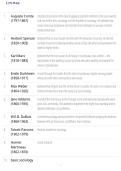
1. Auguste Comte Introduced positivism (the idea of applying scientific methods to the social world)
(1797-1867) and coined the term sociology and the founder of sociology. He believed that
it was necessary to observe and classify human behavior to uncover society's
fundamental laws.
2. Herbert Spencer Believed that no one should interfere with the evolution of society. He did not
(1820-1903) conduct research but developed ideas about society. Idea that society evolves from
lower to higher forms.
3. Karl Marx Believed that the root cause of all misery in society was class conflict—the
(1818-1883) exploitation of the working classes by those who were wealthy and owned the
means of production.
4. Emile Durkheim Found through his studies that the rate of suicide was higher among people
(1858-1917) whose ties with their communities were weak.
5. Max Weber Believed that religion was the central force in society. He used cross-cultural and
(1864-1920) historical materials to trace the causes of social change.
6. Jane Addams Founded the Hull House in the Chicago slums and welcomed people who were
(1860-1935) poor, sick, and needy. She worked to implement the eight-hour workday and to
abolish child labor. Social Reform
7. W.E.B. DuBois Combined sociology and social reform. He spent his lifetime studying the relations
(1868-1963) between African-Americans and Whites. Race relations.
8. Talcott Parsons Abstract models for sociology
(1902-1979)
9. Harriet Social research
Martineau
(1802-1876)
10. basic sociology
, C273 WGU
C273 WGU
Study online at https://quizlet.com/_6i7tn2
research into the behaviors of people in a social environment. It provides knowl-
edge about that society and those people.
11. applied sociology takes the knowledge found by basic sociology and uses it to bring about social
change.
12. Symbolic interac- social life is based on symbols; things to which we attach meaning. Thus, symbolic
tionism meanings a society attaches to relationships, various behaviors, and actions sim-
plify communication and enable the individual or group to define who and what
they are, and to understand the importance of specific behaviors and events.
13. Functional analy- society is viewed as a unit of interrelated parts that must function together.
sis
14. Conflict theory society is seen as being made up of competing groups vying for scarce resources.
Although alliances and cooperation might seem to exist, there is an underlying
struggle for power at all times.
15. List the primary Surveys, Participant observation, Secondary analysis, Documents, Experiments,
ways in which so- Unobtrusive methods
ciologists do re-
search
16. Surveys Collection of data by having people answer questions, such as in graduate satis-
faction surveys and employee satisfaction surveys.
17. Participant Ob- The researcher participates in a research setting while observing what is happen-
servation ing there.
18. What are the eth- Honesty, Openness, Truthfulness, Protecting the anonymity of the participants,
ical guidelines Avoiding misrepresentation of the participants, Conducting safe research
that sociologists
follow?
, C273 WGU
C273 WGU
Study online at https://quizlet.com/_6i7tn2
19. Material Culture This includes items such as jewelry, art, buildings, weapons, machines, clothing,
hairstyles, and so on.
20. Nonmaterial Cul- This is a group's ways of thinking (beliefs, values, and assumptions) and common
ture patterns of behavior (language, gestures, and forms of interactions).
21. Ethnocentrism The use of one's own culture as a yardstick for judging the ways of other individu-
als or societies, generally leading to a negative evaluation of their values, norms,
and behaviors.
22. cultural rela- Not judging a culture, but trying to understand it on its own terms.
tivism
23. Culture includes language, beliefs, values, norms, behaviors, and even material objects
that can be passed from one generation to the next.
24. Subculture are groups whose values and related behaviors are so distinct that they form their
own entity, different from the dominant culture but still relatively compatible with
it.
25. Counterculture are groups whose values set their members in opposition to the dominant culture.
They are usually associated with negative behaviors and perceived as a threat to
the dominant culture.
26. Infuence of me- Because of media, people begin to feel as though certain behaviors are ok or not
dia on identity ok.
and behavior.
27. Mass Media Television, Movies, Video games, Music groups and bands, Entertainment, Media
coverage, Personal devices, such as smartphones
28. What is socializa- Individuals and groups that influence our orientations to life—our self-concept,
tion? emotions, attitudes, and behavior.
C273 WGU
Study online at https://quizlet.com/_6i7tn2
1. Auguste Comte Introduced positivism (the idea of applying scientific methods to the social world)
(1797-1867) and coined the term sociology and the founder of sociology. He believed that
it was necessary to observe and classify human behavior to uncover society's
fundamental laws.
2. Herbert Spencer Believed that no one should interfere with the evolution of society. He did not
(1820-1903) conduct research but developed ideas about society. Idea that society evolves from
lower to higher forms.
3. Karl Marx Believed that the root cause of all misery in society was class conflict—the
(1818-1883) exploitation of the working classes by those who were wealthy and owned the
means of production.
4. Emile Durkheim Found through his studies that the rate of suicide was higher among people
(1858-1917) whose ties with their communities were weak.
5. Max Weber Believed that religion was the central force in society. He used cross-cultural and
(1864-1920) historical materials to trace the causes of social change.
6. Jane Addams Founded the Hull House in the Chicago slums and welcomed people who were
(1860-1935) poor, sick, and needy. She worked to implement the eight-hour workday and to
abolish child labor. Social Reform
7. W.E.B. DuBois Combined sociology and social reform. He spent his lifetime studying the relations
(1868-1963) between African-Americans and Whites. Race relations.
8. Talcott Parsons Abstract models for sociology
(1902-1979)
9. Harriet Social research
Martineau
(1802-1876)
10. basic sociology
, C273 WGU
C273 WGU
Study online at https://quizlet.com/_6i7tn2
research into the behaviors of people in a social environment. It provides knowl-
edge about that society and those people.
11. applied sociology takes the knowledge found by basic sociology and uses it to bring about social
change.
12. Symbolic interac- social life is based on symbols; things to which we attach meaning. Thus, symbolic
tionism meanings a society attaches to relationships, various behaviors, and actions sim-
plify communication and enable the individual or group to define who and what
they are, and to understand the importance of specific behaviors and events.
13. Functional analy- society is viewed as a unit of interrelated parts that must function together.
sis
14. Conflict theory society is seen as being made up of competing groups vying for scarce resources.
Although alliances and cooperation might seem to exist, there is an underlying
struggle for power at all times.
15. List the primary Surveys, Participant observation, Secondary analysis, Documents, Experiments,
ways in which so- Unobtrusive methods
ciologists do re-
search
16. Surveys Collection of data by having people answer questions, such as in graduate satis-
faction surveys and employee satisfaction surveys.
17. Participant Ob- The researcher participates in a research setting while observing what is happen-
servation ing there.
18. What are the eth- Honesty, Openness, Truthfulness, Protecting the anonymity of the participants,
ical guidelines Avoiding misrepresentation of the participants, Conducting safe research
that sociologists
follow?
, C273 WGU
C273 WGU
Study online at https://quizlet.com/_6i7tn2
19. Material Culture This includes items such as jewelry, art, buildings, weapons, machines, clothing,
hairstyles, and so on.
20. Nonmaterial Cul- This is a group's ways of thinking (beliefs, values, and assumptions) and common
ture patterns of behavior (language, gestures, and forms of interactions).
21. Ethnocentrism The use of one's own culture as a yardstick for judging the ways of other individu-
als or societies, generally leading to a negative evaluation of their values, norms,
and behaviors.
22. cultural rela- Not judging a culture, but trying to understand it on its own terms.
tivism
23. Culture includes language, beliefs, values, norms, behaviors, and even material objects
that can be passed from one generation to the next.
24. Subculture are groups whose values and related behaviors are so distinct that they form their
own entity, different from the dominant culture but still relatively compatible with
it.
25. Counterculture are groups whose values set their members in opposition to the dominant culture.
They are usually associated with negative behaviors and perceived as a threat to
the dominant culture.
26. Infuence of me- Because of media, people begin to feel as though certain behaviors are ok or not
dia on identity ok.
and behavior.
27. Mass Media Television, Movies, Video games, Music groups and bands, Entertainment, Media
coverage, Personal devices, such as smartphones
28. What is socializa- Individuals and groups that influence our orientations to life—our self-concept,
tion? emotions, attitudes, and behavior.


