
WGU D080 Complete Exam Study Guide, Practice Questions, and Course Review Material
D080 WGU
Study online at https://quizlet.com/_jptw09
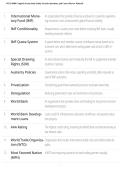
1. International Mone- An organization that provides financial assistance to countries experienc-
tary Fund (IMF) ing economic crises and promotes global financial stability.
2. IMF Conditionality Requirements a country must meet before receiving IMF loans, usually
involving economic reforms.
3. IMF Quota System A system where each member country contributes money based on its
economic size, which determines voting power and access to IMF re-
sources.
4. Special Drawing An international reserve asset created by the IMF to supplement member
Rights (SDR) countries' reserves.
5. Austerity Policies Government actions that reduce spending and debt, often required as
part of IMF assistance.
6. Privatization Transferring government-owned businesses to private ownership.
7. Deregulation Reducing government rules and restrictions on businesses.
8. World Bank An organization that provides loans and funding for long-term economic
development projects.
9. World Bank Develop- Loans used for infrastructure, education, healthcare, and poverty reduc-
ment Loans tion projects.
10. AAA Rating The highest credit rating, meaning the World Bank can borrow money at
low interest rates.
11. World Trade Organiza- Organization that creates international trade rules and settles trade dis-
tion (WTO) putes.
12. Most Favored Nation A WTO rule requiring countries to treat trading partners equally.
(MFN)
, WGU D080 Complete Exam Study Guide, Practice Questions, and Course Review Material
D080 WGU
Study online at https://quizlet.com/_jptw09
13. Trade Transparency Requirement that countries clearly communicate trade policies and regu-
lations.
14. Uruguay Round WTO negotiations that created major trade agreements and established
the WTO.
15. Doha Round WTO negotiations focused on improving trade opportunities for develop-
ing countries.
16. Mercantilism Economic theory that a country becomes wealthy by exporting more than
it imports and collecting wealth.
17. Neo-Mercantilism Modern version of mercantilism where governments protect industries to
increase exports.
18. Absolute Advantage When a country can produce a good more efficiently than another country.
19. Comparative Advan- When a country produces goods with the lowest opportunity cost.
tage
20. Heckscher-Ohlin The- Countries export goods that use their abundant resources.
ory
21. Country Similarity Countries with similar economies and cultures are more likely to trade.
Theory
22. Global Strategic Rival- Companies compete globally by gaining advantages over competitors.
ry Theory
23. Specialization Countries focus on producing goods they make most efficiently.
24. Free Trade Trade between countries with few or no restrictions.
25. Protectionism Government actions designed to protect domestic industries from foreign
competition.
D080 WGU
Study online at https://quizlet.com/_jptw09
1. International Mone- An organization that provides financial assistance to countries experienc-
tary Fund (IMF) ing economic crises and promotes global financial stability.
2. IMF Conditionality Requirements a country must meet before receiving IMF loans, usually
involving economic reforms.
3. IMF Quota System A system where each member country contributes money based on its
economic size, which determines voting power and access to IMF re-
sources.
4. Special Drawing An international reserve asset created by the IMF to supplement member
Rights (SDR) countries' reserves.
5. Austerity Policies Government actions that reduce spending and debt, often required as
part of IMF assistance.
6. Privatization Transferring government-owned businesses to private ownership.
7. Deregulation Reducing government rules and restrictions on businesses.
8. World Bank An organization that provides loans and funding for long-term economic
development projects.
9. World Bank Develop- Loans used for infrastructure, education, healthcare, and poverty reduc-
ment Loans tion projects.
10. AAA Rating The highest credit rating, meaning the World Bank can borrow money at
low interest rates.
11. World Trade Organiza- Organization that creates international trade rules and settles trade dis-
tion (WTO) putes.
12. Most Favored Nation A WTO rule requiring countries to treat trading partners equally.
(MFN)
, WGU D080 Complete Exam Study Guide, Practice Questions, and Course Review Material
D080 WGU
Study online at https://quizlet.com/_jptw09
13. Trade Transparency Requirement that countries clearly communicate trade policies and regu-
lations.
14. Uruguay Round WTO negotiations that created major trade agreements and established
the WTO.
15. Doha Round WTO negotiations focused on improving trade opportunities for develop-
ing countries.
16. Mercantilism Economic theory that a country becomes wealthy by exporting more than
it imports and collecting wealth.
17. Neo-Mercantilism Modern version of mercantilism where governments protect industries to
increase exports.
18. Absolute Advantage When a country can produce a good more efficiently than another country.
19. Comparative Advan- When a country produces goods with the lowest opportunity cost.
tage
20. Heckscher-Ohlin The- Countries export goods that use their abundant resources.
ory
21. Country Similarity Countries with similar economies and cultures are more likely to trade.
Theory
22. Global Strategic Rival- Companies compete globally by gaining advantages over competitors.
ry Theory
23. Specialization Countries focus on producing goods they make most efficiently.
24. Free Trade Trade between countries with few or no restrictions.
25. Protectionism Government actions designed to protect domestic industries from foreign
competition.


