

Written by students who passed Immediately available after payment Read online or as PDF Wrong document? Swap it for free 4.6 TrustPilot
logo-home
Document preview thumbnail
Preview 4 out of 119 pages
Exam (elaborations)

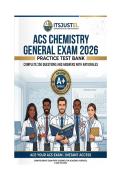
ACS General Chemistry Exam Study Guide | 250 Original Practice Questions with Detailed Explanations | Comprehensive Review | 2026 Edition

Document preview thumbnail
Preview 4 out of 119 pages

Prepare confidently for the ACS General Chemistry Examination with the most comprehensive and up-to-date study guide developed for the 2026 academic year. Designed for college and university students preparing for the American Chemical Society (ACS) General Chemistry Exam, this complete review resource features 250 original, exam-style practice questions carefully written to strengthen conceptual understanding, quantitative problem-solving, and scientific reasoning. Every question includes a correct answer accompanied by a detailed explanation that walks through the underlying chemistry principles, calculations, and reasoning while clarifying why alternative approaches are incorrect. Rather than relying on memorization alone, this guide helps students develop the analytical skills necessary for success in general chemistry coursework, standardized examinations, and future science courses. Built around the core topics traditionally assessed on comprehensive general chemistry examinations, this study guide provides thorough coverage of fundamental chemical principles while reinforcing problem-solving strategies commonly encountered in introductory college chemistry. Whether you are preparing for a departmental final, ACS standardized exam, placement assessment, or cumulative chemistry review, this resource offers extensive practice across every major content area. Comprehensive coverage includes: Atomic Structure & Periodic Trends: Atomic theory, subatomic particles, isotopes, average atomic mass, electron configuration, quantum numbers, orbital diagrams, periodic table organization, effective nuclear charge, atomic and ionic radii, ionization energy, electron affinity, electronegativity, and periodic trends. Chemical Bonding & Molecular Structure: Ionic and covalent bonding, Lewis structures, formal charge, resonance, molecular geometry, VSEPR theory, hybridization, molecular polarity, intermolecular forces, hydrogen bonding, dipole-dipole interactions, London dispersion forces, metallic bonding, and predicting physical and chemical properties from molecular structure. Stoichiometry & Chemical Reactions: Mole calculations, empirical and molecular formulas, balancing chemical equations, limiting reactants, theoretical yield, percent yield, reaction types, oxidation-reduction reactions, precipitation reactions, combustion reactions, and quantitative analysis of chemical processes. States of Matter & Gas Laws: Kinetic molecular theory, ideal gas law, Dalton's law of partial pressures, Graham's law, gas stoichiometry, real gases, Boyle's law, Charles's law, Avogadro's law, combined gas law, gas mixtures, and molecular motion. Thermochemistry: Energy changes, heat transfer, enthalpy, Hess's law, calorimetry, bond dissociation energies, specific heat capacity, phase changes, heating curves, exothermic and endothermic reactions, standard enthalpies of formation, and thermochemical calculations. Chemical Kinetics: Reaction rates, rate laws, integrated rate equations, reaction mechanisms, activation energy, collision theory, catalysts, Arrhenius equation, reaction order, half-life calculations, and factors affecting reaction rates. Chemical Equilibrium: Dynamic equilibrium, equilibrium constants (Kc and Kp), Le Châtelier's Principle, reaction quotients, equilibrium calculations, heterogeneous equilibrium, and applications of equilibrium concepts to chemical systems. Acids, Bases & Buffer Systems: Brønsted-Lowry and Lewis acid-base theories, strong and weak acids and bases, pH and pOH calculations, acid dissociation constants (Ka), base dissociation constants (Kb), buffer solutions, titrations, indicators, hydrolysis, and acid-base equilibria. Solubility & Solution Chemistry: Solution concentration units, molarity, molality, dilution calculations, solubility rules, precipitation reactions, colligative properties, osmotic pressure, vapor pressure, boiling point elevation, freezing point depression, and solution preparation. Electrochemistry: Oxidation-reduction reactions, balancing redox equations, galvanic and electrolytic cells, standard reduction potentials, Nernst equation, electrochemical cell notation, Faraday's laws, electrolysis, corrosion, and battery chemistry. Thermodynamics: Entropy, Gibbs free energy, spontaneity, equilibrium relationships, free energy calculations, thermodynamic favorability, and applications to chemical reactions. Nuclear Chemistry: Radioactivity, nuclear decay processes, half-life calculations, nuclear reactions, fission, fusion, radiation safety, and applications of nuclear chemistry in science and medicine. Laboratory Techniques & Data Analysis: Significant figures, dimensional analysis, measurement accuracy and precision, experimental uncertainty, graph interpretation, solution preparation, laboratory safety, instrumentation fundamentals, and analysis of experimental results. Mathematical Problem Solving: Multi-step calculations involving stoichiometry, gas laws, equilibrium, thermochemistry, electrochemistry, solution chemistry, logarithms, scientific notation, unit conversions, and interpretation of chemistry data presented in tables and graphs. Scientific Reasoning & Exam Readiness: This guide emphasizes conceptual understanding alongside computational accuracy through realistic chemistry scenarios that strengthen analytical thinking, reinforce foundational principles, and prepare students for the style and rigor of comprehensive college chemistry examinations. Detailed explanations help learners understand the reasoning behind each solution while building long-term mastery of essential chemistry concepts. Whether you are reviewing throughout the semester, preparing for a cumulative final examination, or studying for the ACS General Chemistry Exam, this comprehensive study guide provides the practice, explanations, and structured review needed to improve problem-solving skills, strengthen chemistry knowledge, and build confidence for exam day.

Content preview

,ACS CHEMISTRY GENERAL EXAM 2026
COMPLETE 250 QUESTIONS AND ANSWERS WITH RATIONALES
GRADED A+ | 2026 UPDATE | 100% VERIFIED SOLUTIONS


SECTION 1: FUNDAMENTAL CONCEPTS & MATTER (Questions 1-15)
Question 1
The physical material of the universe. It is anything that has mass and
occupies space.
• A) Atom
• B) Matter
• C) Element
• D) Molecule
Correct Answer: B) Matter
Rationale: Matter is the physical material of the universe that has mass
and occupies space. Everything we can touch or measure is made of
matter. Atoms are the building blocks, but matter is the broader
concept encompassing all physical substances .


Question 2
The smallest building block of matter. The smallest particle that retains
the chemical property of the element.
• A) Atom
• B) Molecule

, • C) Element
• D) Compound
Correct Answer: A) Atom
Rationale: Atoms are the fundamental building blocks of matter.
Examples include oxygen (O), helium (He), and sulfur (S) atoms. They
are the smallest units that retain the chemical properties of an
element .


Question 3
Each ________ is made of the same kind of atom.
• A) Molecule
• B) Element
• C) Compound
• D) Mixture
Correct Answer: B) Element
Rationale: An element is a pure substance composed entirely of the
same type of atom. For example, a sample of gold contains only gold
atoms. Compounds contain different types of atoms chemically
combined .


Question 4
Combination of atoms held together in specific shapes.
• A) Element
• B) Molecule

, • C) Compound
• D) Ion
Correct Answer: B) Molecule
Rationale: Molecules are assemblies of two or more atoms bonded
together in specific arrangements. They can be elements (O₂) or
compounds (H₂O) .


Question 5
No fixed volume or shape, conforms to volume and shape of container,
is compressible.
• A) Gas
• B) Liquid
• C) Solid
• D) Plasma
Correct Answer: A) Gas
Rationale: Gases have particles that are far apart and move freely,
allowing them to expand to fill any container. They are highly
compressible due to the large spaces between particles .


Question 6
Fixed volume but no fixed shape, conforms to shape of container.
• A) Gas
• B) Liquid
• C) Solid


Document information

Uploaded on
August 2, 2026
Number of pages
119
Written in
2026/2027
Type
Exam (elaborations)
Contains
Questions & answers
$22.99

Wrong document? Swap it for free Within 14 days of purchase and before downloading, you can choose a different document. You can simply spend the amount again.
Written by students who passed
Immediately available after payment
Read online or as PDF

Seller avatar
Reputation scores are based on the amount of documents a seller has sold for a fee and the reviews they have received for those documents. There are three levels: Bronze, Silver and Gold. The better the reputation, the more your can rely on the quality of the sellers work.
itsjustel
4.0
(1)
Sold
14
Followers
0
Items
785
Last sold
1 week ago


Why students choose Stuvia

Created by fellow students, verified by reviews

Quality you can trust: written by students who passed their tests and reviewed by others who've used these notes.

Didn't get what you expected? Choose another document

No worries! You can instantly pick a different document that better fits what you're looking for.

Pay as you like, start learning right away

No subscription, no commitments. Pay the way you're used to via credit card and download your PDF document instantly.

Student with book image

“Bought, downloaded, and aced it. It really can be that simple.”

Alisha Student

Working on your references?

Create accurate citations in APA, MLA and Harvard with our free citation generator.

Working on your references?

Frequently asked questions
