

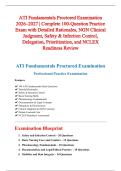
ATI Fundamentals Proctored Examination
2026–2027 | Complete 100-Question Practice
Exam with Detailed Rationales, NGN Clinical
Judgment, Safety & Infection Control,
Delegation, Prioritization, and NCLEX
Readiness Review
ATI Fundamentals Proctored Examination
Professional Practice Examination
Features
✔ 100 ATI Fundamentals-Style Questions
✔ Detailed Rationales
✔ Safety & Infection Control
✔ Basic Nursing Skills
✔ Pharmacology Fundamentals
✔ Documentation & Legal Concepts
✔ Delegation & Prioritization
✔ Clinical Judgment & NGN Concepts
✔ Patient-Centered Care
✔ NCLEX Readiness Assessment
Examination Blueprint
1. Safety and Infection Control – 20 Questions
2. Basic Nursing Care and Comfort – 15 Questions
3. Pharmacology Fundamentals – 10 Questions
4. Documentation and Legal/Ethical Practice – 10 Questions
5. Mobility and Skin Integrity – 10 Questions
,6. Fluid and Electrolyte Balance – 10 Questions
7. Delegation and Prioritization – 10 Questions
8. Clinical Judgment and NGN Concepts – 15 Questions
, Questions 1–100
Safety and Infection Control
1. A nurse enters a client's room and discovers the client lying on the floor. Which
action should the nurse take first?
A. Complete an incident report
B. Assist the client back into bed
C. Assess the client for injuries
D. Notify the healthcare provider
Correct Answer: C. Assess the client for injuries
Rationale: Client safety is the priority. The nurse should assess the client for injuries
before implementing additional interventions or notifications.
ATI Success Strategy: Assessment comes before reporting, documentation, and provider
notification.
Difficulty: Moderate
2. A nurse is caring for a client with methicillin-resistant Staphylococcus aureus
(MRSA). Which precaution should the nurse implement?
A. Airborne precautions
B. Droplet precautions
C. Contact precautions
D. Protective precautions
Correct Answer: C. Contact precautions
Rationale: MRSA is transmitted primarily through direct contact. Contact precautions help
prevent transmission to other clients and healthcare workers.
ATI Success Strategy: Know the isolation categories and diseases commonly associated
with each.
Difficulty: Easy
, 3. A nurse is preparing to administer medication. Which action best supports client
safety?
A. Verifying two client identifiers
B. Asking the roommate to identify the client
C. Using the room number as identification
D. Administering medication immediately upon entering the room
Correct Answer: A. Verifying two client identifiers
Rationale: Using two approved identifiers helps ensure medications are administered to the
correct client and reduces medication errors.
ATI Success Strategy: Never use room numbers as client identifiers.
Difficulty: Easy
4. A nurse is caring for a client with active tuberculosis. Which personal protective
equipment is required?
A. Surgical mask only
B. N95 respirator
C. Sterile gloves only
D. Face shield only
Correct Answer: B. N95 respirator
Rationale: Tuberculosis requires airborne precautions and a fit-tested N95 respirator to
prevent inhalation of airborne particles.
ATI Success Strategy: TB = Airborne Precautions = N95 Respirator.
Difficulty: Easy
5. A nurse notes smoke coming from a wastebasket in a client's room. According to the
RACE protocol, what should the nurse do first?
A. Activate the alarm
B. Confine the fire
C. Rescue clients in danger
D. Extinguish the fire
Correct Answer: C. Rescue clients in danger
Rationale: The first step in the RACE protocol is Rescue individuals who are in immediate
danger.
2026–2027 | Complete 100-Question Practice
Exam with Detailed Rationales, NGN Clinical
Judgment, Safety & Infection Control,
Delegation, Prioritization, and NCLEX
Readiness Review
ATI Fundamentals Proctored Examination
Professional Practice Examination
Features
✔ 100 ATI Fundamentals-Style Questions
✔ Detailed Rationales
✔ Safety & Infection Control
✔ Basic Nursing Skills
✔ Pharmacology Fundamentals
✔ Documentation & Legal Concepts
✔ Delegation & Prioritization
✔ Clinical Judgment & NGN Concepts
✔ Patient-Centered Care
✔ NCLEX Readiness Assessment
Examination Blueprint
1. Safety and Infection Control – 20 Questions
2. Basic Nursing Care and Comfort – 15 Questions
3. Pharmacology Fundamentals – 10 Questions
4. Documentation and Legal/Ethical Practice – 10 Questions
5. Mobility and Skin Integrity – 10 Questions
,6. Fluid and Electrolyte Balance – 10 Questions
7. Delegation and Prioritization – 10 Questions
8. Clinical Judgment and NGN Concepts – 15 Questions
, Questions 1–100
Safety and Infection Control
1. A nurse enters a client's room and discovers the client lying on the floor. Which
action should the nurse take first?
A. Complete an incident report
B. Assist the client back into bed
C. Assess the client for injuries
D. Notify the healthcare provider
Correct Answer: C. Assess the client for injuries
Rationale: Client safety is the priority. The nurse should assess the client for injuries
before implementing additional interventions or notifications.
ATI Success Strategy: Assessment comes before reporting, documentation, and provider
notification.
Difficulty: Moderate
2. A nurse is caring for a client with methicillin-resistant Staphylococcus aureus
(MRSA). Which precaution should the nurse implement?
A. Airborne precautions
B. Droplet precautions
C. Contact precautions
D. Protective precautions
Correct Answer: C. Contact precautions
Rationale: MRSA is transmitted primarily through direct contact. Contact precautions help
prevent transmission to other clients and healthcare workers.
ATI Success Strategy: Know the isolation categories and diseases commonly associated
with each.
Difficulty: Easy
, 3. A nurse is preparing to administer medication. Which action best supports client
safety?
A. Verifying two client identifiers
B. Asking the roommate to identify the client
C. Using the room number as identification
D. Administering medication immediately upon entering the room
Correct Answer: A. Verifying two client identifiers
Rationale: Using two approved identifiers helps ensure medications are administered to the
correct client and reduces medication errors.
ATI Success Strategy: Never use room numbers as client identifiers.
Difficulty: Easy
4. A nurse is caring for a client with active tuberculosis. Which personal protective
equipment is required?
A. Surgical mask only
B. N95 respirator
C. Sterile gloves only
D. Face shield only
Correct Answer: B. N95 respirator
Rationale: Tuberculosis requires airborne precautions and a fit-tested N95 respirator to
prevent inhalation of airborne particles.
ATI Success Strategy: TB = Airborne Precautions = N95 Respirator.
Difficulty: Easy
5. A nurse notes smoke coming from a wastebasket in a client's room. According to the
RACE protocol, what should the nurse do first?
A. Activate the alarm
B. Confine the fire
C. Rescue clients in danger
D. Extinguish the fire
Correct Answer: C. Rescue clients in danger
Rationale: The first step in the RACE protocol is Rescue individuals who are in immediate
danger.


