

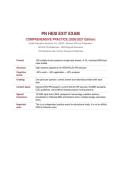
PN HESI EXIT EXAM
COMPREHENSIVE PRACTICE (2026/2027 Edition)
Health Education Systems, Inc. (HESI) • Elsevier PN Exit Preparation
NCLEX-PN Readiness • NGN-Aligned Scenarios
150 Questions with Correct Answers & Rationale
Format: 150 multiple-choice questions (single best answer, A–D), including NGN-style
case studies.
Structure: Eight sections aligned to the HESI/NCLEX-PN test plan.
Cognitive ~30% recall • ~50% application • ~20% analysis.
levels:
Grading: One point per question; correct answer and rationale provided after each
item.
Content basis: Elsevier/HESI PN blueprint, current NCLEX-PN test plan, NCSBN standards,
CDC guidelines, and evidence-based practical nursing practice.
Special 10 NGN-style items (DKA, postpartum hemorrhage, pediatric asthma,
inclusions: prioritization); 5 Maslow/ABC prioritization items; multiple dosage-calculation
items.
Important This is an independent practice exam for educational study; it is not an official
note: HESI or Elsevier exam.
, Section 1: Management of Care – Safety, Delegation, Legal/Ethical, Case
Management (20 questions)
Q1: A practical nurse (PN) is caring for four clients. Which client should the PN assess first?
A. A client with an obstructed airway and cyanosis [CORRECT]
B. A client requesting a meal tray
C. A client ready for discharge
D. A client needing a bath
Correct Answer: A
Rationale: A is correct: airway obstruction is the highest priority (ABCs). B, C, and D are lower priority.
Q2: Which task is appropriate to delegate to assistive personnel (AP)?
A. Administering IV push medication
B. Measuring a stable client's routine vital signs [CORRECT]
C. Performing the initial assessment
D. Providing discharge teaching
Correct Answer: B
Rationale: A is correct: routine vital signs are within the AP's scope. B, C, and D require the nurse's
assessment or medication administration.
Q3: Which task should the PN NOT delegate to unlicensed assistive personnel (UAP)?
A. Assisting a client to the bathroom
B. Measuring and recording intake/output
C. Assessing a client's lung sounds [CORRECT]
D. Changing bed linens
Correct Answer: C
Rationale: A is correct: assessment (auscultation) requires nursing judgment and cannot be delegated. B, C,
and D are routine UAP tasks.
Q4: A PN discovers a medication error was made. What is the first action?
A. Document the error and do nothing else
B. Hide the error
C. Administer the correct dose without telling anyone
D. Assess the client for adverse effects and notify the provider [CORRECT]
Correct Answer: D
Rationale: A is correct: after a medication error, assess for harm and notify the provider. B, C, and D are
unsafe and unethical.
Q5: A client who is confused and attempting to remove an IV line is placed in a wrist restraint.
Which is the most important PN action?
A. Assess the restraint, neurovascular status, and skin, and document regularly [CORRECT]
B. Keep the restraint on continuously for 24 hours
C. Never release the restraint
D. Tie it tightly
Correct Answer: A
Rationale: A is correct: restraints require frequent assessment, release, documentation, and provider orders.
B, C, and D are unsafe.
PN HESI Exit Exam – Comprehensive Practice (2026/2027) Page 2
, Q6: Which action demonstrates adherence to standard precautions?
A. Wearing gloves for all contact regardless of risk
B. Performing hand hygiene and wearing gloves when contact with blood/body fluids is
likely [CORRECT]
C. Reusing gloves between clients
D. Skipping hand hygiene
Correct Answer: B
Rationale: A is correct: standard precautions include hand hygiene and gloves when exposure is likely. B
overuses gloves; C and D spread infection.
Q7: A client with an airborne infection (e.g., tuberculosis) requires which precaution?
A. Droplet precautions only
B. Contact precautions only
C. Negative-pressure isolation room and an N95 respirator [CORRECT]
D. No isolation
Correct Answer: C
Rationale: A is correct: airborne infections require negative-pressure rooms and N95. B and C are for other
transmission; D is incorrect.
Q8: Which client is at highest risk for falls?
A. A young adult with a sprained ankle
B. A client with stable vital signs
C. A fully oriented independent client
D. An older adult with impaired mobility, confusion, and a fall history [CORRECT]
Correct Answer: D
Rationale: A is correct: age, impaired mobility, confusion, and fall history increase fall risk. B, C, and D are
lower risk.
Q9: Which action is appropriate to prevent falls in an at-risk client?
A. Keep the bed low, brakes locked, and the call light within reach [CORRECT]
B. Keep the bed in the highest position
C. Leave the client unsupervised
D. Raise all side rails inconsistently
Correct Answer: A
Rationale: A is correct: low bed, locked brakes, and call light access reduce fall risk. B, C, and D increase
risk.
Q10: A PN observes another staff member being verbally abusive to a client. The PN should:
A. Ignore it
B. Report the incident through proper channels [CORRECT]
C. Handle it informally with no record
D. Wait for the client to complain
Correct Answer: B
Rationale: A is correct: suspected abuse must be reported through proper channels. B, C, and D are
improper.
PN HESI Exit Exam – Comprehensive Practice (2026/2027) Page 3
COMPREHENSIVE PRACTICE (2026/2027 Edition)
Health Education Systems, Inc. (HESI) • Elsevier PN Exit Preparation
NCLEX-PN Readiness • NGN-Aligned Scenarios
150 Questions with Correct Answers & Rationale
Format: 150 multiple-choice questions (single best answer, A–D), including NGN-style
case studies.
Structure: Eight sections aligned to the HESI/NCLEX-PN test plan.
Cognitive ~30% recall • ~50% application • ~20% analysis.
levels:
Grading: One point per question; correct answer and rationale provided after each
item.
Content basis: Elsevier/HESI PN blueprint, current NCLEX-PN test plan, NCSBN standards,
CDC guidelines, and evidence-based practical nursing practice.
Special 10 NGN-style items (DKA, postpartum hemorrhage, pediatric asthma,
inclusions: prioritization); 5 Maslow/ABC prioritization items; multiple dosage-calculation
items.
Important This is an independent practice exam for educational study; it is not an official
note: HESI or Elsevier exam.
, Section 1: Management of Care – Safety, Delegation, Legal/Ethical, Case
Management (20 questions)
Q1: A practical nurse (PN) is caring for four clients. Which client should the PN assess first?
A. A client with an obstructed airway and cyanosis [CORRECT]
B. A client requesting a meal tray
C. A client ready for discharge
D. A client needing a bath
Correct Answer: A
Rationale: A is correct: airway obstruction is the highest priority (ABCs). B, C, and D are lower priority.
Q2: Which task is appropriate to delegate to assistive personnel (AP)?
A. Administering IV push medication
B. Measuring a stable client's routine vital signs [CORRECT]
C. Performing the initial assessment
D. Providing discharge teaching
Correct Answer: B
Rationale: A is correct: routine vital signs are within the AP's scope. B, C, and D require the nurse's
assessment or medication administration.
Q3: Which task should the PN NOT delegate to unlicensed assistive personnel (UAP)?
A. Assisting a client to the bathroom
B. Measuring and recording intake/output
C. Assessing a client's lung sounds [CORRECT]
D. Changing bed linens
Correct Answer: C
Rationale: A is correct: assessment (auscultation) requires nursing judgment and cannot be delegated. B, C,
and D are routine UAP tasks.
Q4: A PN discovers a medication error was made. What is the first action?
A. Document the error and do nothing else
B. Hide the error
C. Administer the correct dose without telling anyone
D. Assess the client for adverse effects and notify the provider [CORRECT]
Correct Answer: D
Rationale: A is correct: after a medication error, assess for harm and notify the provider. B, C, and D are
unsafe and unethical.
Q5: A client who is confused and attempting to remove an IV line is placed in a wrist restraint.
Which is the most important PN action?
A. Assess the restraint, neurovascular status, and skin, and document regularly [CORRECT]
B. Keep the restraint on continuously for 24 hours
C. Never release the restraint
D. Tie it tightly
Correct Answer: A
Rationale: A is correct: restraints require frequent assessment, release, documentation, and provider orders.
B, C, and D are unsafe.
PN HESI Exit Exam – Comprehensive Practice (2026/2027) Page 2
, Q6: Which action demonstrates adherence to standard precautions?
A. Wearing gloves for all contact regardless of risk
B. Performing hand hygiene and wearing gloves when contact with blood/body fluids is
likely [CORRECT]
C. Reusing gloves between clients
D. Skipping hand hygiene
Correct Answer: B
Rationale: A is correct: standard precautions include hand hygiene and gloves when exposure is likely. B
overuses gloves; C and D spread infection.
Q7: A client with an airborne infection (e.g., tuberculosis) requires which precaution?
A. Droplet precautions only
B. Contact precautions only
C. Negative-pressure isolation room and an N95 respirator [CORRECT]
D. No isolation
Correct Answer: C
Rationale: A is correct: airborne infections require negative-pressure rooms and N95. B and C are for other
transmission; D is incorrect.
Q8: Which client is at highest risk for falls?
A. A young adult with a sprained ankle
B. A client with stable vital signs
C. A fully oriented independent client
D. An older adult with impaired mobility, confusion, and a fall history [CORRECT]
Correct Answer: D
Rationale: A is correct: age, impaired mobility, confusion, and fall history increase fall risk. B, C, and D are
lower risk.
Q9: Which action is appropriate to prevent falls in an at-risk client?
A. Keep the bed low, brakes locked, and the call light within reach [CORRECT]
B. Keep the bed in the highest position
C. Leave the client unsupervised
D. Raise all side rails inconsistently
Correct Answer: A
Rationale: A is correct: low bed, locked brakes, and call light access reduce fall risk. B, C, and D increase
risk.
Q10: A PN observes another staff member being verbally abusive to a client. The PN should:
A. Ignore it
B. Report the incident through proper channels [CORRECT]
C. Handle it informally with no record
D. Wait for the client to complain
Correct Answer: B
Rationale: A is correct: suspected abuse must be reported through proper channels. B, C, and D are
improper.
PN HESI Exit Exam – Comprehensive Practice (2026/2027) Page 3


