

MNM2614 – Product and price management
Chapter 1
Marketing = a combination of management tasks and decisions aimed at meeting opportunities and
threats in a dynamic environment in such a way that its market offerings lead to the satisfaction of
consumer needs and wants so that the objectives of the enterprise, the consumer and society are
achieved.
Marketing concept = the marketing concept involves the organisation or integration of the firm’s
resources with the aim of satisfying consumer needs profitably, while not harming society at large.
The task of satisfying consumer needs involves:
• managing the process of identifying and creating a product
• choosing a price for the product that consumers will be willing to pay and that also offers an attractive
profit for the firm
finding ways of delivering the product to consumers (place)
• communicating and promoting the product to consumers.
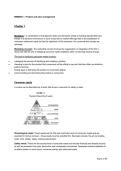
Consumer needs
A motive can be described as a factor that drives a consumer to satisfy a need.
Physiological needs. These needs are the first and most basic level of consumer needs and are
essential for human survival – these needs must be satisfied first. Examples include, the air we breathe,
water, food, shelter, sleep, clothing reproduction.
Safety needs. These are the second level of consumer needs and include financial and lifestyle security
as well as protection from pain, discomfort and unexpected occurrences. Examples include installation of
an alarm system in one's home, insurance policies and retirement plans.
Page 1 of 63
, Love and belonging. These needs are sometimes referred to as social needs and are satisfied after
physiological and safety needs. Social needs address a consumer's desire to be accepted and loved by
people or groups of individuals that are important to them. Marketers appeal the most to these needs. For
example, the purchase of clothing, holiday packages and cosmetics all suggest that buying these
products can bring about love or acceptance in a social setting.
Esteem. This need addresses the need for achievement, self-respect and self-accomplishment. These
needs are shown through recognition of one's accomplishments, prestige (status) and fame. For example,
purchasing a BMW and buying expensive jewellery.
Self-actualisation. This need addresses individuals’ need to realise their full potential and find fulfilment
in these newly learned capabilities. This could be through education, obtaining a doctoral degree or
learning how to speak a foreign language. Other examples include sports and hobbies, such as learning
how to paint.
The value proposition
Value can be defined as the usefulness or benefit that a person gets from a product. In the marketing
context, value always refers to the perception of a product from the point of view of the consumer or
customer
‘Customer value’ can be defined as the sum of the ‘product value’, associated ‘services value’,
‘personnel value’ and ‘image value’.
Ultimately, the value delivered to the customer is the net of the total customer value gained minus the
total cost paid or outlaid by the customer – this net value is also referred to as the ‘customer value
proposition’.
DEFINING A PRODUCT
Product = a bundle of physical, service and symbolic characteristics designed to deliver value to
customers to satisfy their wants and needs.
Tangible versus intangible products
Tangibility refers to the physical characteristics of a product that can be touched. For example, a packet
of Lays chips, a Cadbury Top Deck, a BMW.
Intangible, this is something that cannot be touched. For example, services, such as a flight on SAA or a
train ride on the Rovos Rail.
Page 2 of 63
Chapter 1
Marketing = a combination of management tasks and decisions aimed at meeting opportunities and
threats in a dynamic environment in such a way that its market offerings lead to the satisfaction of
consumer needs and wants so that the objectives of the enterprise, the consumer and society are
achieved.
Marketing concept = the marketing concept involves the organisation or integration of the firm’s
resources with the aim of satisfying consumer needs profitably, while not harming society at large.
The task of satisfying consumer needs involves:
• managing the process of identifying and creating a product
• choosing a price for the product that consumers will be willing to pay and that also offers an attractive
profit for the firm
finding ways of delivering the product to consumers (place)
• communicating and promoting the product to consumers.
Consumer needs
A motive can be described as a factor that drives a consumer to satisfy a need.
Physiological needs. These needs are the first and most basic level of consumer needs and are
essential for human survival – these needs must be satisfied first. Examples include, the air we breathe,
water, food, shelter, sleep, clothing reproduction.
Safety needs. These are the second level of consumer needs and include financial and lifestyle security
as well as protection from pain, discomfort and unexpected occurrences. Examples include installation of
an alarm system in one's home, insurance policies and retirement plans.
Page 1 of 63
, Love and belonging. These needs are sometimes referred to as social needs and are satisfied after
physiological and safety needs. Social needs address a consumer's desire to be accepted and loved by
people or groups of individuals that are important to them. Marketers appeal the most to these needs. For
example, the purchase of clothing, holiday packages and cosmetics all suggest that buying these
products can bring about love or acceptance in a social setting.
Esteem. This need addresses the need for achievement, self-respect and self-accomplishment. These
needs are shown through recognition of one's accomplishments, prestige (status) and fame. For example,
purchasing a BMW and buying expensive jewellery.
Self-actualisation. This need addresses individuals’ need to realise their full potential and find fulfilment
in these newly learned capabilities. This could be through education, obtaining a doctoral degree or
learning how to speak a foreign language. Other examples include sports and hobbies, such as learning
how to paint.
The value proposition
Value can be defined as the usefulness or benefit that a person gets from a product. In the marketing
context, value always refers to the perception of a product from the point of view of the consumer or
customer
‘Customer value’ can be defined as the sum of the ‘product value’, associated ‘services value’,
‘personnel value’ and ‘image value’.
Ultimately, the value delivered to the customer is the net of the total customer value gained minus the
total cost paid or outlaid by the customer – this net value is also referred to as the ‘customer value
proposition’.
DEFINING A PRODUCT
Product = a bundle of physical, service and symbolic characteristics designed to deliver value to
customers to satisfy their wants and needs.
Tangible versus intangible products
Tangibility refers to the physical characteristics of a product that can be touched. For example, a packet
of Lays chips, a Cadbury Top Deck, a BMW.
Intangible, this is something that cannot be touched. For example, services, such as a flight on SAA or a
train ride on the Rovos Rail.
Page 2 of 63


