

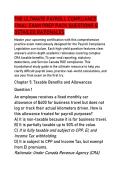
THE ULTIMATE PAYROLL COMPLIANCE
FINAL EXAM PREP PACK QUESTIONS &
DETAILED RATIONALES
Master your upcoming certification with this comprehensive
practice exam meticulously designed for the Payroll Compliance
Legislation curriculum. Each high-yield question features clear
answers and in-depth academic rationales covering complex
CRA taxable benefits, T4 year-end reporting, statutory
deductions, and Service Canada ROE compliance. This
foundational study guide is the ultimate resource to help you
clarify difficult payroll laws, practice real-world calculations, and
ace your final exam on the first try.
Chapter 5: Taxable Benefits and Allowances
Question 1
An employee receives a fixed monthly car
allowance of $400 for business travel but does not
log or track their actual kilometers driven. How is
this allowance treated for payroll purposes?
A) It is non-taxable because it is for business travel.
B) It is partially taxable up to 50% of the value.
C) It is fully taxable and subject to CPP, EI, and
Income Tax withholding.
D) It is subject to CPP and Income Tax, but exempt
from EI premiums.
Rationale: Under Canada Revenue Agency (CRA)
,guidelines, flat-rate or fixed allowances that are not
calculated based on a reasonable per-kilometer
rate are automatically considered a taxable benefit.
Because it is cash remuneration, it is fully subject
to all statutory deductions (CPP, EI, and Income
Tax).
Question 2
An employer pays a per-kilometer automobile
allowance of $0.62 per kilometer to an employee
who drove 800 business kilometers in a single
month. The CRA prescribed reasonable rate is $0.68
per kilometer. How much of this reimbursement is a
taxable benefit?
A) $0
B) $48
C) $496
D) $544
Rationale: When an employer pays a per-kilometer
allowance that is equal to or less than the CRA's
prescribed maximum reasonable rate, the entire
amount is viewed as a non-taxable reimbursement.
The difference between the paid rate and the
maximum rate is not tracked or taxed.
Question 3
,Which of the following employer-paid group
insurance premiums represents a taxable benefit to
the employee for federal income tax purposes?
A) Group Accidental Death and Dismemberment
(AD&D) premiums
B) Group Term Life Insurance premiums
C) Private Health Services Plan (PHSP) dental
coverage premiums
D) Critical Illness Insurance premiums where the
employer is the beneficiary
Rationale: Employer-paid premiums for Group Term
Life Insurance and Dependent Life Insurance are
always considered taxable benefits to the employee.
They must be subjected to CPP and Income Tax
withholding (though they are exempt from EI).
Question 4
When an employer provides an employee with a
company-owned automobile for the entire calendar
year and permits personal driving, what are the two
components used to calculate the total taxable
benefit?
A) Standby charge and operating expense benefit
C) Capital cost allowance and maintenance benefit
C) Lease value charge and depreciation benefit
, D) Fixed mileage allowance and personal fuel
surcharge
Rationale: The personal use of a company vehicle
triggers two distinct taxable benefits under the
Income Tax Act: the standby charge (reflecting the
availability of the vehicle) and the operating
expense benefit (reflecting the cost of personal
driving paid by the employer).
Question 5
An employee uses a company car and drives 24,000
total kilometers during the year, of which 6,000
kilometers are documented as personal use. The
employer pays all operating costs. What baseline
operating cost benefit rate applies if the employee
does not elect to use the alternative 50%
calculation?
A) A flat $500 per year
B) The CRA prescribed flat rate per kilometer of
personal use
C) 50% of the total lease cost of the vehicle
D) 15% of the original purchase cost of the vehicle
Rationale: The standard method for calculating the
operating expense benefit is to multiply the total
number of personal kilometers driven (6,000 km) by
FINAL EXAM PREP PACK QUESTIONS &
DETAILED RATIONALES
Master your upcoming certification with this comprehensive
practice exam meticulously designed for the Payroll Compliance
Legislation curriculum. Each high-yield question features clear
answers and in-depth academic rationales covering complex
CRA taxable benefits, T4 year-end reporting, statutory
deductions, and Service Canada ROE compliance. This
foundational study guide is the ultimate resource to help you
clarify difficult payroll laws, practice real-world calculations, and
ace your final exam on the first try.
Chapter 5: Taxable Benefits and Allowances
Question 1
An employee receives a fixed monthly car
allowance of $400 for business travel but does not
log or track their actual kilometers driven. How is
this allowance treated for payroll purposes?
A) It is non-taxable because it is for business travel.
B) It is partially taxable up to 50% of the value.
C) It is fully taxable and subject to CPP, EI, and
Income Tax withholding.
D) It is subject to CPP and Income Tax, but exempt
from EI premiums.
Rationale: Under Canada Revenue Agency (CRA)
,guidelines, flat-rate or fixed allowances that are not
calculated based on a reasonable per-kilometer
rate are automatically considered a taxable benefit.
Because it is cash remuneration, it is fully subject
to all statutory deductions (CPP, EI, and Income
Tax).
Question 2
An employer pays a per-kilometer automobile
allowance of $0.62 per kilometer to an employee
who drove 800 business kilometers in a single
month. The CRA prescribed reasonable rate is $0.68
per kilometer. How much of this reimbursement is a
taxable benefit?
A) $0
B) $48
C) $496
D) $544
Rationale: When an employer pays a per-kilometer
allowance that is equal to or less than the CRA's
prescribed maximum reasonable rate, the entire
amount is viewed as a non-taxable reimbursement.
The difference between the paid rate and the
maximum rate is not tracked or taxed.
Question 3
,Which of the following employer-paid group
insurance premiums represents a taxable benefit to
the employee for federal income tax purposes?
A) Group Accidental Death and Dismemberment
(AD&D) premiums
B) Group Term Life Insurance premiums
C) Private Health Services Plan (PHSP) dental
coverage premiums
D) Critical Illness Insurance premiums where the
employer is the beneficiary
Rationale: Employer-paid premiums for Group Term
Life Insurance and Dependent Life Insurance are
always considered taxable benefits to the employee.
They must be subjected to CPP and Income Tax
withholding (though they are exempt from EI).
Question 4
When an employer provides an employee with a
company-owned automobile for the entire calendar
year and permits personal driving, what are the two
components used to calculate the total taxable
benefit?
A) Standby charge and operating expense benefit
C) Capital cost allowance and maintenance benefit
C) Lease value charge and depreciation benefit
, D) Fixed mileage allowance and personal fuel
surcharge
Rationale: The personal use of a company vehicle
triggers two distinct taxable benefits under the
Income Tax Act: the standby charge (reflecting the
availability of the vehicle) and the operating
expense benefit (reflecting the cost of personal
driving paid by the employer).
Question 5
An employee uses a company car and drives 24,000
total kilometers during the year, of which 6,000
kilometers are documented as personal use. The
employer pays all operating costs. What baseline
operating cost benefit rate applies if the employee
does not elect to use the alternative 50%
calculation?
A) A flat $500 per year
B) The CRA prescribed flat rate per kilometer of
personal use
C) 50% of the total lease cost of the vehicle
D) 15% of the original purchase cost of the vehicle
Rationale: The standard method for calculating the
operating expense benefit is to multiply the total
number of personal kilometers driven (6,000 km) by


