

Samenvatting Plant physiology H4: Auxins
Introduction:
• Phototropism = Plant moves/bends towards the light
• Coleoptiles = tissues that protect monocot leaves during germination
• When tips removed or shielded → no bending → light signal perceived at the tip BUT
bending occurs at base → some signal
• Signal cannot move through butter or solid → water soluble
• Removing tip & replacing it on one side is sufficient for bending in uniform light
• Signal = Auxin (IAA most common, NAA more stable for in the lab)
o Promote growth
o Root-promoting properties (adventitious & lateral)
o Role in apical dominance → auxin suppresses bud outgrowth
o Different tissues have different sensitivities
o Polar transported from tip to base, not the other way around
o Influence leaf morphology & development
Auxin biosynthesis:
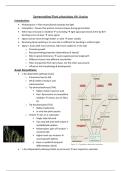
• L-Trp dependent pathway (main)
o 4 branches lead to IAA
o IAA & indole-3-butyric acid
interconverted
o Trp aminotransferase (TAA)
▪ Makes indole-3-pyruvic acid
▪ Has I-Kynurenine as competitive
inhibitor → mimics loss of TAA1
fct
o Trp decarboxylase (TDC)
▪ Makes tryptamine
▪ In only few plant species
o YUCCA → acts on 2 substrates
▪ Single step IAA prod
▪ Two step IAA prod with indole-3-
acetaldehyde oxidase
▪ Mutant gives ‘gain of function’ =
overprod IAA
▪ Higher level yuc mutants →
severe growth defects
▪ there is spatial & temporal
Figure 1: L-Tryptophan dependent pathway
differentiation (GUS)
• L-Trp independent pathway (indole as precursor) → less important, unknown
, Auxin can also be synthesized by bacteria → they can infect a plant → cause overproduction
IAA → crown gal (tumor)
Auxin conjugation & catabolism:
• Nondecarboxylative catabolism & conjugation → (ir)reversible degradation
• IAA ester conjugates → plays an important role in regulating the cellular auxin pool
(degradation, storage, synthesis, translocation)
Auxin Transport:
• Polar, unidirectional (tip → base)
• This regulates apical dominance → release of apical dominance via
decapitation reduces auxin flow → cytokinine awakens lateral
meristems → lateral shoots activate rootward auxin transport again
o Strength apical dominance modulates tree shape
• Auxin is a weak acid
o Apoplast → acidic → IAA protonated &
uncharged
o Cytosol → neutral → IAA- deprotonated &
charged
o Driven by asymmetric distribution of auxin
transporter proteins
o Influx = passive by diffusion
o Efflux = active by transporters (bv PIN = pinnacle-
like SAM)
• PIN protein abundance regulated by
auxin (canalization hypothesis = feedback
system (PIN endosome trafficking) →
regulates export
• Asymmetric PIN distribution induces
polarity of intercellular auxin transport
bcs location responds to direction of
auxin flow
• Reversed fountain model
Introduction:
• Phototropism = Plant moves/bends towards the light
• Coleoptiles = tissues that protect monocot leaves during germination
• When tips removed or shielded → no bending → light signal perceived at the tip BUT
bending occurs at base → some signal
• Signal cannot move through butter or solid → water soluble
• Removing tip & replacing it on one side is sufficient for bending in uniform light
• Signal = Auxin (IAA most common, NAA more stable for in the lab)
o Promote growth
o Root-promoting properties (adventitious & lateral)
o Role in apical dominance → auxin suppresses bud outgrowth
o Different tissues have different sensitivities
o Polar transported from tip to base, not the other way around
o Influence leaf morphology & development
Auxin biosynthesis:
• L-Trp dependent pathway (main)
o 4 branches lead to IAA
o IAA & indole-3-butyric acid
interconverted
o Trp aminotransferase (TAA)
▪ Makes indole-3-pyruvic acid
▪ Has I-Kynurenine as competitive
inhibitor → mimics loss of TAA1
fct
o Trp decarboxylase (TDC)
▪ Makes tryptamine
▪ In only few plant species
o YUCCA → acts on 2 substrates
▪ Single step IAA prod
▪ Two step IAA prod with indole-3-
acetaldehyde oxidase
▪ Mutant gives ‘gain of function’ =
overprod IAA
▪ Higher level yuc mutants →
severe growth defects
▪ there is spatial & temporal
Figure 1: L-Tryptophan dependent pathway
differentiation (GUS)
• L-Trp independent pathway (indole as precursor) → less important, unknown
, Auxin can also be synthesized by bacteria → they can infect a plant → cause overproduction
IAA → crown gal (tumor)
Auxin conjugation & catabolism:
• Nondecarboxylative catabolism & conjugation → (ir)reversible degradation
• IAA ester conjugates → plays an important role in regulating the cellular auxin pool
(degradation, storage, synthesis, translocation)
Auxin Transport:
• Polar, unidirectional (tip → base)
• This regulates apical dominance → release of apical dominance via
decapitation reduces auxin flow → cytokinine awakens lateral
meristems → lateral shoots activate rootward auxin transport again
o Strength apical dominance modulates tree shape
• Auxin is a weak acid
o Apoplast → acidic → IAA protonated &
uncharged
o Cytosol → neutral → IAA- deprotonated &
charged
o Driven by asymmetric distribution of auxin
transporter proteins
o Influx = passive by diffusion
o Efflux = active by transporters (bv PIN = pinnacle-
like SAM)
• PIN protein abundance regulated by
auxin (canalization hypothesis = feedback
system (PIN endosome trafficking) →
regulates export
• Asymmetric PIN distribution induces
polarity of intercellular auxin transport
bcs location responds to direction of
auxin flow
• Reversed fountain model


