

Written by students who passed Immediately available after payment Read online or as PDF Wrong document? Swap it for free 4.6 TrustPilot
logo-home
Document preview thumbnail
Preview 3 out of 22 pages
Exam (elaborations)

NORA Review 2026 | 300+ Exam Questions & Verified Answers | Oil Burners, Hydronic Heating, Boilers, Combustion Analysis, Fuel Systems & HVAC Controls

Document preview thumbnail
Preview 3 out of 22 pages

This comprehensive NORA Review 2026 study guide contains 300+ exam-style questions and verified answers designed to prepare technicians for the National Oilheat Research Alliance (NORA) Certification examination. The resource provides extensive coverage of oil burner operation, combustion fundamentals, fuel oil properties, fuel pumps, oil burner nozzles, combustion air adjustment, draft systems, combustion analysis, electrical fundamentals, burner motors, ignition systems, primary controls, hydronic heating systems, steam boilers, expansion tanks, circulator pumps, zoning systems, boiler controls, preventive maintenance, troubleshooting, and residential heating system performance. The material is presented in a structured question-and-answer format that reinforces technical knowledge, improves diagnostic skills, and supports success on certification examinations. This study guide thoroughly reviews essential oilheat service concepts, including combustion efficiency, burner setup, high static pressure burners, ASTM fuel characteristics, flash point, pour point, viscosity, BTU values, oil storage tanks, sludge formation, bacterial contamination, vacuum testing, one-pipe and two-pipe fuel systems, oil filtration, nozzle sizing, pump pressure adjustments, combustion chambers, chimney draft, draft regulators, smoke testing, combustion efficiency testing, carbon monoxide prevention, CO₂ and O₂ measurements, stack temperature, electrical circuits, voltage, amperage, resistance, Ohm's Law, cad-cell controls, ignition systems, interrupted ignition, thermostats, aquastats, high-limit controls, switching relays, ECM motors, combustion diagnostics, and preventive maintenance procedures. The guide also provides extensive coverage of hydronic heating systems, including boilers, circulator pumps, expansion tanks, corrosion control, glycol systems, balancing valves, mixing valves, pressure-reducing valves, backflow preventers, air separators, air scoops, radiant floor heating, PEX tubing, steam heating systems, zone valves, pressure-relief valves, low-water cutoff controls, outdoor reset controls, boiler commissioning, heat loss calculations, Manual J principles, and residential heating system troubleshooting. The questions emphasize real-world service procedures, system optimization, safe installation practices, and energy-efficient operation of residential oil-fired heating equipment. This resource is ideal for technicians preparing for NORA Certification, HVAC licensing examinations, oilheat apprenticeship programs, HVACR technical education, preventive maintenance competency assessments, and residential heating service careers. It strengthens understanding of combustion performance, hydronic system design, boiler operation, fuel delivery systems, electrical diagnostics, and industry best practices required for servicing modern oil-fired heating systems. Relevant Students: NORA Certification candidates, HVAC students, HVACR students, Oilheat Technician apprentices, Residential Heating Technician students, Boiler Technician trainees, Hydronic Heating students, Furnace Service Technician students, Mechanical Engineering Technology students, Building Maintenance students, Skilled Trades students, Vocational Technical School students, Community College HVAC students, Fuel Oil Service Technicians, Facilities Maintenance professionals, Energy Systems Technology students. APA References: National Oilheat Research Alliance. (2023). NORA Bronze Technician Manual. National Oilheat Research Alliance. National Fire Protection Association. (2024). NFPA 31: Standard for the Installation of Oil-Burning Equipment. National Fire Protection Association. Burkhardt, J. (2022). Residential Oil Burners (4th ed.). Cengage Learning. Keywords NORA Review, NORA Certification, NORA Exam, Oilheat Technician, HVAC, HVACR, Residential Heating, Oil Burner, Fuel Oil, Heating Oil, Combustion, Combustion Analysis, Combustion Air, Fuel Pump, Oil Pump, Oil Burner Nozzle, Burner Motor, ECM Motor, Ignition System, Ignition Transformer, Cad Cell, Primary Control, Interrupted Ignition, Thermostat, Aquastat, High Limit Control, Switching Relay, Electrical Fundamentals, Voltage, Amperage, Resistance, Ohms Law, Fuel Tank, Oil Storage Tank, Fuel Lines, Oil Filter, One Pipe System, Two Pipe System, Vacuum Testing, Oil Deaerator, Draft Regulator, Chimney Draft, Stack Temperature, Smoke Test, Carbon Monoxide, CO₂ Testing, O₂ Testing, Heat Exchanger, Boiler, Hydronic Heating, Steam Boiler, Hot Water Boiler, Expansion Tank, Pressure Reducing Valve, Relief Valve, Air Separator, Air Scoop, Balancing Valve, Mixing Valve, Zone Valve, Circulator Pump, Radiant Heating, PEX Tubing, Low Water Cutoff, Pressuretrol, Backflow Preventer, Boiler Controls, Preventive Maintenance, Boiler Troubleshooting, Heating System Diagnostics, Heat Loss Calculation, ACCA Manual J, HVAC Certification, Practice Questions, Verified Answers

Content preview

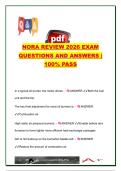
NORA REVIEW 2026 EXAM
QUESTIONS AND ANSWERS |
100% PASS


In a typical oil burner, the motor drives: - ANSWER ✔✔Both the fuel

unit and the fan


The key final adjustment for most oil burners is: - ANSWER

✔✔Combustion air


High static air pressure burners: - ANSWER ✔✔Enable boilers and

furnaces to have tighter more efficient heat exchanger passages


Dirt or lint build-up on the burnerfan blades will: - ANSWER

✔✔Reduce the amount of combustion air

,One gallon of #2 oil contains approximately: - ANSWER ✔✔140,000

BTU's


All petroleum products are chemical compounds of: - ANSWER

✔✔Hydrogen and Carbon


The pour point of #2 oil is: - ANSWER ✔✔The lowest temperature at

which oil will flow


Flash point of a fuel is an indication of: - ANSWER ✔✔The maximum

temperature at which it can be safely stored and handled without serious

fire hazard


The pour point of #2 oil can be reduced by: - ANSWER ✔✔Blending it

with kerosene


As heating oil gets colder its viscosity (thickness): - ANSWER

✔✔Increases


A tank without a vent alarm: - ANSWER ✔✔Should not be filled


Oil lines that contact concrete or dirt should be: - ANSWER

✔✔Coated or sleeved in plastic pipe with no fittings below the floor


What is the most common source of water in oil tanks? - ANSWER

✔✔Condensation

, The home for bacterial growth and sludge in the bottom of the oil tank is:

- ANSWER ✔✔Water


Pumping the old oil from a tank being replaced into the new tank: -

ANSWER ✔✔Must be avoided because it can lead to premature tank

failure


Fuel units perform the following functions: - ANSWER ✔✔Move oil

from the tank to the burner and deliver it at a constant regulated

pressure to the nozzle


The best way to clear a clogged oil line is to: - ANSWER ✔✔Use a

hand pump to suck the blockage out

If the oil level in the tank is 4 feet below and 10 feet away from the fuel

unit and the oil filter is clean the vacuum reading should be

approximately: - ANSWER ✔✔4 to 7 inches


If the operating vacuum is significantly less than the calculated vacuum

you probably have: - ANSWER ✔✔A suction line leak


If the operating vacuum reading is significantly above the calculated

vacuum you probably have: - ANSWER ✔✔A clogged oil filter


COPYRIGHT©PROFFKERRYMARTIN 2025/2026. YEAR PUBLISHED 2026. COMPANY REGISTRATION NUMBER: 619652435. TERMS OF USE.
PRIVACY STATEMENT. ALL RIGHTS RESERVED


Document information

Uploaded on
August 2, 2026
Number of pages
22
Written in
2026/2027
Type
Exam (elaborations)
Contains
Questions & answers
$18.99

Wrong document? Swap it for free Within 14 days of purchase and before downloading, you can choose a different document. You can simply spend the amount again.
Written by students who passed
Immediately available after payment
Read online or as PDF

Seller avatar
Reputation scores are based on the amount of documents a seller has sold for a fee and the reviews they have received for those documents. There are three levels: Bronze, Silver and Gold. The better the reputation, the more your can rely on the quality of the sellers work.
PROFFKERRYMARTIN
3.4
(59)
Sold
301
Followers
10
Items
11356
Last sold
2 days ago


Why students choose Stuvia

Created by fellow students, verified by reviews

Quality you can trust: written by students who passed their exams and reviewed by others who've used these revision notes.

Didn't get what you expected? Choose another document

No problem! You can straightaway pick a different document that better suits what you're after.

Pay as you like, start learning straight away

No subscription, no commitments. Pay the way you're used to via credit card and download your PDF document instantly.

Student with book image

“Bought, downloaded, and smashed it. It really can be that simple.”

Alisha Student

Working on your references?

Create accurate citations in APA, MLA and Harvard with our free citation generator.

Working on your references?

Frequently asked questions
