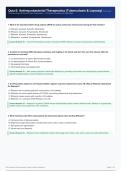
Quiz 6: Antimycobacterial Therapeutics (Tuberculosis & Leprosy) Advanced
Pharmacology NP Board Exam Preparation • 10 Practice Questions & Rationales
1. What is the standard initial 4-drug regimen (RIPE) for active pulmonary Tuberculosis during the first 8 weeks?
A. Rifampin, Isoniazid, Penicillin, Ethambutol
B. Rifampin, Isoniazid, Pyrazinamide, Ethambutol
C. Rifabutin, Isoniazid, Piperacillin, Erythromycin
D. Rifapentine, Isoniazid, Pyrazinamide, Streptomycin
Correct Answer: B — Active TB initial phase consists of 8 weeks of RIPE: Rifampin, Isoniazid, Pyrazinamide, and Ethambutol.
2. A patient on Isoniazid (INH) develops numbness and tingling in his hands and feet. How can this adverse effect be
prevented or reversed?
A. Co-administration of Vitamin B6 (Pyridoxine) daily
B. Co-administration of Vitamin B12 (Cyanocobalamin)
C. Decreasing fluid intake
D. Administering folic acid supplements
Correct Answer: A — INH causes pyridoxine (Vitamin B6) deficiency by promoting its excretion and competing for pyridoxal kinase;
daily B6 supplementation prevents peripheral neuropathy.
3. An HIV-positive patient on a Protease Inhibitor regimen requires treatment for active TB. Why is Rifabutin substituted
for Rifampin?
A. Rifampin has no activity against M. tuberculosis in HIV patients
B. Rifabutin is a much weaker inducer of CYP3A4, minimizing antiretroviral drug interactions
C. Rifampin causes severe optic neuritis in HIV patients
D. Rifabutin is an oral liquid while Rifampin is IV only
Correct Answer: B — Rifampin is a potent CYP3A4 inducer that drastically lowers Protease Inhibitor levels. Rifabutin is a significantly
weaker inducer and is preferred in HIV co-infection.
4. What harmless side effect must patients be forewarned about when starting Rifampin?
A. Permanent loss of taste perception
B. Bright red-orange discoloration of bodily fluids (urine, tears, sweat, contact lenses)
C. Dark green skin pigmentation
D. Severe hair loss (alopecia)
Correct Answer: B — Rifampin and its metabolites impart a red-orange color to tears, urine, saliva, sweat, and soft contact lenses.
NP Advanced Pharmacology Exam Practice Questions Page 1 of 3
Pharmacology NP Board Exam Preparation • 10 Practice Questions & Rationales
1. What is the standard initial 4-drug regimen (RIPE) for active pulmonary Tuberculosis during the first 8 weeks?
A. Rifampin, Isoniazid, Penicillin, Ethambutol
B. Rifampin, Isoniazid, Pyrazinamide, Ethambutol
C. Rifabutin, Isoniazid, Piperacillin, Erythromycin
D. Rifapentine, Isoniazid, Pyrazinamide, Streptomycin
Correct Answer: B — Active TB initial phase consists of 8 weeks of RIPE: Rifampin, Isoniazid, Pyrazinamide, and Ethambutol.
2. A patient on Isoniazid (INH) develops numbness and tingling in his hands and feet. How can this adverse effect be
prevented or reversed?
A. Co-administration of Vitamin B6 (Pyridoxine) daily
B. Co-administration of Vitamin B12 (Cyanocobalamin)
C. Decreasing fluid intake
D. Administering folic acid supplements
Correct Answer: A — INH causes pyridoxine (Vitamin B6) deficiency by promoting its excretion and competing for pyridoxal kinase;
daily B6 supplementation prevents peripheral neuropathy.
3. An HIV-positive patient on a Protease Inhibitor regimen requires treatment for active TB. Why is Rifabutin substituted
for Rifampin?
A. Rifampin has no activity against M. tuberculosis in HIV patients
B. Rifabutin is a much weaker inducer of CYP3A4, minimizing antiretroviral drug interactions
C. Rifampin causes severe optic neuritis in HIV patients
D. Rifabutin is an oral liquid while Rifampin is IV only
Correct Answer: B — Rifampin is a potent CYP3A4 inducer that drastically lowers Protease Inhibitor levels. Rifabutin is a significantly
weaker inducer and is preferred in HIV co-infection.
4. What harmless side effect must patients be forewarned about when starting Rifampin?
A. Permanent loss of taste perception
B. Bright red-orange discoloration of bodily fluids (urine, tears, sweat, contact lenses)
C. Dark green skin pigmentation
D. Severe hair loss (alopecia)
Correct Answer: B — Rifampin and its metabolites impart a red-orange color to tears, urine, saliva, sweat, and soft contact lenses.
NP Advanced Pharmacology Exam Practice Questions Page 1 of 3