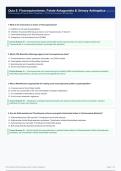
Quiz 5: Fluoroquinolones, Folate Antagonists & Urinary Antiseptics Advanced
Pharmacology NP Board Exam Preparation • 10 Practice Questions & Rationales
1. What is the mechanism of action of Fluoroquinolones?
A. Inhibition of cell wall transpeptidation
B. Inhibition of bacterial DNA Gyrase (Gram-) and Topoisomerase IV (Gram+)
C. Irreversible binding to the 30S ribosomal subunit
D. Antagonism of p-aminobenzoic acid (PABA)
Correct Answer: B — Fluoroquinolones target bacterial DNA Gyrase (topoisomerase II) in Gram-negative bacteria and
Topoisomerase IV in Gram-positive bacteria, preventing DNA replication.
2. Which FDA Black Box Warnings apply to the Fluoroquinolone class?
A. Tendonitis/tendon rupture, peripheral neuropathy, and CNS toxicities
B. Fatal aplastic anemia and Gray Baby Syndrome
C. Nephrotoxicity and irreversible ototoxicity
D. Severe heart failure exacerbation
Correct Answer: A — Fluoroquinolones carry boxed warnings for disabling ADEs: tendinitis/tendon rupture, peripheral neuropathy,
CNS effects (hallucinations, seizures), and worsening Myasthenia Gravis.
3. Why is Moxifloxacin inappropriate for treating acute uncomplicated cystitis or pyelonephritis?
A. It causes severe hemorrhagic cystitis
B. It does not concentrate in the urine (eliminated via hepatic metabolism)
C. It is completely inactivated by urinary acid pH
D. It only covers anaerobic organisms
Correct Answer: B — Moxifloxacin undergoes hepatic elimination and achieves minimal active renal concentration, making it
ineffective for urinary tract infections.
4. How do Sulfonamides and Trimethoprim achieve synergistic bactericidal action in Cotrimoxazole (Bactrim)?
A. Sulfonamides block 30S subunits; Trimethoprim blocks 50S subunits
B. Sulfonamides inhibit dihydropteroate synthetase; Trimethoprim inhibits dihydrofolate reductase
C. Sulfonamides lyse cell walls; Trimethoprim inhibits DNA gyrase
D. Both drugs directly depolarize bacterial cell membranes
Correct Answer: B — Bactrim inhibits two sequential steps in bacterial folate synthesis: Sulfamethoxazole inhibits dihydropteroate
synthetase, and Trimethoprim inhibits dihydrofolate reductase.
NP Advanced Pharmacology Exam Practice Questions Page 1 of 3
Pharmacology NP Board Exam Preparation • 10 Practice Questions & Rationales
1. What is the mechanism of action of Fluoroquinolones?
A. Inhibition of cell wall transpeptidation
B. Inhibition of bacterial DNA Gyrase (Gram-) and Topoisomerase IV (Gram+)
C. Irreversible binding to the 30S ribosomal subunit
D. Antagonism of p-aminobenzoic acid (PABA)
Correct Answer: B — Fluoroquinolones target bacterial DNA Gyrase (topoisomerase II) in Gram-negative bacteria and
Topoisomerase IV in Gram-positive bacteria, preventing DNA replication.
2. Which FDA Black Box Warnings apply to the Fluoroquinolone class?
A. Tendonitis/tendon rupture, peripheral neuropathy, and CNS toxicities
B. Fatal aplastic anemia and Gray Baby Syndrome
C. Nephrotoxicity and irreversible ototoxicity
D. Severe heart failure exacerbation
Correct Answer: A — Fluoroquinolones carry boxed warnings for disabling ADEs: tendinitis/tendon rupture, peripheral neuropathy,
CNS effects (hallucinations, seizures), and worsening Myasthenia Gravis.
3. Why is Moxifloxacin inappropriate for treating acute uncomplicated cystitis or pyelonephritis?
A. It causes severe hemorrhagic cystitis
B. It does not concentrate in the urine (eliminated via hepatic metabolism)
C. It is completely inactivated by urinary acid pH
D. It only covers anaerobic organisms
Correct Answer: B — Moxifloxacin undergoes hepatic elimination and achieves minimal active renal concentration, making it
ineffective for urinary tract infections.
4. How do Sulfonamides and Trimethoprim achieve synergistic bactericidal action in Cotrimoxazole (Bactrim)?
A. Sulfonamides block 30S subunits; Trimethoprim blocks 50S subunits
B. Sulfonamides inhibit dihydropteroate synthetase; Trimethoprim inhibits dihydrofolate reductase
C. Sulfonamides lyse cell walls; Trimethoprim inhibits DNA gyrase
D. Both drugs directly depolarize bacterial cell membranes
Correct Answer: B — Bactrim inhibits two sequential steps in bacterial folate synthesis: Sulfamethoxazole inhibits dihydropteroate
synthetase, and Trimethoprim inhibits dihydrofolate reductase.
NP Advanced Pharmacology Exam Practice Questions Page 1 of 3