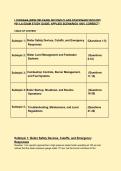
LOUISIANA (NEW ORLEANS) SECOND CLASS STATIONARY BOILERS
661-LA EXAM STUDY GUIDE: APPLIED SCENARIOS 100% CORRECT!
TABLE OF CONTENT
Subtopic 1: Boiler Safety Devices, Cutoffs, and Emergency (Questions 1-5)
Responses
Subtopic 2: Water Level Management and Feedwater (Questions
Systems 6-10)
Subtopic 3: Combustion Controls, Burner Management, (Questions
and Fuel Systems 11-15)
Subtopic 4: Boiler Startup, Shutdown, and Routine (Questions
Operations 16-20)
Subtopic 5: Troubleshooting, Maintenance, and Local (Questions
Regulations 21-30)
Subtopic 1: Boiler Safety Devices, Cutoffs, and Emergency
Responses
Question 1 An operator approaches a high-pressure steam boiler operating at 100 psi and
notices that the steam pressure gauge reads 115 psi, but the burner continues to fire
, aggressively without modulating or shutting down. What is the immediate, primary action the
operator must take?
A. Open the main steam stop valve completely to bleed off the excess pressure into the plant
header.
B. Manually trip the burner emergency fuel shutoff switch and investigate the operating and
high-limit pressure controls.
C. Feed cold water rapidly into the boiler to cool down the internal water volume and lower the
pressure.
D. Open the boiler blowdown valves fully to discharge steam and water until the pressure drops.
Correct Answer: B. Manually trip the burner emergency fuel shutoff switch and investigate the
operating and high-limit pressure controls.
Rationale: When a boiler exceeds its normal operating pressure and the automatic controls fail
to shut off the burner, the immediate priority is to stop the heat input by manually tripping the
fuel supply. Opening main steam lines too quickly during a pressure spike can cause water
hammer, and feeding cold water rapidly can thermally shock the vessel.
Question 2 During routine shift rounds, an operator notices that the water level in the gauge
glass is completely out of sight at the bottom. There is no visible water in the glass, and the
boiler is actively firing. What action is strictly prohibited?
A. Immediately tripping the burner manually to cut off all fuel and heat.
B. Checking the water column blowdown valves to see if the connection lines are plugged.
C. Opening the main blowdown valve wide open to drain the remaining water out of the boiler
vessel.
D. Closing the automatic feedwater valve isolation lines.
Correct Answer: C. Opening the main blowdown valve wide open to drain the remaining water
out of the boiler vessel.
Rationale: When a boiler has a low water condition where the water level drops out of sight,
opening the blowdown valve or adding water can be catastrophic. Introducing cold feedwater
onto overheated, exposed boiler metal can cause severe thermal shock, metal warping, or a
catastrophic explosion. The burner must be shut off immediately, and the boiler allowed to cool
down safely.
Question 3 A low-water fuel cutoff (LWFC) device fails to shut down the burner during a
simulated testing procedure. What must the operator do before placing the boiler back into full
commercial operation?
661-LA EXAM STUDY GUIDE: APPLIED SCENARIOS 100% CORRECT!
TABLE OF CONTENT
Subtopic 1: Boiler Safety Devices, Cutoffs, and Emergency (Questions 1-5)
Responses
Subtopic 2: Water Level Management and Feedwater (Questions
Systems 6-10)
Subtopic 3: Combustion Controls, Burner Management, (Questions
and Fuel Systems 11-15)
Subtopic 4: Boiler Startup, Shutdown, and Routine (Questions
Operations 16-20)
Subtopic 5: Troubleshooting, Maintenance, and Local (Questions
Regulations 21-30)
Subtopic 1: Boiler Safety Devices, Cutoffs, and Emergency
Responses
Question 1 An operator approaches a high-pressure steam boiler operating at 100 psi and
notices that the steam pressure gauge reads 115 psi, but the burner continues to fire
, aggressively without modulating or shutting down. What is the immediate, primary action the
operator must take?
A. Open the main steam stop valve completely to bleed off the excess pressure into the plant
header.
B. Manually trip the burner emergency fuel shutoff switch and investigate the operating and
high-limit pressure controls.
C. Feed cold water rapidly into the boiler to cool down the internal water volume and lower the
pressure.
D. Open the boiler blowdown valves fully to discharge steam and water until the pressure drops.
Correct Answer: B. Manually trip the burner emergency fuel shutoff switch and investigate the
operating and high-limit pressure controls.
Rationale: When a boiler exceeds its normal operating pressure and the automatic controls fail
to shut off the burner, the immediate priority is to stop the heat input by manually tripping the
fuel supply. Opening main steam lines too quickly during a pressure spike can cause water
hammer, and feeding cold water rapidly can thermally shock the vessel.
Question 2 During routine shift rounds, an operator notices that the water level in the gauge
glass is completely out of sight at the bottom. There is no visible water in the glass, and the
boiler is actively firing. What action is strictly prohibited?
A. Immediately tripping the burner manually to cut off all fuel and heat.
B. Checking the water column blowdown valves to see if the connection lines are plugged.
C. Opening the main blowdown valve wide open to drain the remaining water out of the boiler
vessel.
D. Closing the automatic feedwater valve isolation lines.
Correct Answer: C. Opening the main blowdown valve wide open to drain the remaining water
out of the boiler vessel.
Rationale: When a boiler has a low water condition where the water level drops out of sight,
opening the blowdown valve or adding water can be catastrophic. Introducing cold feedwater
onto overheated, exposed boiler metal can cause severe thermal shock, metal warping, or a
catastrophic explosion. The burner must be shut off immediately, and the boiler allowed to cool
down safely.
Question 3 A low-water fuel cutoff (LWFC) device fails to shut down the burner during a
simulated testing procedure. What must the operator do before placing the boiler back into full
commercial operation?