

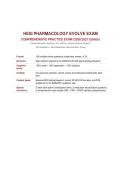
HESI PHARMACOLOGY EVOLVE EXAM
COMPREHENSIVE PRACTICE EXAM (2026/2027 Edition)
Health Education Systems, Inc. (HESI) • Elsevier Evolve Platform
100 Questions • Safe Medication Administration Focus
Format: 100 multiple-choice questions (single best answer, A–D).
Structure: Eight sections aligned to the HESI/NCLEX-RN pharmacology blueprint.
Cognitive ~30% recall • ~50% application • ~20% analysis.
levels:
Grading: One point per question; correct answer and rationale provided after each
item.
Content basis: Elsevier/HESI testing blueprint, current NCLEX-RN test plan, and FDA
guidelines for the 2026/2027 academic year.
Special 5 "best initial action" prioritization items; 3 medication-reconciliation questions;
inclusions: 2 comprehensive case studies (DM + CKD + HFrEF; geriatric polypharmacy).
, Section 1: Cardiovascular & Renal Medications (15 questions)
Q1: The nurse is preparing to administer digoxin 0.125 mg PO to a client with heart failure. The
client's apical heart rate is 54 beats/min. Which action should the nurse take first?
A. Withhold the digoxin and notify the health care provider [CORRECT]
B. Administer the digoxin and recheck the heart rate in 30 minutes
C. Administer the digoxin with a full glass of water
D. Give a half dose and document the apical rate
Correct Answer: A
Rationale: A is correct: digoxin should be withheld for an apical pulse below 60 beats/min, and the provider
notified, because bradycardia is a sign of digoxin toxicity or excessive effect. B, C, and D risk worsening
bradycardia or are inappropriate.
Q2: A client prescribed furosemide 40 mg PO daily is being discharged. Which teaching point is the
priority?
A. Take the medication at bedtime
B. Take the medication in the morning to avoid nocturia [CORRECT]
C. Restrict potassium-rich foods
D. Avoid drinking fluids during the day
Correct Answer: B
Rationale: A is correct: loop diuretics cause diuresis, so taking in the morning reduces nocturia, and the client
should maintain potassium-rich intake. B, C, and D are incorrect because bedtime dosing causes nocturia,
potassium should be replaced, and fluids should not be over-restricted.
Q3: Which laboratory value requires immediate follow-up for a client taking spironolactone?
A. Sodium 140 mEq/L
B. Glucose 100 mg/dL
C. Potassium 5.9 mEq/L [CORRECT]
D. Calcium 9.5 mg/dL
Correct Answer: C
Rationale: A is correct: spironolactone is a potassium-sparing diuretic; hyperkalemia (K >5.5) requires
immediate action. B, C, and D are within normal limits.
Q4: A client is receiving an IV infusion of heparin. Which value best indicates that the heparin is at a
therapeutic level?
A. INR of 2.5
B. Platelet count of 150,000/mm3
C. Prothrombin time within normal range
D. Activated partial thromboplastin time (aPTT) within the target range (typically 1.5-2.5x
control) [CORRECT]
Correct Answer: D
Rationale: A is correct: heparin is monitored by aPTT, titrated to 1.5-2.5 times control. B and D relate to
warfarin/PT-INR; C is not a therapeutic anticoagulation indicator.
Q5: Which medication is the antidote for warfarin toxicity with bleeding?
A. Vitamin K (phytonadione) [CORRECT]
B. Protamine sulfate
C. Naloxone
D. Flumazenil
Correct Answer: A
Rationale: A is correct: vitamin K reverses warfarin by restoring vitamin K-dependent clotting factors. B
reverses heparin; C reverses opioids; D reverses benzodiazepines.
HESI Pharmacology Evolve Exam (2026/2027 Edition) Page 2
, Q6: A client prescribed lisinopril develops a dry, hacking cough. The nurse should recognize this
as:
A. Anaphylaxis requiring epinephrine immediately
B. A common side effect of ACE inhibitors due to increased bradykinin, which may warrant
switching to an ARB [CORRECT]
C. A sign of pulmonary embolism
D. Expected and requires no intervention
Correct Answer: B
Rationale: A is correct: ACE inhibitors cause a nonproductive cough from bradykinin accumulation; switching
to an ARB is common. B overstates (cough is not anaphylaxis); C and D are incorrect.
Q7: A client taking amiodarone for atrial fibrillation. Which assessment finding requires the nurse to
notify the health care provider?
A. Slight photosensitivity of the skin
B. Corneal microdeposits
C. New complaints of shortness of breath and crackles in the lung bases [CORRECT]
D. Bluish-gray skin discoloration
Correct Answer: C
Rationale: A is correct: amiodarone can cause pulmonary toxicity (pneumonitis/fibrosis) presenting with
dyspnea and crackles, a serious adverse effect requiring prompt notification. B, C, and D are known but
generally less emergent side effects.
Q8: Which nursing action is most appropriate when a client receiving IV potassium chloride
complains of burning at the IV site?
A. Decrease the flow rate and continue
B. Flush the line with normal saline
C. Apply a cold compress and continue
D. Stop the infusion, assess the site, and notify the provider; potassium is a vesicant that can
cause tissue damage [CORRECT]
Correct Answer: D
Rationale: A is correct: IV potassium can cause phlebitis/tissue irritation; the infusion should be stopped and
the site assessed before continuing. B, C, and D risk further tissue damage.
Q9: The nurse is teaching a client newly prescribed warfarin. Which statement by the client
indicates understanding?
A. "I will avoid suddenly increasing leafy green vegetables without telling my
provider" [CORRECT]
B. "I can take aspirin for headaches without concern"
C. "I do not need to monitor for bleeding"
D. "I can skip doses if my INR is too low"
Correct Answer: A
Rationale: A is correct: consistent vitamin K intake is important because diet affects INR; patients should
inform the provider before changes. B, C, and D are unsafe (aspirin increases bleeding risk; bleeding must
be monitored; doses should not be skipped).
HESI Pharmacology Evolve Exam (2026/2027 Edition) Page 3
COMPREHENSIVE PRACTICE EXAM (2026/2027 Edition)
Health Education Systems, Inc. (HESI) • Elsevier Evolve Platform
100 Questions • Safe Medication Administration Focus
Format: 100 multiple-choice questions (single best answer, A–D).
Structure: Eight sections aligned to the HESI/NCLEX-RN pharmacology blueprint.
Cognitive ~30% recall • ~50% application • ~20% analysis.
levels:
Grading: One point per question; correct answer and rationale provided after each
item.
Content basis: Elsevier/HESI testing blueprint, current NCLEX-RN test plan, and FDA
guidelines for the 2026/2027 academic year.
Special 5 "best initial action" prioritization items; 3 medication-reconciliation questions;
inclusions: 2 comprehensive case studies (DM + CKD + HFrEF; geriatric polypharmacy).
, Section 1: Cardiovascular & Renal Medications (15 questions)
Q1: The nurse is preparing to administer digoxin 0.125 mg PO to a client with heart failure. The
client's apical heart rate is 54 beats/min. Which action should the nurse take first?
A. Withhold the digoxin and notify the health care provider [CORRECT]
B. Administer the digoxin and recheck the heart rate in 30 minutes
C. Administer the digoxin with a full glass of water
D. Give a half dose and document the apical rate
Correct Answer: A
Rationale: A is correct: digoxin should be withheld for an apical pulse below 60 beats/min, and the provider
notified, because bradycardia is a sign of digoxin toxicity or excessive effect. B, C, and D risk worsening
bradycardia or are inappropriate.
Q2: A client prescribed furosemide 40 mg PO daily is being discharged. Which teaching point is the
priority?
A. Take the medication at bedtime
B. Take the medication in the morning to avoid nocturia [CORRECT]
C. Restrict potassium-rich foods
D. Avoid drinking fluids during the day
Correct Answer: B
Rationale: A is correct: loop diuretics cause diuresis, so taking in the morning reduces nocturia, and the client
should maintain potassium-rich intake. B, C, and D are incorrect because bedtime dosing causes nocturia,
potassium should be replaced, and fluids should not be over-restricted.
Q3: Which laboratory value requires immediate follow-up for a client taking spironolactone?
A. Sodium 140 mEq/L
B. Glucose 100 mg/dL
C. Potassium 5.9 mEq/L [CORRECT]
D. Calcium 9.5 mg/dL
Correct Answer: C
Rationale: A is correct: spironolactone is a potassium-sparing diuretic; hyperkalemia (K >5.5) requires
immediate action. B, C, and D are within normal limits.
Q4: A client is receiving an IV infusion of heparin. Which value best indicates that the heparin is at a
therapeutic level?
A. INR of 2.5
B. Platelet count of 150,000/mm3
C. Prothrombin time within normal range
D. Activated partial thromboplastin time (aPTT) within the target range (typically 1.5-2.5x
control) [CORRECT]
Correct Answer: D
Rationale: A is correct: heparin is monitored by aPTT, titrated to 1.5-2.5 times control. B and D relate to
warfarin/PT-INR; C is not a therapeutic anticoagulation indicator.
Q5: Which medication is the antidote for warfarin toxicity with bleeding?
A. Vitamin K (phytonadione) [CORRECT]
B. Protamine sulfate
C. Naloxone
D. Flumazenil
Correct Answer: A
Rationale: A is correct: vitamin K reverses warfarin by restoring vitamin K-dependent clotting factors. B
reverses heparin; C reverses opioids; D reverses benzodiazepines.
HESI Pharmacology Evolve Exam (2026/2027 Edition) Page 2
, Q6: A client prescribed lisinopril develops a dry, hacking cough. The nurse should recognize this
as:
A. Anaphylaxis requiring epinephrine immediately
B. A common side effect of ACE inhibitors due to increased bradykinin, which may warrant
switching to an ARB [CORRECT]
C. A sign of pulmonary embolism
D. Expected and requires no intervention
Correct Answer: B
Rationale: A is correct: ACE inhibitors cause a nonproductive cough from bradykinin accumulation; switching
to an ARB is common. B overstates (cough is not anaphylaxis); C and D are incorrect.
Q7: A client taking amiodarone for atrial fibrillation. Which assessment finding requires the nurse to
notify the health care provider?
A. Slight photosensitivity of the skin
B. Corneal microdeposits
C. New complaints of shortness of breath and crackles in the lung bases [CORRECT]
D. Bluish-gray skin discoloration
Correct Answer: C
Rationale: A is correct: amiodarone can cause pulmonary toxicity (pneumonitis/fibrosis) presenting with
dyspnea and crackles, a serious adverse effect requiring prompt notification. B, C, and D are known but
generally less emergent side effects.
Q8: Which nursing action is most appropriate when a client receiving IV potassium chloride
complains of burning at the IV site?
A. Decrease the flow rate and continue
B. Flush the line with normal saline
C. Apply a cold compress and continue
D. Stop the infusion, assess the site, and notify the provider; potassium is a vesicant that can
cause tissue damage [CORRECT]
Correct Answer: D
Rationale: A is correct: IV potassium can cause phlebitis/tissue irritation; the infusion should be stopped and
the site assessed before continuing. B, C, and D risk further tissue damage.
Q9: The nurse is teaching a client newly prescribed warfarin. Which statement by the client
indicates understanding?
A. "I will avoid suddenly increasing leafy green vegetables without telling my
provider" [CORRECT]
B. "I can take aspirin for headaches without concern"
C. "I do not need to monitor for bleeding"
D. "I can skip doses if my INR is too low"
Correct Answer: A
Rationale: A is correct: consistent vitamin K intake is important because diet affects INR; patients should
inform the provider before changes. B, C, and D are unsafe (aspirin increases bleeding risk; bleeding must
be monitored; doses should not be skipped).
HESI Pharmacology Evolve Exam (2026/2027 Edition) Page 3


