

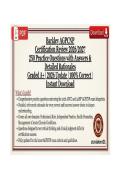
, Barkley AGPCNP Certification Review 2026/2027
250 Practice Questions with Answers & Detailed Rationales
Graded A+ | 2026 Update | 100% Correct | Instant Download
Content Areas Covered:
• Cardiovascular Disorders
• Pulmonary Disorders
• Endocrine & Metabolic Disorders
• Neurological Disorders
• Gastrointestinal Disorders
• Renal & Genitourinary Disorders
• Musculoskeletal Disorders
• Dermatological Disorders
• Psychiatric & Mental Health
• Women's & Men's Health
• Infectious Diseases
• Geriatric Syndromes
• Pharmacology
• Professional Practice & Ethics
SECTION 1: CARDIOVASCULAR DISORDERS (Questions 1–
35)
Question 1
A 72-year-old male with a history of CAD presents with crushing substernal chest pain
radiating to the left arm. Which initial intervention is MOST appropriate?
,A. Administer morphine IV
B. Administer 325 mg aspirin PO
C. Start heparin infusion
D. Obtain cardiac enzymes
Answer: B. Administer 325 mg aspirin PO
Rationale: Aspirin should be administered immediately to inhibit platelet aggregation
and reduce mortality in acute MI. Other interventions (morphine, heparin, enzymes)
follow afterward.
Question 2
A patient with atrial fibrillation has a CHA₂DS₂-VASc score of 3. What is the best
management to reduce stroke risk?
A. No anticoagulation needed
B. Dual antiplatelet therapy
C. Oral anticoagulation (e.g., apixaban)
D. Rate control with beta-blocker
Answer: C. Oral anticoagulation (e.g., apixaban)
Rationale: A CHA₂DS₂-VASc score ≥ 2 in men (≥ 3 in women) warrants oral
anticoagulation to reduce stroke risk. Antiplatelet therapy alone is insufficient.
Question 3
In cardiogenic shock, which hemodynamic profile is expected?
A. High CI, low SVR, high PCWP
B. Low CI, high SVR, high PCWP
C. Low CI, low SVR, low PCWP
D. High CI, high SVR, normal PCWP
Answer: B. Low CI, high SVR, high PCWP
, Rationale: Cardiogenic shock presents with low cardiac index (reduced forward flow),
high afterload (compensatory vasoconstriction/SVR), and pulmonary congestion (high
wedge pressure/PCWP).
Question 4
Which ECG finding is most suggestive of pericarditis?
A. ST elevation in V1-V4
B. Diffuse ST elevation and PR depression
C. ST depression in leads II, III, aVF
D. T-wave inversion only in V5-V6
Answer: B. Diffuse ST elevation and PR depression
Rationale: Pericarditis classically shows diffuse ST elevation and PR depression across
multiple leads (not localized like MI).
Question 5
A patient with decompensated HFrEF is admitted. Which medication improves long-
term mortality?
A. IV furosemide
B. Digoxin
C. Sacubitril/valsartan
D. IV milrinone
Answer: C. Sacubitril/valsartan
Rationale: ARNI (sacubitril/valsartan) improves survival in HFrEF, while diuretics and
inotropes only provide symptomatic relief without mortality benefit.
250 Practice Questions with Answers & Detailed Rationales
Graded A+ | 2026 Update | 100% Correct | Instant Download
Content Areas Covered:
• Cardiovascular Disorders
• Pulmonary Disorders
• Endocrine & Metabolic Disorders
• Neurological Disorders
• Gastrointestinal Disorders
• Renal & Genitourinary Disorders
• Musculoskeletal Disorders
• Dermatological Disorders
• Psychiatric & Mental Health
• Women's & Men's Health
• Infectious Diseases
• Geriatric Syndromes
• Pharmacology
• Professional Practice & Ethics
SECTION 1: CARDIOVASCULAR DISORDERS (Questions 1–
35)
Question 1
A 72-year-old male with a history of CAD presents with crushing substernal chest pain
radiating to the left arm. Which initial intervention is MOST appropriate?
,A. Administer morphine IV
B. Administer 325 mg aspirin PO
C. Start heparin infusion
D. Obtain cardiac enzymes
Answer: B. Administer 325 mg aspirin PO
Rationale: Aspirin should be administered immediately to inhibit platelet aggregation
and reduce mortality in acute MI. Other interventions (morphine, heparin, enzymes)
follow afterward.
Question 2
A patient with atrial fibrillation has a CHA₂DS₂-VASc score of 3. What is the best
management to reduce stroke risk?
A. No anticoagulation needed
B. Dual antiplatelet therapy
C. Oral anticoagulation (e.g., apixaban)
D. Rate control with beta-blocker
Answer: C. Oral anticoagulation (e.g., apixaban)
Rationale: A CHA₂DS₂-VASc score ≥ 2 in men (≥ 3 in women) warrants oral
anticoagulation to reduce stroke risk. Antiplatelet therapy alone is insufficient.
Question 3
In cardiogenic shock, which hemodynamic profile is expected?
A. High CI, low SVR, high PCWP
B. Low CI, high SVR, high PCWP
C. Low CI, low SVR, low PCWP
D. High CI, high SVR, normal PCWP
Answer: B. Low CI, high SVR, high PCWP
, Rationale: Cardiogenic shock presents with low cardiac index (reduced forward flow),
high afterload (compensatory vasoconstriction/SVR), and pulmonary congestion (high
wedge pressure/PCWP).
Question 4
Which ECG finding is most suggestive of pericarditis?
A. ST elevation in V1-V4
B. Diffuse ST elevation and PR depression
C. ST depression in leads II, III, aVF
D. T-wave inversion only in V5-V6
Answer: B. Diffuse ST elevation and PR depression
Rationale: Pericarditis classically shows diffuse ST elevation and PR depression across
multiple leads (not localized like MI).
Question 5
A patient with decompensated HFrEF is admitted. Which medication improves long-
term mortality?
A. IV furosemide
B. Digoxin
C. Sacubitril/valsartan
D. IV milrinone
Answer: C. Sacubitril/valsartan
Rationale: ARNI (sacubitril/valsartan) improves survival in HFrEF, while diuretics and
inotropes only provide symptomatic relief without mortality benefit.


