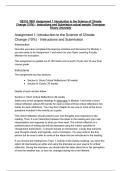
GEOG 3991 Assignment 1 Introduction to the Science of Climate
Change (10%) - Instructions and Submission actual sample Thompson
Rivers University
Assignment 1: Introduction to the Science of Climate
Change (10%) - Instructions and Submission
Introduction
Now that you have completed the learning activities and discussion for Module 1,
you are ready to do Assignment 1 and send it to your Open Learning Faculty
Member for evaluation.
This assignment is graded out of 100 marks and is worth 10 per cent of your final
course grade.
Instructions
The assignment has two sections:
● Section A: Short Critical Reflections (30 marks)
● Section B: Essay (70 marks)
Details of each section follow.
Section A: Short Critical Reflections (30 marks)
Select one of the assigned readings in each topic in Module 1 and write a short
critical reflection (about 250 words) for each (a total of three critical reflections; ten
marks for each reflection). You may find it helpful to use one or more of the focus
questions included in the activity as a guide.
The critical reflection should present your own thoughts and responses to the
reading. Thus, it is an interaction between the ideas in the reading and your own
interpretation and response to what you have read. The critical reflection is a
polished piece of writing that will be assessed using the criteria specified in
“Assignment Instructions”. It should include an introduction, a body that presents
your thoughts clearly and logically, and a conclusion. You may write in the first
person but be sure to refer to some of the ideas that are introduced in the reading.
If you choose the reading from Topic 1, Activity 4 (the Zwicky reading), you have the
option of interviewing an elder and using the interview as your source for critical
reflection. During the interview, you should ask the elder about his or her perception
of how the weather has, or has not, changed during his or her lifetime.
, Section A
Topic 1 Reading Three: Predicting Climate
Can we accurately predict the climate in the future? We have access to snowfall
records for the past 125 years1, yet we cannot predict next years snowfall. Predicting
future climates is based on computer models. These models vary slightly, but are
based on the same baseline data. The most recent models are from 2005 and
include contributions from 23 different groups. This is the datum used for current
projections supported by the IPCC.
How much faith do we have in these models? They are only as good as the data that
is used in them. Can we model future climates based on data that is gathered under
one umbrella, the IPCC? There have been numerous scientific predictions that have
not come to fruition. The following were predictions made after the first Earth Day in
1970. “Population will inevitably and completely outstrip whatever small increases in
food supplies we make,” Paul Ehrlich confidently declared in the April 1970 issue of
Mademoiselle. “The death rate will increase until at least 100-200 million people per
year will be starving to death during the next ten years.”2 Kenneth Watt warned about
a pending Ice Age in a speech. “The world has been chilling sharply for about twenty
years,” he declared. “If present trends continue, the world will be about four degrees
colder for the global mean temperature in 1990, but eleven degrees colder in the
year 2000. This is about twice what it would take to put us into an ice age.” 3 Neither
of these came true, and looking at them now, they seem absurd. Science has come
a long way since 1970, and the information we now share has become vast and
useful. Information that is used in these models may or may not be accurate, and
they certainly will only apply under conditions that are exactly as modelled. What if
plague kills everyone in India or China, or forest fire levels the IPCC, or a sudden
unpredictable continental shift envelopes the UN? This is only to illustrate the
complexity of modelling, it is only useful for planning alternative actions and may
change at any time.
1 (n.d.). Seasonal Snowfall - National Weather Service. Retrieved November 12, 2019, from
https://www.weather.gov/bou/SeasonalSnowfall
2 (2019, April 21). 18 spectacularly wrong predictions made around the time of ...... Retrieved
November 12, 2019, from https://www.aei.org/carpe-diem/18-spectacularly-wrong-predictions-made-
around-the-time-of-first-earth-day-in-1970-expect-more-this-year-3/
3 (2019, April 21). 18 spectacularly wrong predictions made around the time of ...... Retrieved
November 12, 2019, from https://www.aei.org/carpe-diem/18-spectacularly-wrong-predictions-made-
around-the-time-of-first-earth-day-in-1970-expect-more-this-year-3/
Change (10%) - Instructions and Submission actual sample Thompson
Rivers University
Assignment 1: Introduction to the Science of Climate
Change (10%) - Instructions and Submission
Introduction
Now that you have completed the learning activities and discussion for Module 1,
you are ready to do Assignment 1 and send it to your Open Learning Faculty
Member for evaluation.
This assignment is graded out of 100 marks and is worth 10 per cent of your final
course grade.
Instructions
The assignment has two sections:
● Section A: Short Critical Reflections (30 marks)
● Section B: Essay (70 marks)
Details of each section follow.
Section A: Short Critical Reflections (30 marks)
Select one of the assigned readings in each topic in Module 1 and write a short
critical reflection (about 250 words) for each (a total of three critical reflections; ten
marks for each reflection). You may find it helpful to use one or more of the focus
questions included in the activity as a guide.
The critical reflection should present your own thoughts and responses to the
reading. Thus, it is an interaction between the ideas in the reading and your own
interpretation and response to what you have read. The critical reflection is a
polished piece of writing that will be assessed using the criteria specified in
“Assignment Instructions”. It should include an introduction, a body that presents
your thoughts clearly and logically, and a conclusion. You may write in the first
person but be sure to refer to some of the ideas that are introduced in the reading.
If you choose the reading from Topic 1, Activity 4 (the Zwicky reading), you have the
option of interviewing an elder and using the interview as your source for critical
reflection. During the interview, you should ask the elder about his or her perception
of how the weather has, or has not, changed during his or her lifetime.
, Section A
Topic 1 Reading Three: Predicting Climate
Can we accurately predict the climate in the future? We have access to snowfall
records for the past 125 years1, yet we cannot predict next years snowfall. Predicting
future climates is based on computer models. These models vary slightly, but are
based on the same baseline data. The most recent models are from 2005 and
include contributions from 23 different groups. This is the datum used for current
projections supported by the IPCC.
How much faith do we have in these models? They are only as good as the data that
is used in them. Can we model future climates based on data that is gathered under
one umbrella, the IPCC? There have been numerous scientific predictions that have
not come to fruition. The following were predictions made after the first Earth Day in
1970. “Population will inevitably and completely outstrip whatever small increases in
food supplies we make,” Paul Ehrlich confidently declared in the April 1970 issue of
Mademoiselle. “The death rate will increase until at least 100-200 million people per
year will be starving to death during the next ten years.”2 Kenneth Watt warned about
a pending Ice Age in a speech. “The world has been chilling sharply for about twenty
years,” he declared. “If present trends continue, the world will be about four degrees
colder for the global mean temperature in 1990, but eleven degrees colder in the
year 2000. This is about twice what it would take to put us into an ice age.” 3 Neither
of these came true, and looking at them now, they seem absurd. Science has come
a long way since 1970, and the information we now share has become vast and
useful. Information that is used in these models may or may not be accurate, and
they certainly will only apply under conditions that are exactly as modelled. What if
plague kills everyone in India or China, or forest fire levels the IPCC, or a sudden
unpredictable continental shift envelopes the UN? This is only to illustrate the
complexity of modelling, it is only useful for planning alternative actions and may
change at any time.
1 (n.d.). Seasonal Snowfall - National Weather Service. Retrieved November 12, 2019, from
https://www.weather.gov/bou/SeasonalSnowfall
2 (2019, April 21). 18 spectacularly wrong predictions made around the time of ...... Retrieved
November 12, 2019, from https://www.aei.org/carpe-diem/18-spectacularly-wrong-predictions-made-
around-the-time-of-first-earth-day-in-1970-expect-more-this-year-3/
3 (2019, April 21). 18 spectacularly wrong predictions made around the time of ...... Retrieved
November 12, 2019, from https://www.aei.org/carpe-diem/18-spectacularly-wrong-predictions-made-
around-the-time-of-first-earth-day-in-1970-expect-more-this-year-3/