

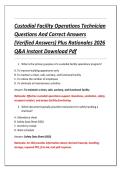
Custodial Facility Operations Technician
Questions And Correct Answers
(Verified Answers) Plus Rationales 2026
Q&A Instant Download Pdf
1. What is the primary purpose of a custodial facility operations program?
A. To improve building appearance only
B. To maintain a clean, safe, sanitary, and functional facility
C. To reduce the number of employees
D. To eliminate all maintenance activities
Answer: To maintain a clean, safe, sanitary, and functional facility
Rationale: Effective custodial operations support cleanliness, sanitation, safety,
occupant comfort, and proper facility functioning.
2. Which document typically provides instructions for safely handling a
chemical?
A. Attendance sheet
B. Safety Data Sheet (SDS)
C. Inventory receipt
D. Work schedule
Answer: Safety Data Sheet (SDS)
Rationale: An SDS provides information about chemical hazards, handling,
storage, required PPE, first aid, and spill response.
, 3. What is the best general practice before using an unfamiliar cleaning
chemical?
A. Mix it with another cleaner
B. Smell it to identify it
C. Read the label and SDS
D. Dilute it with hot water automatically
Answer: Read the label and SDS
Rationale: Product labels and SDS information provide the proper instructions,
hazards, dilution requirements, PPE, and emergency precautions.
4. Why should cleaning chemicals generally not be mixed unless specifically
directed by the manufacturer?
A. They become less expensive
B. They may create hazardous reactions or gases
C. They always lose their color
D. They become easier to store
Answer: They may create hazardous reactions or gases
Rationale: Some chemical combinations can produce toxic gases, heat, pressure,
or other dangerous reactions.
5. Which PPE is commonly used to protect hands when handling cleaning
chemicals?
A. Safety glasses
B. Earplugs
C. Chemical-resistant gloves
D. Dust mask only
Answer: Chemical-resistant gloves
Rationale: Appropriate gloves help prevent skin contact with irritating,
corrosive, or otherwise hazardous chemicals.
, 6. What is the purpose of a wet-floor warning sign?
A. To identify the custodian
B. To prevent slips and falls
C. To indicate the floor is permanently damaged
D. To identify the cleaning chemical used
Answer: To prevent slips and falls
Rationale: Warning signs alert occupants to temporary hazards such as wet or
slippery floors.
7. Which action should be taken before operating powered custodial
equipment?
A. Remove all guards
B. Inspect the equipment for defects
C. Increase the operating speed
D. Disconnect the safety features
Answer: Inspect the equipment for defects
Rationale: Pre-use inspections can identify damaged cords, loose parts,
defective guards, leaks, or other hazards before operation.
8. What is the primary function of a vacuum cleaner?
A. Polish metal
B. Remove dry debris and particulate matter
C. Disinfect plumbing
D. Strip floor finish
Answer: Remove dry debris and particulate matter
Rationale: Vacuum cleaners are designed primarily to collect dust, dirt, and
other dry debris from floors and surfaces.
, 9. Which vacuum attachment is generally useful for cleaning corners and
narrow spaces?
A. Floor brush only
B. Crevice tool
C. Wet mop head
D. Floor squeegee
Answer: Crevice tool
Rationale: A crevice tool is designed to reach narrow gaps, edges, corners, and
other confined areas.
10.What is the purpose of a HEPA filter?
A. To increase water temperature
B. To capture very fine airborne particles
C. To add fragrance to the air
D. To increase floor gloss
Answer: To capture very fine airborne particles
Rationale: HEPA filtration is designed to remove a high percentage of small
airborne particles from an air stream.
11.What should a custodian do when a vacuum's electrical cord is damaged?
A. Wrap it with paper
B. Continue using it carefully
C. Remove it from service and report the defect
D. Place it under a carpet
Answer: Remove it from service and report the defect
Rationale: Damaged electrical cords can cause shocks, burns, fires, or other
injuries and should not be used until properly repaired or replaced.
12.What is the first step in effective floor cleaning?
Questions And Correct Answers
(Verified Answers) Plus Rationales 2026
Q&A Instant Download Pdf
1. What is the primary purpose of a custodial facility operations program?
A. To improve building appearance only
B. To maintain a clean, safe, sanitary, and functional facility
C. To reduce the number of employees
D. To eliminate all maintenance activities
Answer: To maintain a clean, safe, sanitary, and functional facility
Rationale: Effective custodial operations support cleanliness, sanitation, safety,
occupant comfort, and proper facility functioning.
2. Which document typically provides instructions for safely handling a
chemical?
A. Attendance sheet
B. Safety Data Sheet (SDS)
C. Inventory receipt
D. Work schedule
Answer: Safety Data Sheet (SDS)
Rationale: An SDS provides information about chemical hazards, handling,
storage, required PPE, first aid, and spill response.
, 3. What is the best general practice before using an unfamiliar cleaning
chemical?
A. Mix it with another cleaner
B. Smell it to identify it
C. Read the label and SDS
D. Dilute it with hot water automatically
Answer: Read the label and SDS
Rationale: Product labels and SDS information provide the proper instructions,
hazards, dilution requirements, PPE, and emergency precautions.
4. Why should cleaning chemicals generally not be mixed unless specifically
directed by the manufacturer?
A. They become less expensive
B. They may create hazardous reactions or gases
C. They always lose their color
D. They become easier to store
Answer: They may create hazardous reactions or gases
Rationale: Some chemical combinations can produce toxic gases, heat, pressure,
or other dangerous reactions.
5. Which PPE is commonly used to protect hands when handling cleaning
chemicals?
A. Safety glasses
B. Earplugs
C. Chemical-resistant gloves
D. Dust mask only
Answer: Chemical-resistant gloves
Rationale: Appropriate gloves help prevent skin contact with irritating,
corrosive, or otherwise hazardous chemicals.
, 6. What is the purpose of a wet-floor warning sign?
A. To identify the custodian
B. To prevent slips and falls
C. To indicate the floor is permanently damaged
D. To identify the cleaning chemical used
Answer: To prevent slips and falls
Rationale: Warning signs alert occupants to temporary hazards such as wet or
slippery floors.
7. Which action should be taken before operating powered custodial
equipment?
A. Remove all guards
B. Inspect the equipment for defects
C. Increase the operating speed
D. Disconnect the safety features
Answer: Inspect the equipment for defects
Rationale: Pre-use inspections can identify damaged cords, loose parts,
defective guards, leaks, or other hazards before operation.
8. What is the primary function of a vacuum cleaner?
A. Polish metal
B. Remove dry debris and particulate matter
C. Disinfect plumbing
D. Strip floor finish
Answer: Remove dry debris and particulate matter
Rationale: Vacuum cleaners are designed primarily to collect dust, dirt, and
other dry debris from floors and surfaces.
, 9. Which vacuum attachment is generally useful for cleaning corners and
narrow spaces?
A. Floor brush only
B. Crevice tool
C. Wet mop head
D. Floor squeegee
Answer: Crevice tool
Rationale: A crevice tool is designed to reach narrow gaps, edges, corners, and
other confined areas.
10.What is the purpose of a HEPA filter?
A. To increase water temperature
B. To capture very fine airborne particles
C. To add fragrance to the air
D. To increase floor gloss
Answer: To capture very fine airborne particles
Rationale: HEPA filtration is designed to remove a high percentage of small
airborne particles from an air stream.
11.What should a custodian do when a vacuum's electrical cord is damaged?
A. Wrap it with paper
B. Continue using it carefully
C. Remove it from service and report the defect
D. Place it under a carpet
Answer: Remove it from service and report the defect
Rationale: Damaged electrical cords can cause shocks, burns, fires, or other
injuries and should not be used until properly repaired or replaced.
12.What is the first step in effective floor cleaning?


