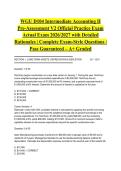
GU D104 Intermediate Accounting II
W
Pre-Assessment V2 Official Practice Exam
Actual Exam 2026/2027 with Detailed
Rationales | Complete Exam-Style Questions |
Pass Guaranteed – A+ Graded
═════════════════════════════════════
═
SECTION 1: LONG-TERM ASSETS, DEPRECIATION & DEPLETION Q1 – Q10
══════════════════════════════════════
Question 1 of 50
echCorp begins construction on a new data center on January 1. During the year, TechCorp
T
incurs weighted-average accumulated expenditures of $2,500,000. TechCorp has an
outstanding construction loan of $1,500,000 at 6% interest, and a general corporate bond of
$1,000,000 at 8% interest. Determine the amount of interest to capitalize for the year.
. $170,000 ✓ CORRECT
A
B. $130,000
C. $120,000
D. $210,000
orrect Answer: A
C
Rationale: Under ASC 835, avoidable interest is calculated by applying the specific borrowing
rate to the specific loan amount and the weighted-average rate of general borrowings to the
excess expenditures. For TechCorp, $1,500,000 at 6% yields $90,000, and the remaining
$1,000,000 at 8% yields $80,000, totaling $170,000. Choice B is incorrect because it fails to
capitalize interest on the excess expenditures beyond the specific construction loan.
Question 2 of 50
pex Manufacturing purchases machinery for $60,000 with a salvage value of $5,000 and a
A
useful life of 5 years. Management decides to use the double-declining balance method for
depreciation. Calculate the depreciation expense recorded in the second year of the asset's life.
. $12,000
A
B. $14,400 ✓ CORRECT
C. $24,000
,D. $15,000
orrect Answer: B
C
Rationale: The double-declining balance rate is 2 divided by 5, or 40%, and it is applied to the
book value at the beginning of the year without subtracting salvage value initially. Year 1
depreciation is $24,000 ($60,000 × 40%), leaving a book value of $36,000, which results in Year
2 depreciation of $14,400 ($36,000 × 40%). Choice A is incorrect because it incorrectly deducts
salvage value before applying the depreciation rate, which violates DDB methodology.
Question 3 of 50
orizon Mining acquires a mineral deposit for $5,000,000 and estimates that 1,000,000 tons of
H
ore can be extracted. During the first year of operations, Horizon extracts 80,000 tons of ore, but
only sells 60,000 tons. Calculate the depletion expense recognized for the year.
. $400,000
A
B. $250,000
C. $300,000 ✓ CORRECT
D. $500,000
orrect Answer: C
C
Rationale: Under GAAP, depletion expense is based on the units extracted during the period,
calculated as the depletion per unit multiplied by the number of units extracted. The depletion
rate is $5 per ton ($5,000,,000,000), resulting in depletion expense of $300,000 (60,000
tons extracted × $5). Choice A is incorrect because it multiplies the rate by the tons sold rather
than the tons extracted, improperly deferring the cost.
Question 4 of 50
vergreen Corp owns a manufacturing plant with a carrying amount of $1,400,000. Due to a
E
permanent decline in demand, the expected future undiscounted cash flows from the plant are
estimated at $1,500,000, while the fair value is $1,200,000. Determine the accounting treatment
for the plant.
. Recognize a $200,000 impairment loss.
A
B. Recognize a $300,000 impairment loss.
C. Recognize a $100,000 impairment loss.
D. Recognize no impairment loss. ✓ CORRECT
orrect Answer: D
C
Rationale: Under ASC 360, a long-lived asset is tested for impairment only when the expected
future undiscounted cash flows are less than the carrying amount of the asset. Because the
undiscounted cash flows of $1,500,000 exceed the carrying amount of $1,400,000, the asset is
not impaired, and no loss is recognized. Choice B is incorrect because it improperly compares
, the carrying amount to the fair value before performing the recoverability test using
undiscounted cash flows.
Question 5 of 50
kyline Logistics acquires a fleet of delivery trucks for a lump-sum payment of $800,000. The
S
fleet includes 10 standard trucks valued at $50,000 each and 5 heavy-duty trucks valued at
$80,000 each. Determine the cost allocated to one heavy-duty truck.
. $64,000 ✓ CORRECT
A
B. $80,000
C. $50,000
D. $72,000
orrect Answer: A
C
Rationale: In a lump-sum purchase, the total cost is allocated to the individual assets based on
their relative fair market values. The total fair value is $900,000 [(10 × $50,000) + (5 ×
$80,000)], so the cost allocated to each heavy-duty truck is $64,000 [($800,000 / $900,000) ×
$80,000]. Choice B is incorrect because it assigns the standalone fair value to the truck rather
than allocating the actual purchase price paid.
Question 6 of 50
mega Industries exchanges old equipment with a book value of $40,000 (cost $70,000,
O
accumulated depreciation $30,000) for new equipment. The fair value of the old equipment is
$45,000, and Omega pays $10,000 in cash. The transaction lacks commercial substance.
Determine the recorded cost of the new equipment.
. $55,000
A
B. $50,000 ✓ CORRECT
C. $45,000
D. $60,000
orrect Answer: B
C
Rationale: For an exchange lacking commercial substance, the new asset is recorded at the
book value of the old asset plus any cash paid, and no gain is recognized. The recorded cost of
the new equipment is $50,000 ($40,000 book value + $10,000 cash paid). Choice A is incorrect
because it recognizes the fair value of the old asset plus cash, which improperly records a gain
on a non-monetary exchange lacking commercial substance.
Question 7 of 50
W
Pre-Assessment V2 Official Practice Exam
Actual Exam 2026/2027 with Detailed
Rationales | Complete Exam-Style Questions |
Pass Guaranteed – A+ Graded
═════════════════════════════════════
═
SECTION 1: LONG-TERM ASSETS, DEPRECIATION & DEPLETION Q1 – Q10
══════════════════════════════════════
Question 1 of 50
echCorp begins construction on a new data center on January 1. During the year, TechCorp
T
incurs weighted-average accumulated expenditures of $2,500,000. TechCorp has an
outstanding construction loan of $1,500,000 at 6% interest, and a general corporate bond of
$1,000,000 at 8% interest. Determine the amount of interest to capitalize for the year.
. $170,000 ✓ CORRECT
A
B. $130,000
C. $120,000
D. $210,000
orrect Answer: A
C
Rationale: Under ASC 835, avoidable interest is calculated by applying the specific borrowing
rate to the specific loan amount and the weighted-average rate of general borrowings to the
excess expenditures. For TechCorp, $1,500,000 at 6% yields $90,000, and the remaining
$1,000,000 at 8% yields $80,000, totaling $170,000. Choice B is incorrect because it fails to
capitalize interest on the excess expenditures beyond the specific construction loan.
Question 2 of 50
pex Manufacturing purchases machinery for $60,000 with a salvage value of $5,000 and a
A
useful life of 5 years. Management decides to use the double-declining balance method for
depreciation. Calculate the depreciation expense recorded in the second year of the asset's life.
. $12,000
A
B. $14,400 ✓ CORRECT
C. $24,000
,D. $15,000
orrect Answer: B
C
Rationale: The double-declining balance rate is 2 divided by 5, or 40%, and it is applied to the
book value at the beginning of the year without subtracting salvage value initially. Year 1
depreciation is $24,000 ($60,000 × 40%), leaving a book value of $36,000, which results in Year
2 depreciation of $14,400 ($36,000 × 40%). Choice A is incorrect because it incorrectly deducts
salvage value before applying the depreciation rate, which violates DDB methodology.
Question 3 of 50
orizon Mining acquires a mineral deposit for $5,000,000 and estimates that 1,000,000 tons of
H
ore can be extracted. During the first year of operations, Horizon extracts 80,000 tons of ore, but
only sells 60,000 tons. Calculate the depletion expense recognized for the year.
. $400,000
A
B. $250,000
C. $300,000 ✓ CORRECT
D. $500,000
orrect Answer: C
C
Rationale: Under GAAP, depletion expense is based on the units extracted during the period,
calculated as the depletion per unit multiplied by the number of units extracted. The depletion
rate is $5 per ton ($5,000,,000,000), resulting in depletion expense of $300,000 (60,000
tons extracted × $5). Choice A is incorrect because it multiplies the rate by the tons sold rather
than the tons extracted, improperly deferring the cost.
Question 4 of 50
vergreen Corp owns a manufacturing plant with a carrying amount of $1,400,000. Due to a
E
permanent decline in demand, the expected future undiscounted cash flows from the plant are
estimated at $1,500,000, while the fair value is $1,200,000. Determine the accounting treatment
for the plant.
. Recognize a $200,000 impairment loss.
A
B. Recognize a $300,000 impairment loss.
C. Recognize a $100,000 impairment loss.
D. Recognize no impairment loss. ✓ CORRECT
orrect Answer: D
C
Rationale: Under ASC 360, a long-lived asset is tested for impairment only when the expected
future undiscounted cash flows are less than the carrying amount of the asset. Because the
undiscounted cash flows of $1,500,000 exceed the carrying amount of $1,400,000, the asset is
not impaired, and no loss is recognized. Choice B is incorrect because it improperly compares
, the carrying amount to the fair value before performing the recoverability test using
undiscounted cash flows.
Question 5 of 50
kyline Logistics acquires a fleet of delivery trucks for a lump-sum payment of $800,000. The
S
fleet includes 10 standard trucks valued at $50,000 each and 5 heavy-duty trucks valued at
$80,000 each. Determine the cost allocated to one heavy-duty truck.
. $64,000 ✓ CORRECT
A
B. $80,000
C. $50,000
D. $72,000
orrect Answer: A
C
Rationale: In a lump-sum purchase, the total cost is allocated to the individual assets based on
their relative fair market values. The total fair value is $900,000 [(10 × $50,000) + (5 ×
$80,000)], so the cost allocated to each heavy-duty truck is $64,000 [($800,000 / $900,000) ×
$80,000]. Choice B is incorrect because it assigns the standalone fair value to the truck rather
than allocating the actual purchase price paid.
Question 6 of 50
mega Industries exchanges old equipment with a book value of $40,000 (cost $70,000,
O
accumulated depreciation $30,000) for new equipment. The fair value of the old equipment is
$45,000, and Omega pays $10,000 in cash. The transaction lacks commercial substance.
Determine the recorded cost of the new equipment.
. $55,000
A
B. $50,000 ✓ CORRECT
C. $45,000
D. $60,000
orrect Answer: B
C
Rationale: For an exchange lacking commercial substance, the new asset is recorded at the
book value of the old asset plus any cash paid, and no gain is recognized. The recorded cost of
the new equipment is $50,000 ($40,000 book value + $10,000 cash paid). Choice A is incorrect
because it recognizes the fair value of the old asset plus cash, which improperly records a gain
on a non-monetary exchange lacking commercial substance.
Question 7 of 50