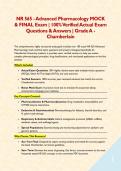
NR 565 - Advanced Pharmacology MOCK
& FINAL Exam | 100% Verified Actual Exam
Questions & Answers | Grade A -
Chamberlain
This comprehensive, highly structured study guide includes over 100 actual NR 565 Advanced
Pharmacology mock and final exam questions and answers. Designed specifically for
Chamberlain University students, it provides exact, verified answers to help you master
complex pharmacological principles, drug classifications, and case-based applications on the first
attempt.
What’s Included:
• Actual Exam Questions: 100+ highly relevant exam-style multiple-choice questions
(MCQs), Select All That Apply (SATA), and case scenarios.
• Verified Answers: 100% accurate, peer-reviewed solutions that match the current
Chamberlain curriculum.
• Bonus Mock Exam: A practice mock test to simulate the actual test-taking
environment and gauge your readiness.
Key Concepts Covered:
• Pharmacokinetics & Pharmacodynamics: Drug metabolism, bioavailability, and
CYP450 enzyme interactions.
• Endocrine & Gastrointestinal: Pharmacotherapy for diabetes, thyroid disorders, and
H. pylori triple therapy.
• Respiratory & Antimicrobials: Asthma management protocols (SABAs, LABAs),
antibiotic classes, and antifungal agents.
• Special Populations: Essential dosing and monitoring adjustments for pediatric and
geriatric patients.
Why Choose This Resource?
• Ace Your Final: Designed by expert nursing students and vetted for accuracy against
the latest Chamberlain curriculum guidelines.
• Save Time: Eliminate the stress of guessing. Get direct, accurate answers to the most
frequently tested NR 565 concepts in one convenient PDF document.
1
, • Boost Confidence: Practice with the exact type of scenario-based questions you will
see on test day to ensure you pass with flying colors.
Secure your copy of the NR 565 MOCK & FINAL Exam guide today to ensure you pass your
advanced pharmacology fundamentals course without the overwhelm!
Q1. Which cluster of findings does the source list as most expected in
hypothyroidism? [Multiple Choice]
A) Tachycardia, insomnia, weight loss, goiter
B) Shortness of breath, wheezing, fatigue
C) Irritability, anxiety, dizziness, increased sweating
D) Dry pale skin, brittle hair, fatigue, myxedema
Answer: Dry pale skin, brittle hair, fatigue, myxedema
Explanation: Hypothyroidism typically causes slowing of metabolic processes, producing dry pale
skin, brittle hair, fatigue, and myxedema (nonpitting edema). The other choices describe
respiratory symptoms, hyperthyroid features (tachycardia, weight loss, insomnia), or
adrenergic/hyperthyroid signs (anxiety, sweating), which are not consistent with hypothyroidism
as described in the text.
Q2. Which class of diabetic medications does the source identify as most likely
to cause hypoglycemia? [Multiple Choice]
A) Dipeptidyl peptidase-4 inhibitors (DPP4i)
B) Thiazolidinediones (TZDs)
C) Biguanides
D) Sulfonylureas
Answer: Sulfonylureas
Explanation: Sulfonylureas stimulate insulin release from pancreatic beta cells and therefore
carry a higher risk of hypoglycemia compared with classes like biguanides (metformin), TZDs, or
DPP-4 inhibitors. Those other classes have lower intrinsic hypoglycemia risk when used alone.
Q3. Which agent does the text list as first-line treatment for hyperthyroidism
(Graves' disease)? [Multiple Choice]
A) Metoprolol
2
, B) Allopurinol
C) Levothyroxine
D) Methimazole
Answer: Methimazole
Explanation: Methimazole is listed as the first-line antithyroid medication for
hyperthyroidism/Graves' disease because it inhibits thyroid hormone synthesis. Metoprolol may
be used adjunctively to control symptoms like tachycardia but is not a primary antithyroid agent;
allopurinol treats gout and is unrelated; levothyroxine is used to treat hypothyroidism, not
hyperthyroidism.
Q4. For a newly diagnosed diabetic patient with adequate renal and hepatic
function, which medication does the material identify as first-line? [Multiple Choice]
A) Liraglutide (Victoza)
B) NovoLog sliding scale insulin
C) Oral Metformin
D) Glipizide
Answer: Oral Metformin
Explanation: Oral metformin is the recommended first-line therapy for most newly diagnosed
type 2 diabetes patients with adequate renal and hepatic function because it improves insulin
sensitivity and reduces hepatic glucose production. The other choices may be indicated in certain
scenarios but are not listed as first-line in the text: insulin regimens, GLP-1 receptor agonists like
liraglutide, and sulfonylureas such as glipizide are alternative or adjunctive options rather than
initial standard first-line therapy here.
Q5. Which drug class should be avoided in patients with increased risk for
urinary tract or genital infections? [Multiple Choice]
A) All of the above
B) Sodium-Glucose Cotransporter 2 (SGLT-2) Inhibitors
C) Thiazolidinediones (Glitazones)
D) Biguanide
Answer: Sodium-Glucose Cotransporter 2 (SGLT-2) Inhibitors
Explanation: SGLT-2 inhibitors increase urinary glucose excretion, which can predispose patients
to urinary tract and genital infections; therefore the class should be avoided in those at increased
3
, risk. Thiazolidinediones and biguanides are not identified in the source as causing these
infections. "All of the above" is incorrect because only SGLT-2 inhibitors are singled out in the text
for this risk.
Q6. Which patient population does the source identify as being at highest risk
for methylxanthine toxicity? [Multiple Choice]
A) Older adults
B) Asians
C) Women of child-bearing age
D) Diabetics
Answer: Older adults
Explanation: Older adults are noted to be at greatest risk for methylxanthine (e.g., theophylline)
toxicity, likely due to age-related changes in drug metabolism and comorbidities. The other
groups (Asians, women of child-bearing age, diabetics) are not identified in the source as the
highest-risk population for this toxicity.
Q7. Which statement about sulfonylureas is supported by the source text?
[Multiple Choice]
A) Sulfonylureas cause a dose-dependent reduction in blood glucose
B) Sulfonylureas are not safe to prescribe to pregnant and/or breast-feeding women
C) Patients should be educated about signs and symptoms of hypoglycemia
D) Sulfonylureas are indicated only for patients diagnosed with type 2 diabetes
Answer: Sulfonylureas are not safe to prescribe to pregnant and/or breast-feeding
women
Explanation: The source lists as incorrect the statement that sulfonylureas are safe in pregnancy
or breastfeeding, which implies they should not be prescribed to pregnant or breast-feeding
women. The other statements are true or presented as appropriate care in the text: patients
should be taught hypoglycemia signs, sulfonylureas reduce glucose in a dose-dependent way,
and they are indicated for type 2 diabetes patients — thus they are not the correct choice for this
question about safety in pregnancy/breastfeeding.
Q8. An 18-year-old reports asthma symptoms 4–5 times per week with once-
weekly nighttime exacerbations. What severity classification does the text give?
[Multiple Choice]
A) Intermittent asthma
4
& FINAL Exam | 100% Verified Actual Exam
Questions & Answers | Grade A -
Chamberlain
This comprehensive, highly structured study guide includes over 100 actual NR 565 Advanced
Pharmacology mock and final exam questions and answers. Designed specifically for
Chamberlain University students, it provides exact, verified answers to help you master
complex pharmacological principles, drug classifications, and case-based applications on the first
attempt.
What’s Included:
• Actual Exam Questions: 100+ highly relevant exam-style multiple-choice questions
(MCQs), Select All That Apply (SATA), and case scenarios.
• Verified Answers: 100% accurate, peer-reviewed solutions that match the current
Chamberlain curriculum.
• Bonus Mock Exam: A practice mock test to simulate the actual test-taking
environment and gauge your readiness.
Key Concepts Covered:
• Pharmacokinetics & Pharmacodynamics: Drug metabolism, bioavailability, and
CYP450 enzyme interactions.
• Endocrine & Gastrointestinal: Pharmacotherapy for diabetes, thyroid disorders, and
H. pylori triple therapy.
• Respiratory & Antimicrobials: Asthma management protocols (SABAs, LABAs),
antibiotic classes, and antifungal agents.
• Special Populations: Essential dosing and monitoring adjustments for pediatric and
geriatric patients.
Why Choose This Resource?
• Ace Your Final: Designed by expert nursing students and vetted for accuracy against
the latest Chamberlain curriculum guidelines.
• Save Time: Eliminate the stress of guessing. Get direct, accurate answers to the most
frequently tested NR 565 concepts in one convenient PDF document.
1
, • Boost Confidence: Practice with the exact type of scenario-based questions you will
see on test day to ensure you pass with flying colors.
Secure your copy of the NR 565 MOCK & FINAL Exam guide today to ensure you pass your
advanced pharmacology fundamentals course without the overwhelm!
Q1. Which cluster of findings does the source list as most expected in
hypothyroidism? [Multiple Choice]
A) Tachycardia, insomnia, weight loss, goiter
B) Shortness of breath, wheezing, fatigue
C) Irritability, anxiety, dizziness, increased sweating
D) Dry pale skin, brittle hair, fatigue, myxedema
Answer: Dry pale skin, brittle hair, fatigue, myxedema
Explanation: Hypothyroidism typically causes slowing of metabolic processes, producing dry pale
skin, brittle hair, fatigue, and myxedema (nonpitting edema). The other choices describe
respiratory symptoms, hyperthyroid features (tachycardia, weight loss, insomnia), or
adrenergic/hyperthyroid signs (anxiety, sweating), which are not consistent with hypothyroidism
as described in the text.
Q2. Which class of diabetic medications does the source identify as most likely
to cause hypoglycemia? [Multiple Choice]
A) Dipeptidyl peptidase-4 inhibitors (DPP4i)
B) Thiazolidinediones (TZDs)
C) Biguanides
D) Sulfonylureas
Answer: Sulfonylureas
Explanation: Sulfonylureas stimulate insulin release from pancreatic beta cells and therefore
carry a higher risk of hypoglycemia compared with classes like biguanides (metformin), TZDs, or
DPP-4 inhibitors. Those other classes have lower intrinsic hypoglycemia risk when used alone.
Q3. Which agent does the text list as first-line treatment for hyperthyroidism
(Graves' disease)? [Multiple Choice]
A) Metoprolol
2
, B) Allopurinol
C) Levothyroxine
D) Methimazole
Answer: Methimazole
Explanation: Methimazole is listed as the first-line antithyroid medication for
hyperthyroidism/Graves' disease because it inhibits thyroid hormone synthesis. Metoprolol may
be used adjunctively to control symptoms like tachycardia but is not a primary antithyroid agent;
allopurinol treats gout and is unrelated; levothyroxine is used to treat hypothyroidism, not
hyperthyroidism.
Q4. For a newly diagnosed diabetic patient with adequate renal and hepatic
function, which medication does the material identify as first-line? [Multiple Choice]
A) Liraglutide (Victoza)
B) NovoLog sliding scale insulin
C) Oral Metformin
D) Glipizide
Answer: Oral Metformin
Explanation: Oral metformin is the recommended first-line therapy for most newly diagnosed
type 2 diabetes patients with adequate renal and hepatic function because it improves insulin
sensitivity and reduces hepatic glucose production. The other choices may be indicated in certain
scenarios but are not listed as first-line in the text: insulin regimens, GLP-1 receptor agonists like
liraglutide, and sulfonylureas such as glipizide are alternative or adjunctive options rather than
initial standard first-line therapy here.
Q5. Which drug class should be avoided in patients with increased risk for
urinary tract or genital infections? [Multiple Choice]
A) All of the above
B) Sodium-Glucose Cotransporter 2 (SGLT-2) Inhibitors
C) Thiazolidinediones (Glitazones)
D) Biguanide
Answer: Sodium-Glucose Cotransporter 2 (SGLT-2) Inhibitors
Explanation: SGLT-2 inhibitors increase urinary glucose excretion, which can predispose patients
to urinary tract and genital infections; therefore the class should be avoided in those at increased
3
, risk. Thiazolidinediones and biguanides are not identified in the source as causing these
infections. "All of the above" is incorrect because only SGLT-2 inhibitors are singled out in the text
for this risk.
Q6. Which patient population does the source identify as being at highest risk
for methylxanthine toxicity? [Multiple Choice]
A) Older adults
B) Asians
C) Women of child-bearing age
D) Diabetics
Answer: Older adults
Explanation: Older adults are noted to be at greatest risk for methylxanthine (e.g., theophylline)
toxicity, likely due to age-related changes in drug metabolism and comorbidities. The other
groups (Asians, women of child-bearing age, diabetics) are not identified in the source as the
highest-risk population for this toxicity.
Q7. Which statement about sulfonylureas is supported by the source text?
[Multiple Choice]
A) Sulfonylureas cause a dose-dependent reduction in blood glucose
B) Sulfonylureas are not safe to prescribe to pregnant and/or breast-feeding women
C) Patients should be educated about signs and symptoms of hypoglycemia
D) Sulfonylureas are indicated only for patients diagnosed with type 2 diabetes
Answer: Sulfonylureas are not safe to prescribe to pregnant and/or breast-feeding
women
Explanation: The source lists as incorrect the statement that sulfonylureas are safe in pregnancy
or breastfeeding, which implies they should not be prescribed to pregnant or breast-feeding
women. The other statements are true or presented as appropriate care in the text: patients
should be taught hypoglycemia signs, sulfonylureas reduce glucose in a dose-dependent way,
and they are indicated for type 2 diabetes patients — thus they are not the correct choice for this
question about safety in pregnancy/breastfeeding.
Q8. An 18-year-old reports asthma symptoms 4–5 times per week with once-
weekly nighttime exacerbations. What severity classification does the text give?
[Multiple Choice]
A) Intermittent asthma
4