
LECTURE NOTES: COMPLEX • A complex number z = a + bi can be
NUMBERS II (GEOMETRY AND treated as a vector from the origin (0, 0)
to the point (a, b).
OPERATIONS)
• Addition/Subtraction: If Z₁ = a + bi and
Z₂ = c + di, then Z₁ ± Z₂ = (a ± c) + (b
± d)i.
1. ARGAND DIAGRAM
(GEOMETRIC REPRESENTATION) • Multiplication: (a + bi)(c + di) = (ac −
bd) + (ad + bc)i, where i² = −1.
• Complex numbers are represented on
a two-dimensional plane called the
Argand Diagram or Complex Plane.
EQUALITY OF COMPLEX NUMBERS
• Horizontal Axis: Real Axis (represents a
If z₁ = a + ib and z₂ = c + id are equal,
in z = a + bi)
then:
- 0 +
• Real Parts: a = c
• Vertical Axis: Imaginary Axis
• Imaginary Parts: b = d
(represents b in z = a + bi)
To solve problems:
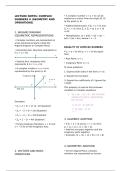
• A complex number z = a + bi is
represented by the point (a, b). 1. Express both sides in the form a + ib.
Imaginary axis a, b 2. Equate the real parts.
z=a+
3. Equate the coefficients of i (ignore the
bi
b i itself).
- 0 +
a This property is used to find unknown
Real axis
variables in complex equations.
1. 3a + i(b − 5) = 9 − 5bi. Find the
values of a and b, respectively.
[JU: 14–15]
Examples:
A. (3, 5) B. (5/6, 3)
• Z₁ = 2 + 3i → (2, 3), 1st Quadrant
C. (3, 5/6) D. (2,
• Z₂ = −2 + 3i → 2nd Quadrant
5.6)
• Z₃ = −2 − 3i → 3rd Quadrant
• Z₄ = 2 − 3i → 4th Quadrant 3. ALGEBRIC ADDITION
• Purely Imaginary Numbers: z = 5i and • If Z₁ = a + ib and Z₂ = c + id, then
z = −5i lie on the Imaginary Axis. Z₁ + Z₂ = (a + c) + i(b + d).
• Add the real parts together and the
imaginary parts together.
• Example: (2 + 3i) + (4 + 5i) = 6 + 8i.
4. GEOMETRIC ADDITION
2. VECTORS AND BASIC • On the Argand Plane, complex
OPERATIONS numbers are represented as vectors.


