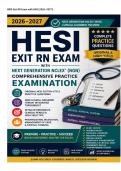
HESI Exit RN Exam with NGN (2026–2027)
,Table of Contents
HESI Exit RN Exam with Next Generation NCLEX (NGN)
Comprehensive Practice Examination (2026–2027)
Section Content
I Foundations of Professional Nursing
II Adult Medical-Surgical Nursing
III Pharmacology & Medication Administration
IV Maternal-Newborn Nursing
V Pediatric Nursing
VI Mental Health & Behavioral Nursing
VII Leadership, Management & Community Health
VIII Emergency, Critical Care & Specialty Nursing
IX NGN Clinical Judgment & Comprehensive Review
Exam Features
200 Original HESI Exit RN–Style Practice Questions
Next Generation NCLEX (NGN) Clinical Judgment Format
Four Multiple-Choice Questions (A–D)
Balanced & Randomized Answer Distribution
Detailed Rationales
Why the Other Options Are Incorrect
Clinical Pearls
, HESI High-Yield Tips
Prioritization & Clinical Decision-Making
Leadership, Delegation & Management of Care
Emergency & Critical Care Nursing
Adult Medical-Surgical Nursing
Pharmacology & Safe Medication Administration
Maternal-Newborn Nursing
Pediatric Nursing
Mental Health & Behavioral Nursing
Community Health Nursing
Comprehensive NGN Clinical Judgment Review
Exam Summary
Category Coverage
Total Questions 200
Exam Style HESI Exit RN + NGN
Difficulty Level Moderate to Advanced
Question Format Multiple Choice (A–D)
Clinical Judgment Integrated Throughout
Rationales Included
Clinical Pearls Included
,Category Coverage
HESI High-Yield Tips Included
Answer Distribution Balanced & Randomized
HESI Exit RN with NGN – Comprehensive Practice Examination
Section I – Foundations of Professional Nursing
Questions 1
1. During morning rounds, a registered nurse receives reports on four clients. Which client should the
nurse assess first?
A. A postoperative client reporting pain rated 7/10 despite receiving analgesics 2 hours ago.
B. A client with heart failure whose oxygen saturation has decreased from 95% to 88% on room air.
C. A client with diabetes requesting breakfast.
D. A client scheduled for discharge who has questions about medications.
Correct Answer: B
Rationale: A sudden drop in oxygen saturation indicates impaired oxygenation, an immediate threat to
life requiring prompt assessment.
Why the Other Options Are Incorrect
• A: Pain requires treatment but is not as immediately life-threatening.
• C: Breakfast can wait briefly.
• D: Discharge teaching is important but not urgent.
Clinical Pearl: Always prioritize airway, breathing, and circulation (ABC).
HESI High-Yield Tip: Unexpected respiratory deterioration takes priority over pain or discharge
needs.
,2. Before administering a medication, the nurse notices the client's identification band is missing. What is
the priority action?
A. Ask another nurse to identify the client.
B. Delay the medication until the client's identity is verified and a new identification band is applied.
C. Ask the client to state their first name only.
D. Compare the client's room number with the medication administration record.
Correct Answer: B
Rationale: Safe medication administration requires positive patient identification using approved
identifiers.
Why the Other Options Are Incorrect
• A: Another nurse cannot verify identity without approved methods.
• C: One identifier is insufficient.
• D: Room numbers are never acceptable identifiers.
Clinical Pearl: Two approved identifiers are required before medication administration.
HESI High-Yield Tip: Never administer medications without proper patient identification.
3. A client refuses a scheduled dose of an antihypertensive medication. Which action best demonstrates
respect for patient autonomy?
A. Explain the medication, assess the reason for refusal, and document the decision.
B. Notify security because the client is refusing treatment.
C. Administer the medication after explaining its importance.
D. Ask the family to persuade the client.
Correct Answer: A
Rationale: Competent adults have the right to refuse treatment after receiving appropriate information.
Why the Other Options Are Incorrect
• B: Refusal is not a security issue.
, • C: Administering medication against the client's wishes is inappropriate.
• D: Family input cannot override the client's decision.
Clinical Pearl: Respect for autonomy includes informed refusal.
HESI High-Yield Tip: Assess, educate, document, and notify the provider when appropriate.
4. Which intervention best demonstrates evidence-based nursing practice?
A. Performing a procedure because it has always been done that way.
B. Combining current research, clinical expertise, and patient preferences to guide care.
C. Following only physician preferences.
D. Using information from coworkers without reviewing current evidence.
Correct Answer: B
Rationale: Evidence-based practice integrates research evidence, clinical expertise, and patient values.
Why the Other Options Are Incorrect
• A: Tradition alone is not evidence.
• C: Decisions should be collaborative.
• D: Anecdotal experience alone is insufficient.
Clinical Pearl: Evidence-based practice improves patient outcomes and safety.
HESI High-Yield Tip: Research + expertise + patient preferences = evidence-based care.
5. While documenting an assessment, the nurse realizes an incorrect entry has been made in the
electronic health record. What is the most appropriate action?
A. Delete the original entry completely.
B. Follow agency policy to correct the error while maintaining the original documentation.
C. Leave the error uncorrected.
D. Ask another nurse to document the correction.
,Correct Answer: B
Rationale: Documentation errors should be corrected according to organizational policy while preserving
the integrity of the record.
Why the Other Options Are Incorrect
• A: Original entries should remain traceable.
• C: Errors should be corrected promptly.
• D: The person making the error should correct it.
Clinical Pearl: Accurate documentation is a legal responsibility.
HESI High-Yield Tip: Never falsify or erase medical records.
6. A nurse delegates ambulation of a stable postoperative client to an assistive personnel (AP). Which
responsibility remains with the RN?
A. Determining whether the client is appropriate for ambulation.
B. Recording the client's distance walked.
C. Assisting the client with footwear.
D. Returning the client to bed.
Correct Answer: A
Rationale: The RN retains responsibility for assessment and determining whether delegation is
appropriate.
Why the Other Options Are Incorrect
• B: AP can document assigned tasks according to policy.
• C: AP may assist safely.
• D: AP can help return the client to bed.
Clinical Pearl: Assessment, teaching, and evaluation cannot be delegated.
HESI High-Yield Tip: Delegate tasks—not nursing judgment.
,7. A newly licensed nurse is caring for four clients. Which assignment should the charge nurse question?
A. Stable client requiring routine oral medications.
B. Client receiving discharge instructions after uncomplicated surgery.
C. Client with newly diagnosed diabetic ketoacidosis requiring frequent reassessment.
D. Stable client requiring assistance with hygiene.
Correct Answer: C
Rationale: Clients requiring frequent assessment and clinical judgment should be assigned to experienced
nurses.
Why the Other Options Are Incorrect
• A: Appropriate for a new graduate.
• B: Suitable with support.
• D: Stable care is appropriate.
Clinical Pearl: Complex, unstable patients require experienced clinical judgment.
HESI High-Yield Tip: Unstable patients should not be assigned to the least experienced nurse.
8. Which statement by the nurse best reflects therapeutic communication?
A. "Everything will be okay."
B. "Tell me more about what concerns you most today."
C. "You shouldn't worry."
D. "If I were you, I'd choose surgery."
Correct Answer: B
Rationale: Open-ended questions encourage clients to express concerns and promote effective
communication.
Why the Other Options Are Incorrect
• A: Offers false reassurance.
, • C: Minimizes feelings.
• D: Gives personal advice.
Clinical Pearl: Therapeutic communication focuses on the patient's perspective.
HESI High-Yield Tip: Open-ended questions foster assessment and trust.
9. A nurse enters a client's room and notices smoke coming from an electrical outlet. Which action should
occur first?
A. Activate the fire alarm.
B. Remove the client from immediate danger.
C. Extinguish the fire.
D. Close all hallway doors.
Correct Answer: B
Rationale: The first priority in the RACE sequence is Rescue anyone in immediate danger.
Why the Other Options Are Incorrect
• A: Alarm follows rescue.
• C: Extinguish only if safe after rescue.
• D: Containment occurs later.
Clinical Pearl: Remember RACE: Rescue, Alarm, Contain, Extinguish/Evacuate.
HESI High-Yield Tip: Patient safety comes before fire suppression.
10. Which action best protects client confidentiality?
A. Discussing client information only with healthcare team members involved in care.
B. Sharing information with visitors who ask politely.
C. Leaving the electronic health record open during lunch.
D. Discussing patient conditions in the elevator.
, Correct Answer: A
Rationale: Protected health information should only be shared with authorized individuals involved in
the client's care.
Why the Other Options Are Incorrect
• B: Visitors require patient permission.
• C: Records must be secured.
• D: Public discussions violate confidentiality.
Clinical Pearl: Protect verbal, written, and electronic patient information.
HESI High-Yield Tip: HIPAA violations commonly involve casual conversations and unsecured
records.
11. A registered nurse is preparing assignments for the upcoming shift. Which task is most
appropriate to delegate to an experienced unlicensed assistive personnel (UAP)?
A. Assess a client admitted with chest pain.
B. Reinforce discharge instructions for a client with heart failure.
C. Obtain and document routine vital signs for a stable postoperative client.
D. Evaluate the effectiveness of a newly administered analgesic.
Correct Answer: C
Rationale: Obtaining routine vital signs for a stable client is within the scope of practice of an experienced
UAP. The RN remains responsible for interpreting the findings and determining whether additional
intervention is needed.*
Why the Other Options Are Incorrect
• A: Initial assessments must be completed by the RN.
• B: Client teaching is the responsibility of the RN.
• D: Evaluation of interventions cannot be delegated.
Clinical Pearl: Delegate stable, routine, predictable tasks to UAPs.
,Table of Contents
HESI Exit RN Exam with Next Generation NCLEX (NGN)
Comprehensive Practice Examination (2026–2027)
Section Content
I Foundations of Professional Nursing
II Adult Medical-Surgical Nursing
III Pharmacology & Medication Administration
IV Maternal-Newborn Nursing
V Pediatric Nursing
VI Mental Health & Behavioral Nursing
VII Leadership, Management & Community Health
VIII Emergency, Critical Care & Specialty Nursing
IX NGN Clinical Judgment & Comprehensive Review
Exam Features
200 Original HESI Exit RN–Style Practice Questions
Next Generation NCLEX (NGN) Clinical Judgment Format
Four Multiple-Choice Questions (A–D)
Balanced & Randomized Answer Distribution
Detailed Rationales
Why the Other Options Are Incorrect
Clinical Pearls
, HESI High-Yield Tips
Prioritization & Clinical Decision-Making
Leadership, Delegation & Management of Care
Emergency & Critical Care Nursing
Adult Medical-Surgical Nursing
Pharmacology & Safe Medication Administration
Maternal-Newborn Nursing
Pediatric Nursing
Mental Health & Behavioral Nursing
Community Health Nursing
Comprehensive NGN Clinical Judgment Review
Exam Summary
Category Coverage
Total Questions 200
Exam Style HESI Exit RN + NGN
Difficulty Level Moderate to Advanced
Question Format Multiple Choice (A–D)
Clinical Judgment Integrated Throughout
Rationales Included
Clinical Pearls Included
,Category Coverage
HESI High-Yield Tips Included
Answer Distribution Balanced & Randomized
HESI Exit RN with NGN – Comprehensive Practice Examination
Section I – Foundations of Professional Nursing
Questions 1
1. During morning rounds, a registered nurse receives reports on four clients. Which client should the
nurse assess first?
A. A postoperative client reporting pain rated 7/10 despite receiving analgesics 2 hours ago.
B. A client with heart failure whose oxygen saturation has decreased from 95% to 88% on room air.
C. A client with diabetes requesting breakfast.
D. A client scheduled for discharge who has questions about medications.
Correct Answer: B
Rationale: A sudden drop in oxygen saturation indicates impaired oxygenation, an immediate threat to
life requiring prompt assessment.
Why the Other Options Are Incorrect
• A: Pain requires treatment but is not as immediately life-threatening.
• C: Breakfast can wait briefly.
• D: Discharge teaching is important but not urgent.
Clinical Pearl: Always prioritize airway, breathing, and circulation (ABC).
HESI High-Yield Tip: Unexpected respiratory deterioration takes priority over pain or discharge
needs.
,2. Before administering a medication, the nurse notices the client's identification band is missing. What is
the priority action?
A. Ask another nurse to identify the client.
B. Delay the medication until the client's identity is verified and a new identification band is applied.
C. Ask the client to state their first name only.
D. Compare the client's room number with the medication administration record.
Correct Answer: B
Rationale: Safe medication administration requires positive patient identification using approved
identifiers.
Why the Other Options Are Incorrect
• A: Another nurse cannot verify identity without approved methods.
• C: One identifier is insufficient.
• D: Room numbers are never acceptable identifiers.
Clinical Pearl: Two approved identifiers are required before medication administration.
HESI High-Yield Tip: Never administer medications without proper patient identification.
3. A client refuses a scheduled dose of an antihypertensive medication. Which action best demonstrates
respect for patient autonomy?
A. Explain the medication, assess the reason for refusal, and document the decision.
B. Notify security because the client is refusing treatment.
C. Administer the medication after explaining its importance.
D. Ask the family to persuade the client.
Correct Answer: A
Rationale: Competent adults have the right to refuse treatment after receiving appropriate information.
Why the Other Options Are Incorrect
• B: Refusal is not a security issue.
, • C: Administering medication against the client's wishes is inappropriate.
• D: Family input cannot override the client's decision.
Clinical Pearl: Respect for autonomy includes informed refusal.
HESI High-Yield Tip: Assess, educate, document, and notify the provider when appropriate.
4. Which intervention best demonstrates evidence-based nursing practice?
A. Performing a procedure because it has always been done that way.
B. Combining current research, clinical expertise, and patient preferences to guide care.
C. Following only physician preferences.
D. Using information from coworkers without reviewing current evidence.
Correct Answer: B
Rationale: Evidence-based practice integrates research evidence, clinical expertise, and patient values.
Why the Other Options Are Incorrect
• A: Tradition alone is not evidence.
• C: Decisions should be collaborative.
• D: Anecdotal experience alone is insufficient.
Clinical Pearl: Evidence-based practice improves patient outcomes and safety.
HESI High-Yield Tip: Research + expertise + patient preferences = evidence-based care.
5. While documenting an assessment, the nurse realizes an incorrect entry has been made in the
electronic health record. What is the most appropriate action?
A. Delete the original entry completely.
B. Follow agency policy to correct the error while maintaining the original documentation.
C. Leave the error uncorrected.
D. Ask another nurse to document the correction.
,Correct Answer: B
Rationale: Documentation errors should be corrected according to organizational policy while preserving
the integrity of the record.
Why the Other Options Are Incorrect
• A: Original entries should remain traceable.
• C: Errors should be corrected promptly.
• D: The person making the error should correct it.
Clinical Pearl: Accurate documentation is a legal responsibility.
HESI High-Yield Tip: Never falsify or erase medical records.
6. A nurse delegates ambulation of a stable postoperative client to an assistive personnel (AP). Which
responsibility remains with the RN?
A. Determining whether the client is appropriate for ambulation.
B. Recording the client's distance walked.
C. Assisting the client with footwear.
D. Returning the client to bed.
Correct Answer: A
Rationale: The RN retains responsibility for assessment and determining whether delegation is
appropriate.
Why the Other Options Are Incorrect
• B: AP can document assigned tasks according to policy.
• C: AP may assist safely.
• D: AP can help return the client to bed.
Clinical Pearl: Assessment, teaching, and evaluation cannot be delegated.
HESI High-Yield Tip: Delegate tasks—not nursing judgment.
,7. A newly licensed nurse is caring for four clients. Which assignment should the charge nurse question?
A. Stable client requiring routine oral medications.
B. Client receiving discharge instructions after uncomplicated surgery.
C. Client with newly diagnosed diabetic ketoacidosis requiring frequent reassessment.
D. Stable client requiring assistance with hygiene.
Correct Answer: C
Rationale: Clients requiring frequent assessment and clinical judgment should be assigned to experienced
nurses.
Why the Other Options Are Incorrect
• A: Appropriate for a new graduate.
• B: Suitable with support.
• D: Stable care is appropriate.
Clinical Pearl: Complex, unstable patients require experienced clinical judgment.
HESI High-Yield Tip: Unstable patients should not be assigned to the least experienced nurse.
8. Which statement by the nurse best reflects therapeutic communication?
A. "Everything will be okay."
B. "Tell me more about what concerns you most today."
C. "You shouldn't worry."
D. "If I were you, I'd choose surgery."
Correct Answer: B
Rationale: Open-ended questions encourage clients to express concerns and promote effective
communication.
Why the Other Options Are Incorrect
• A: Offers false reassurance.
, • C: Minimizes feelings.
• D: Gives personal advice.
Clinical Pearl: Therapeutic communication focuses on the patient's perspective.
HESI High-Yield Tip: Open-ended questions foster assessment and trust.
9. A nurse enters a client's room and notices smoke coming from an electrical outlet. Which action should
occur first?
A. Activate the fire alarm.
B. Remove the client from immediate danger.
C. Extinguish the fire.
D. Close all hallway doors.
Correct Answer: B
Rationale: The first priority in the RACE sequence is Rescue anyone in immediate danger.
Why the Other Options Are Incorrect
• A: Alarm follows rescue.
• C: Extinguish only if safe after rescue.
• D: Containment occurs later.
Clinical Pearl: Remember RACE: Rescue, Alarm, Contain, Extinguish/Evacuate.
HESI High-Yield Tip: Patient safety comes before fire suppression.
10. Which action best protects client confidentiality?
A. Discussing client information only with healthcare team members involved in care.
B. Sharing information with visitors who ask politely.
C. Leaving the electronic health record open during lunch.
D. Discussing patient conditions in the elevator.
, Correct Answer: A
Rationale: Protected health information should only be shared with authorized individuals involved in
the client's care.
Why the Other Options Are Incorrect
• B: Visitors require patient permission.
• C: Records must be secured.
• D: Public discussions violate confidentiality.
Clinical Pearl: Protect verbal, written, and electronic patient information.
HESI High-Yield Tip: HIPAA violations commonly involve casual conversations and unsecured
records.
11. A registered nurse is preparing assignments for the upcoming shift. Which task is most
appropriate to delegate to an experienced unlicensed assistive personnel (UAP)?
A. Assess a client admitted with chest pain.
B. Reinforce discharge instructions for a client with heart failure.
C. Obtain and document routine vital signs for a stable postoperative client.
D. Evaluate the effectiveness of a newly administered analgesic.
Correct Answer: C
Rationale: Obtaining routine vital signs for a stable client is within the scope of practice of an experienced
UAP. The RN remains responsible for interpreting the findings and determining whether additional
intervention is needed.*
Why the Other Options Are Incorrect
• A: Initial assessments must be completed by the RN.
• B: Client teaching is the responsibility of the RN.
• D: Evaluation of interventions cannot be delegated.
Clinical Pearl: Delegate stable, routine, predictable tasks to UAPs.