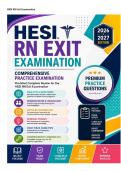
HESI RN Exit Examination
,HESI RN Exit Examination
Comprehensive Practice Examination (2026–2027)
Table of Contents
Section Content
Section I Foundations of Professional Nursing
Section II Adult Medical-Surgical Nursing
Section III Pharmacology & Medication Administration
Section IV Maternal-Newborn Nursing
Section V Pediatric Nursing
Section VI Mental Health Nursing
Section VII Leadership, Management & Community Health
Section VIII Emergency & Critical Care Nursing
Section IX NGN Clinical Judgment & Comprehensive Exit Review
Examination Features
• 200 Premium NCLEX® & HESI-Style Questions
• Four Multiple-Choice Options (A–D)
• Comprehensive Answer Key
• Detailed Rationales
• Why the Other Options Are Incorrect
• Clinical Pearls
• HESI High-Yield Tips
, • NGN Clinical Judgment Scenarios
• Prioritization & Delegation Questions
• Emergency & Critical Care Concepts
• Pharmacology & Medication Safety
• Leadership & Community Health Review
• Comprehensive Exit Exam Preparation
Total Questions: 200
Designed for:
• HESI RN Exit Examination
• HESI Comprehensive Review
• NCLEX-RN® Preparation
• RN Program Final Exit Testing
• Nursing School Comprehensive Exams
Section I – Foundations of Professional Nursing
1. A newly licensed RN asks which principle best defines professional nursing practice. Which response
by the preceptor is most accurate?
A. Completing assigned tasks as quickly as possible
B. Following physician prescriptions without question
C. Providing evidence-based, patient-centered care while maintaining professional accountability
D. Prioritizing organizational policies over patient needs
, Correct Answer: C. Providing evidence-based, patient-centered care while maintaining
professional accountability
Rationale: Professional nursing integrates evidence-based practice, clinical judgment, ethics,
accountability, and patient-centered care.
Why the other options are incorrect:
• A: Speed should never replace safe practice.
• B: Nurses independently evaluate the appropriateness of care.
• D: Patient safety and ethical practice remain priorities.
Clinical Pearl: Professional accountability extends to every clinical decision.
HESI High-Yield Tip: Evidence-based, patient-centered care defines professional nursing.
2. A nurse identifies a discrepancy between a medication prescription and the patient's documented
allergy. What should the nurse do first?
A. Administer the medication as prescribed.
B. Clarify the prescription before administering the medication.
C. Ask another nurse to administer it.
D. Document the allergy after giving the medication.
Correct Answer: B. Clarify the prescription before administering the medication
Rationale: Nurses must question potentially unsafe prescriptions before administration.
Why the other options are incorrect:
• A: May place the patient at risk.
• C: Responsibility cannot be delegated.
• D: Documentation does not prevent harm.
Clinical Pearl: Patient safety always supersedes routine workflow.
, HESI High-Yield Tip: Question any order that appears unsafe.
3. Which action best demonstrates patient advocacy?
A. Following every request from the healthcare provider without question
B. Remaining silent when a patient expresses concerns
C. Encouraging the family to make all healthcare decisions
D. Speaking up when the patient's safety or wishes are at risk
Correct Answer: D. Speaking up when the patient's safety or wishes are at risk
Rationale: Advocacy involves protecting patient rights and ensuring safe, ethical care.
Why the other options are incorrect:
• A: Nurses must exercise independent judgment.
• B: Patient concerns require attention.
• C: Competent patients retain decision-making authority.
Clinical Pearl: Advocacy is a core professional responsibility.
HESI High-Yield Tip: Advocate whenever safety or patient autonomy is threatened.
4. During interdisciplinary rounds, which communication technique promotes the safest patient care?
A. Using the SBAR communication framework
B. Giving only verbal updates
C. Reporting information from memory
D. Discussing only abnormal findings
Correct Answer: A. Using the SBAR communication framework
Rationale: SBAR standardizes communication and reduces errors.
,Why the other options are incorrect:
• B: Important details may be omitted.
• C: Memory alone is unreliable.
• D: Comprehensive communication is essential.
Clinical Pearl: Standardized communication improves patient outcomes.
HESI High-Yield Tip: SBAR = Situation, Background, Assessment, Recommendation.
5. A nurse is caring for four patients. Which patient should be assessed first?
A. A patient requesting a blanket
B. A patient scheduled for discharge
C. A patient reporting sudden chest pain and shortness of breath
D. A patient waiting for breakfast
Correct Answer: C. A patient reporting sudden chest pain and shortness of breath
Rationale: Possible myocardial ischemia requires immediate assessment.
Why the other options are incorrect:
• A: Comfort measure.
• B: Stable patient.
• D: Lower priority.
Clinical Pearl: Prioritize airway, breathing, circulation, and acute changes.
HESI High-Yield Tip: New chest pain is always high priority.
6. Which nursing action best reflects accountability?
A. Documenting care before it is completed
,B. Ignoring a minor medication error
C. Delegating assessments to an assistant
D. Reporting and documenting a medication error promptly
Correct Answer: D. Reporting and documenting a medication error promptly
Rationale: Accountability includes honestly reporting errors to improve patient safety.
Why the other options are incorrect:
• A: Falsifying documentation is unethical.
• B: Errors must be reported.
• C: Assessment is the RN's responsibility.
Clinical Pearl: Reporting errors supports quality improvement.
HESI High-Yield Tip: Accountability means owning both actions and outcomes.
7. Which patient situation best illustrates informed consent?
A. A competent patient voluntarily signs consent after understanding the procedure, risks,
benefits, and alternatives.
B. A family member signs because it is more convenient.
C. The patient signs after receiving sedation.
D. The nurse explains only the benefits.
Correct Answer: A. A competent patient voluntarily signs consent after understanding the
procedure, risks, benefits, and alternatives.
Rationale: Valid informed consent requires understanding, competence, and voluntariness.
Why the other options are incorrect:
• B: Family cannot routinely consent for competent adults.
• C: Sedation may impair decision-making.
, • D: Risks and alternatives must also be explained.
Clinical Pearl: Providers obtain informed consent; nurses verify understanding and witness signatures
when appropriate.
HESI High-Yield Tip: Consent must be informed and voluntary.
8. Which behavior best demonstrates therapeutic communication?
A. Changing the subject when the patient cries
B. Giving personal opinions
C. Offering false reassurance
D. Using active listening and open-ended questions
Correct Answer: D. Using active listening and open-ended questions
Rationale: Therapeutic communication encourages expression and builds trust.
Why the other options are incorrect:
• A: Dismisses emotions.
• B: Focus shifts away from the patient.
• C: False reassurance minimizes concerns.
Clinical Pearl: Silence is often a therapeutic communication tool.
HESI High-Yield Tip: Open-ended questions encourage meaningful dialogue.
9. Which action is appropriate when delegating care to an experienced UAP?
A. Performing the initial nursing assessment
B. Assisting a stable patient with bathing and hygiene
C. Teaching discharge medications
, D. Evaluating pain management effectiveness
Correct Answer: B. Assisting a stable patient with bathing and hygiene
Rationale: Routine, non-assessment tasks may be delegated to UAPs.
Why the other options are incorrect:
• A: RN responsibility.
• C: Teaching cannot be delegated.
• D: Evaluation requires nursing judgment.
Clinical Pearl: Delegate tasks—not responsibility.
HESI High-Yield Tip: Stable patients and predictable tasks are appropriate for delegation.
10. Which nursing action best supports evidence-based practice?
A. Continuing outdated procedures because they are familiar
B. Relying only on personal experience
C. Integrating current research, clinical expertise, and patient preferences
D. Ignoring new clinical guidelines
Correct Answer: C. Integrating current research, clinical expertise, and patient preferences
Rationale: Evidence-based practice combines research evidence, clinical expertise, and patient values.
Why the other options are incorrect:
• A: May compromise care.
• B: Evidence extends beyond experience.
• D: Current guidelines improve care quality.
Clinical Pearl: Lifelong learning is essential for professional nurses.
HESI High-Yield Tip: EBP = Best evidence + Clinical expertise + Patient preferences.
,HESI RN Exit Examination
Comprehensive Practice Examination (2026–2027)
Table of Contents
Section Content
Section I Foundations of Professional Nursing
Section II Adult Medical-Surgical Nursing
Section III Pharmacology & Medication Administration
Section IV Maternal-Newborn Nursing
Section V Pediatric Nursing
Section VI Mental Health Nursing
Section VII Leadership, Management & Community Health
Section VIII Emergency & Critical Care Nursing
Section IX NGN Clinical Judgment & Comprehensive Exit Review
Examination Features
• 200 Premium NCLEX® & HESI-Style Questions
• Four Multiple-Choice Options (A–D)
• Comprehensive Answer Key
• Detailed Rationales
• Why the Other Options Are Incorrect
• Clinical Pearls
• HESI High-Yield Tips
, • NGN Clinical Judgment Scenarios
• Prioritization & Delegation Questions
• Emergency & Critical Care Concepts
• Pharmacology & Medication Safety
• Leadership & Community Health Review
• Comprehensive Exit Exam Preparation
Total Questions: 200
Designed for:
• HESI RN Exit Examination
• HESI Comprehensive Review
• NCLEX-RN® Preparation
• RN Program Final Exit Testing
• Nursing School Comprehensive Exams
Section I – Foundations of Professional Nursing
1. A newly licensed RN asks which principle best defines professional nursing practice. Which response
by the preceptor is most accurate?
A. Completing assigned tasks as quickly as possible
B. Following physician prescriptions without question
C. Providing evidence-based, patient-centered care while maintaining professional accountability
D. Prioritizing organizational policies over patient needs
, Correct Answer: C. Providing evidence-based, patient-centered care while maintaining
professional accountability
Rationale: Professional nursing integrates evidence-based practice, clinical judgment, ethics,
accountability, and patient-centered care.
Why the other options are incorrect:
• A: Speed should never replace safe practice.
• B: Nurses independently evaluate the appropriateness of care.
• D: Patient safety and ethical practice remain priorities.
Clinical Pearl: Professional accountability extends to every clinical decision.
HESI High-Yield Tip: Evidence-based, patient-centered care defines professional nursing.
2. A nurse identifies a discrepancy between a medication prescription and the patient's documented
allergy. What should the nurse do first?
A. Administer the medication as prescribed.
B. Clarify the prescription before administering the medication.
C. Ask another nurse to administer it.
D. Document the allergy after giving the medication.
Correct Answer: B. Clarify the prescription before administering the medication
Rationale: Nurses must question potentially unsafe prescriptions before administration.
Why the other options are incorrect:
• A: May place the patient at risk.
• C: Responsibility cannot be delegated.
• D: Documentation does not prevent harm.
Clinical Pearl: Patient safety always supersedes routine workflow.
, HESI High-Yield Tip: Question any order that appears unsafe.
3. Which action best demonstrates patient advocacy?
A. Following every request from the healthcare provider without question
B. Remaining silent when a patient expresses concerns
C. Encouraging the family to make all healthcare decisions
D. Speaking up when the patient's safety or wishes are at risk
Correct Answer: D. Speaking up when the patient's safety or wishes are at risk
Rationale: Advocacy involves protecting patient rights and ensuring safe, ethical care.
Why the other options are incorrect:
• A: Nurses must exercise independent judgment.
• B: Patient concerns require attention.
• C: Competent patients retain decision-making authority.
Clinical Pearl: Advocacy is a core professional responsibility.
HESI High-Yield Tip: Advocate whenever safety or patient autonomy is threatened.
4. During interdisciplinary rounds, which communication technique promotes the safest patient care?
A. Using the SBAR communication framework
B. Giving only verbal updates
C. Reporting information from memory
D. Discussing only abnormal findings
Correct Answer: A. Using the SBAR communication framework
Rationale: SBAR standardizes communication and reduces errors.
,Why the other options are incorrect:
• B: Important details may be omitted.
• C: Memory alone is unreliable.
• D: Comprehensive communication is essential.
Clinical Pearl: Standardized communication improves patient outcomes.
HESI High-Yield Tip: SBAR = Situation, Background, Assessment, Recommendation.
5. A nurse is caring for four patients. Which patient should be assessed first?
A. A patient requesting a blanket
B. A patient scheduled for discharge
C. A patient reporting sudden chest pain and shortness of breath
D. A patient waiting for breakfast
Correct Answer: C. A patient reporting sudden chest pain and shortness of breath
Rationale: Possible myocardial ischemia requires immediate assessment.
Why the other options are incorrect:
• A: Comfort measure.
• B: Stable patient.
• D: Lower priority.
Clinical Pearl: Prioritize airway, breathing, circulation, and acute changes.
HESI High-Yield Tip: New chest pain is always high priority.
6. Which nursing action best reflects accountability?
A. Documenting care before it is completed
,B. Ignoring a minor medication error
C. Delegating assessments to an assistant
D. Reporting and documenting a medication error promptly
Correct Answer: D. Reporting and documenting a medication error promptly
Rationale: Accountability includes honestly reporting errors to improve patient safety.
Why the other options are incorrect:
• A: Falsifying documentation is unethical.
• B: Errors must be reported.
• C: Assessment is the RN's responsibility.
Clinical Pearl: Reporting errors supports quality improvement.
HESI High-Yield Tip: Accountability means owning both actions and outcomes.
7. Which patient situation best illustrates informed consent?
A. A competent patient voluntarily signs consent after understanding the procedure, risks,
benefits, and alternatives.
B. A family member signs because it is more convenient.
C. The patient signs after receiving sedation.
D. The nurse explains only the benefits.
Correct Answer: A. A competent patient voluntarily signs consent after understanding the
procedure, risks, benefits, and alternatives.
Rationale: Valid informed consent requires understanding, competence, and voluntariness.
Why the other options are incorrect:
• B: Family cannot routinely consent for competent adults.
• C: Sedation may impair decision-making.
, • D: Risks and alternatives must also be explained.
Clinical Pearl: Providers obtain informed consent; nurses verify understanding and witness signatures
when appropriate.
HESI High-Yield Tip: Consent must be informed and voluntary.
8. Which behavior best demonstrates therapeutic communication?
A. Changing the subject when the patient cries
B. Giving personal opinions
C. Offering false reassurance
D. Using active listening and open-ended questions
Correct Answer: D. Using active listening and open-ended questions
Rationale: Therapeutic communication encourages expression and builds trust.
Why the other options are incorrect:
• A: Dismisses emotions.
• B: Focus shifts away from the patient.
• C: False reassurance minimizes concerns.
Clinical Pearl: Silence is often a therapeutic communication tool.
HESI High-Yield Tip: Open-ended questions encourage meaningful dialogue.
9. Which action is appropriate when delegating care to an experienced UAP?
A. Performing the initial nursing assessment
B. Assisting a stable patient with bathing and hygiene
C. Teaching discharge medications
, D. Evaluating pain management effectiveness
Correct Answer: B. Assisting a stable patient with bathing and hygiene
Rationale: Routine, non-assessment tasks may be delegated to UAPs.
Why the other options are incorrect:
• A: RN responsibility.
• C: Teaching cannot be delegated.
• D: Evaluation requires nursing judgment.
Clinical Pearl: Delegate tasks—not responsibility.
HESI High-Yield Tip: Stable patients and predictable tasks are appropriate for delegation.
10. Which nursing action best supports evidence-based practice?
A. Continuing outdated procedures because they are familiar
B. Relying only on personal experience
C. Integrating current research, clinical expertise, and patient preferences
D. Ignoring new clinical guidelines
Correct Answer: C. Integrating current research, clinical expertise, and patient preferences
Rationale: Evidence-based practice combines research evidence, clinical expertise, and patient values.
Why the other options are incorrect:
• A: May compromise care.
• B: Evidence extends beyond experience.
• D: Current guidelines improve care quality.
Clinical Pearl: Lifelong learning is essential for professional nurses.
HESI High-Yield Tip: EBP = Best evidence + Clinical expertise + Patient preferences.