

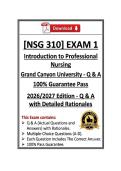
,NSG310/NSG 310 Exam 1 | Introduction to Professional
Nursing | Grand Canyon University | Q & A | 2026/2027
Edition (PDF)
1. Which of the following best describes the primary focus of the art of nursing?
A) The technical performance of clinical procedures and treatments
B) The compassionate, empathetic, and interpersonal aspects of patient care
C) The scientific research that underpins evidence-based practice
D) The administrative management of healthcare units and staff
Correct Answer: The compassionate, empathetic, and interpersonal aspects of patient care
Rationale: The art of nursing encompasses the compassionate, empathetic, and interpersonal
dimensions of care, emphasizing the human connection between nurse and patient. The science of
nursing involves the technical and evidence-based components. Administrative management and clinical
procedures are related but distinct concepts.
2. Which historical figure is credited with establishing the first professional nursing school at St. Thomas'
Hospital in London?
A) Lillian Wald
B) Clara Barton
C) Florence Nightingale
D) Dorothea Dix
Correct Answer: Florence Nightingale
Rationale: Florence Nightingale established the first professional nursing school at St. Thomas' Hospital
in London in 1860. She is considered the pioneer of modern nursing practice and professional nursing
education. Lillian Wald is known for community health nursing, Clara Barton founded the American Red
Cross, and Dorothea Dix advocated for mental health reform.
3. What was the primary reason for the creation of Associate Degree in Nursing (ADN) programs?
,A) To replace all diploma nursing programs
B) To increase the nursing workforce during a shortage
C) To prepare nurses for advanced practice roles
D) To standardize nursing education across the United States
Correct Answer: To increase the nursing workforce during a shortage
Rationale: ADN programs were developed to address nursing shortages by providing a shorter, more
accessible pathway to becoming a registered nurse. The first ADN program was established by Mildred
Montag in the 1950s. These programs were intended to produce technical nurses, not to replace
diploma programs or prepare advanced practice nurses.
4. Which nursing theorist is known for the Theory of Interpersonal Relations, which emphasizes the
therapeutic relationship between nurse and patient?
A) Dorothea Orem
B) Hildegard Peplau
C) Jean Watson
D) Martha Rogers
Correct Answer: Hildegard Peplau
Rationale: Hildegard Peplau developed the Theory of Interpersonal Relations, which focuses on the
nurse-patient relationship as the foundation of nursing practice. Dorothea Orem developed the Self-
Care Deficit Theory, Jean Watson developed the Theory of Human Caring, and Martha Rogers developed
the Science of Unitary Human Beings.
5. According to the NSG 310 Exam 1 blueprint, what percentage of the exam is dedicated to Topic 1:
Introduction to Nursing Fundamentals, Concepts of Health, and Vital Signs?
A) 28%
B) 32%
C) 42%
D) 46%
, Correct Answer: 28%
Rationale: The NSG 310 Exam 1 blueprint specifies that Topic 1 (Introduction to Nursing Fundamentals,
Concepts of Health, and Vital Signs) comprises 28% of the exam. Topic 2 (Concepts of Disease, Safety,
and Infection Control) covers 42%, and the remaining percentage covers other topics. An alternative
blueprint shows Topic 1 at 46%, but the 28% figure is from the student blueprint.
6. Which of the following is a key component of the Arizona Nurse Practice Act?
A) It establishes the curriculum for all nursing schools in Arizona
B) It defines the legal scope of practice for registered nurses in Arizona
C) It sets the salary standards for nurses employed in Arizona hospitals
D) It determines the number of continuing education credits required nationally
Correct Answer: It defines the legal scope of practice for registered nurses in Arizona
Rationale: The Nurse Practice Act in each state defines the legal scope of practice for nurses, including
standards for safe practice, grounds for disciplinary action, and requirements for licensure. It does not
establish school curricula, set salaries, or determine national continuing education requirements.
7. A registered nurse (RN) is delegating tasks to unlicensed assistive personnel (UAP). Which task is
appropriate for the RN to delegate?
A) Administering IV push medications
B) Performing trach care and suctioning
C) Assisting a patient with toileting and ambulation
D) Performing an initial patient assessment
Correct Answer: Assisting a patient with toileting and ambulation
Rationale: UAPs are qualified to assist with toileting, ambulation, bed baths, and monitoring intake and
output. They cannot administer medications, perform sterile procedures like trach care, or conduct
initial patient assessments. These tasks require the clinical judgment of a licensed nurse.
Nursing | Grand Canyon University | Q & A | 2026/2027
Edition (PDF)
1. Which of the following best describes the primary focus of the art of nursing?
A) The technical performance of clinical procedures and treatments
B) The compassionate, empathetic, and interpersonal aspects of patient care
C) The scientific research that underpins evidence-based practice
D) The administrative management of healthcare units and staff
Correct Answer: The compassionate, empathetic, and interpersonal aspects of patient care
Rationale: The art of nursing encompasses the compassionate, empathetic, and interpersonal
dimensions of care, emphasizing the human connection between nurse and patient. The science of
nursing involves the technical and evidence-based components. Administrative management and clinical
procedures are related but distinct concepts.
2. Which historical figure is credited with establishing the first professional nursing school at St. Thomas'
Hospital in London?
A) Lillian Wald
B) Clara Barton
C) Florence Nightingale
D) Dorothea Dix
Correct Answer: Florence Nightingale
Rationale: Florence Nightingale established the first professional nursing school at St. Thomas' Hospital
in London in 1860. She is considered the pioneer of modern nursing practice and professional nursing
education. Lillian Wald is known for community health nursing, Clara Barton founded the American Red
Cross, and Dorothea Dix advocated for mental health reform.
3. What was the primary reason for the creation of Associate Degree in Nursing (ADN) programs?
,A) To replace all diploma nursing programs
B) To increase the nursing workforce during a shortage
C) To prepare nurses for advanced practice roles
D) To standardize nursing education across the United States
Correct Answer: To increase the nursing workforce during a shortage
Rationale: ADN programs were developed to address nursing shortages by providing a shorter, more
accessible pathway to becoming a registered nurse. The first ADN program was established by Mildred
Montag in the 1950s. These programs were intended to produce technical nurses, not to replace
diploma programs or prepare advanced practice nurses.
4. Which nursing theorist is known for the Theory of Interpersonal Relations, which emphasizes the
therapeutic relationship between nurse and patient?
A) Dorothea Orem
B) Hildegard Peplau
C) Jean Watson
D) Martha Rogers
Correct Answer: Hildegard Peplau
Rationale: Hildegard Peplau developed the Theory of Interpersonal Relations, which focuses on the
nurse-patient relationship as the foundation of nursing practice. Dorothea Orem developed the Self-
Care Deficit Theory, Jean Watson developed the Theory of Human Caring, and Martha Rogers developed
the Science of Unitary Human Beings.
5. According to the NSG 310 Exam 1 blueprint, what percentage of the exam is dedicated to Topic 1:
Introduction to Nursing Fundamentals, Concepts of Health, and Vital Signs?
A) 28%
B) 32%
C) 42%
D) 46%
, Correct Answer: 28%
Rationale: The NSG 310 Exam 1 blueprint specifies that Topic 1 (Introduction to Nursing Fundamentals,
Concepts of Health, and Vital Signs) comprises 28% of the exam. Topic 2 (Concepts of Disease, Safety,
and Infection Control) covers 42%, and the remaining percentage covers other topics. An alternative
blueprint shows Topic 1 at 46%, but the 28% figure is from the student blueprint.
6. Which of the following is a key component of the Arizona Nurse Practice Act?
A) It establishes the curriculum for all nursing schools in Arizona
B) It defines the legal scope of practice for registered nurses in Arizona
C) It sets the salary standards for nurses employed in Arizona hospitals
D) It determines the number of continuing education credits required nationally
Correct Answer: It defines the legal scope of practice for registered nurses in Arizona
Rationale: The Nurse Practice Act in each state defines the legal scope of practice for nurses, including
standards for safe practice, grounds for disciplinary action, and requirements for licensure. It does not
establish school curricula, set salaries, or determine national continuing education requirements.
7. A registered nurse (RN) is delegating tasks to unlicensed assistive personnel (UAP). Which task is
appropriate for the RN to delegate?
A) Administering IV push medications
B) Performing trach care and suctioning
C) Assisting a patient with toileting and ambulation
D) Performing an initial patient assessment
Correct Answer: Assisting a patient with toileting and ambulation
Rationale: UAPs are qualified to assist with toileting, ambulation, bed baths, and monitoring intake and
output. They cannot administer medications, perform sterile procedures like trach care, or conduct
initial patient assessments. These tasks require the clinical judgment of a licensed nurse.


