

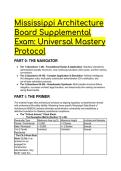
Mississippi Architecture
Board Supplemental
Exam: Universal Mastery
Protocol
PART 0: THE NAVIGATOR
● Tier 1 (Questions 1–28) - Foundational Syntax & Application: Statutory exemptions,
administrative penalty minimums, core continuing education (CE) syntax, and firm naming
conventions.
● Tier 2 (Questions 29–58) - Complex Application & Simulation: Artificial Intelligence
(AI) delegation rules, multi-party construction administration (CA) notification, and
out-of-state solicitation protocols.
● Tier 3 (Questions 59–88) - Grandmaster Synthesis: Multi-variable structural failure
mitigation, successor architect legal transfers, and mixed-entity firm naming conventions
during Board audits.
PART I: THE PRIMER
This material forges elite architectural scholars by aligning regulatory comprehension directly
with professional life-safety liability. Mastering these specific Mississippi State Board of
Architecture (MSBOA) statutes eliminates administrative vulnerability and establishes a
definitive foundation for flawless jurisdictional compliance.
● The "Critical Axioms" Cheat Sheet:
○ The Exemption Matrix (Section 73-1-39):
Ownership Type Maximum Area (sq ft) Maximum Height Architectural Mandate
Private / Commercial < 5,000 < 3 Stories Exempt
State / Municipal < 10,000 <= 2 Stories Exempt
1-to-2 Family Unlimited Unlimited Exempt
Residential
* The CA 5-Point Rule
(Rule 3.2.16): If an
architect is not
engaged for
Construction
Administration, they
MUST notify five
,Ownership Type Maximum Area (sq ft) Maximum Height Architectural Mandate
distinct entities in
writing: The Building
Official, The Board, The
Owner, The Client, and
The Contractor.
* The AI Prohibition
(Rule 4.5.2 G):
Licensees shall NOT
delegate critical
decision-making
responsibilities to AI or
automated systems.
Technology usage
never absolves the
architect of legal
compliance or
responsible control.
* The Entity Firewall
(Section 73-1-19):
Mississippi architecture
cannot be practiced
through a standard LLC
or Business
Corporation (Inc.).
Practice is strictly
limited to Professional
Limited Liability
Companies (PLLC),
Professional
Corporations (PC),
Professional
Associations (PA), Sole
Proprietorships, and
Partnerships.
* The Continuing
Education Imperative:
Architects must
complete 12 Continuing
Education Hours
(CEHs) per calendar
year, and 100% of
these hours must cover
Health, Safety, and
Welfare (HSW) topics.
PART II: THE ELITE TEST BANK
,Tier 1 - Foundational Syntax & Application
Q1: Under Miss. Code Ann. §73-1-39, a client requests design services for a new structure.
Based on statutory exemptions, which project STRICTLY requires a licensed Mississippi
architect? A) A 4,500 sq ft privately owned two-story medical clinic B) A 12,000 sq ft
single-family luxury residential estate C) A 6,000 sq ft privately owned single-story church D) A
9,500 sq ft two-story municipal office building
● The Answer: C (A 6,000 sq ft privately owned single-story church)
● Distractor Analysis:
○ A is incorrect: Private commercial buildings under 5,000 sq ft and under three
stories are exempt.
○ B is incorrect: Single-family residences are fully exempt regardless of total square
footage.
○ D is incorrect: State buildings containing less than 10,000 sq ft and not exceeding
two stories are exempt.
The Mentor's Analysis: Size and ownership dictate the regulatory threshold. When evaluating
exemptions, the immediate priority is verifying the gross area against the specific ownership
class. By utilizing the 5,000 sq ft private threshold, the architect bypasses the trap of illegal
unlicensed practice. Professional/Academic Intuition: Private non-residential structures hit
the architectural mandate at exactly 5,000 sq ft or three stories.
Q2: An architect completes 14 CEHs in a calendar year, but only 10 hours are in Health, Safety,
and Welfare (HSW) topics. Based on MSBOA rules, what is the penalty for this deficiency? A)
Revocation and a $1,000 fine B) Admonition and a $500 fine for the deficient calendar year C)
Probation and required re-examination D) A warning letter with a 30-day cure period
● The Answer: B (Admonition and a $500 fine for the deficient calendar year)
● Distractor Analysis:
○ A is incorrect: Revocation is reserved for severe ethics violations like plan
stamping, not CE deficiencies.
○ C is incorrect: Re-examination is not a standard penalty for CE failure.
○ D is incorrect: Late credits trigger a specific financial penalty, not a warning period.
The Mentor's Analysis: Continuing education is tied to public safety. When reporting CEHs, the
immediate priority is ensuring 12 hours carry the HSW designation. By utilizing qualified HSW
settings, the practitioner bypasses administrative penalties. Professional/Academic Intuition:
Volume does not negate the HSW mandate; the deficiency fine is $500 per calendar year.
Q3: What is the mandatory minimum penalty for "plan stamping" (affixing a seal to plans not
prepared under the architect's responsible control) in Mississippi? A) Suspension and a $1,000
fine B) Reprimand and a $1,500 fine C) Revocation and a $2,500 fine D) Probation and a
$5,000 fine
● The Answer: C (Revocation and a $2,500 fine)
● Distractor Analysis:
○ A is incorrect: Suspension is insufficient for this tier of violation.
○ B is incorrect: This mirrors the CA violation penalty, not plan stamping.
○ D is incorrect: Probation allows continued practice, which the Board revokes for this
offense.
The Mentor's Analysis: Plan stamping is the ultimate betrayal of public trust. When integrating
external documents, the immediate priority is establishing documented responsible control. By
utilizing legitimate supervisory protocols, the architect bypasses career-ending disciplinary
, action. Professional/Academic Intuition: A seal without supervision is a guaranteed
revocation.
Q4: A licensed architect wishes to incorporate to attract investment. Based on MSBOA entity
rules, which structure is PROHIBITED for offering architectural services? A) Professional
Limited Liability Company (PLLC) B) Professional Association (PA) C) Standard Limited Liability
Company (LLC) D) Professional Corporation (PC)
● The Answer: C (Standard Limited Liability Company (LLC))
● Distractor Analysis:
○ A is incorrect: PLLCs are legal.
○ B is incorrect: PAs are legally recognized.
○ D is incorrect: PCs are permitted if stockholders hold appropriate licenses.
The Mentor's Analysis: Corporate shields cannot bypass professional accountability. When
forming a firm, the immediate priority is selecting a "Professional" specific entity. By utilizing a
PLLC, PA, or PC, the architect bypasses the trap of illegal practice. Professional/Academic
Intuition: Standard LLCs and Business Corporations (Inc.) are strictly banned for
architectural practice in Mississippi.
Q5: For how long MUST an architect retain documentation proving completion of their
Continuing Education Hours (CEHs)? A) Two years B) Three years C) Five years D) Six years
● The Answer: D (Six years)
● Distractor Analysis:
○ A is incorrect: Two years is the renewal cycle, not the retention period.
○ B is incorrect: A common IRS limit, but incorrect here.
○ C is incorrect: Five years applies to third-party drafting evidence.
The Mentor's Analysis: Audits operate on delayed timelines. When completing CE, the
immediate priority is archiving the certificates. By utilizing a six-year retention protocol, the
practitioner bypasses the trap of failing a random audit. Professional/Academic Intuition: CEH
certificates must survive three full biennial renewal cycles.
Q6: A candidate who passed the ARE and AXP wishes to market themselves in Mississippi
while their MSBOA application is processing. Which action is legal? A) Using the title "Architect"
with the word "Pending" B) Using the title "Intern Architect" unconditionally C) Refraining from
using the title "Architect" or any derivation thereof D) Using the title if they notify the Board in
writing
● The Answer: C (Refraining from using the title "Architect" or any derivation thereof)
● Distractor Analysis:
○ A is incorrect: Modifiers do not bypass the Title Act.
○ B is incorrect: "Intern Architect" is restricted and regulated.
○ D is incorrect: Notification does not grant title rights to unlicensed individuals.
The Mentor's Analysis: Mississippi enforces a strict Title Act. When awaiting licensure, the
immediate priority is scrubbing marketing material of protected terminology. By utilizing
unrestricted titles like "Project Manager," the candidate bypasses unlicensed practice penalties.
Professional/Academic Intuition: The title "Architect" is a licensed credential, not an
academic degree descriptor.
Q7: What is the specific physical requirement for a Mississippi architectural seal? A) A 1-by-2
inch rectangle B) A 1.5-inch diameter circle C) A 2-inch diameter square D) An embossed
hexagonal stamp
● The Answer: B (A 1.5-inch diameter circle)
● Distractor Analysis:
○ A is incorrect: Seals must be circular.
Board Supplemental
Exam: Universal Mastery
Protocol
PART 0: THE NAVIGATOR
● Tier 1 (Questions 1–28) - Foundational Syntax & Application: Statutory exemptions,
administrative penalty minimums, core continuing education (CE) syntax, and firm naming
conventions.
● Tier 2 (Questions 29–58) - Complex Application & Simulation: Artificial Intelligence
(AI) delegation rules, multi-party construction administration (CA) notification, and
out-of-state solicitation protocols.
● Tier 3 (Questions 59–88) - Grandmaster Synthesis: Multi-variable structural failure
mitigation, successor architect legal transfers, and mixed-entity firm naming conventions
during Board audits.
PART I: THE PRIMER
This material forges elite architectural scholars by aligning regulatory comprehension directly
with professional life-safety liability. Mastering these specific Mississippi State Board of
Architecture (MSBOA) statutes eliminates administrative vulnerability and establishes a
definitive foundation for flawless jurisdictional compliance.
● The "Critical Axioms" Cheat Sheet:
○ The Exemption Matrix (Section 73-1-39):
Ownership Type Maximum Area (sq ft) Maximum Height Architectural Mandate
Private / Commercial < 5,000 < 3 Stories Exempt
State / Municipal < 10,000 <= 2 Stories Exempt
1-to-2 Family Unlimited Unlimited Exempt
Residential
* The CA 5-Point Rule
(Rule 3.2.16): If an
architect is not
engaged for
Construction
Administration, they
MUST notify five
,Ownership Type Maximum Area (sq ft) Maximum Height Architectural Mandate
distinct entities in
writing: The Building
Official, The Board, The
Owner, The Client, and
The Contractor.
* The AI Prohibition
(Rule 4.5.2 G):
Licensees shall NOT
delegate critical
decision-making
responsibilities to AI or
automated systems.
Technology usage
never absolves the
architect of legal
compliance or
responsible control.
* The Entity Firewall
(Section 73-1-19):
Mississippi architecture
cannot be practiced
through a standard LLC
or Business
Corporation (Inc.).
Practice is strictly
limited to Professional
Limited Liability
Companies (PLLC),
Professional
Corporations (PC),
Professional
Associations (PA), Sole
Proprietorships, and
Partnerships.
* The Continuing
Education Imperative:
Architects must
complete 12 Continuing
Education Hours
(CEHs) per calendar
year, and 100% of
these hours must cover
Health, Safety, and
Welfare (HSW) topics.
PART II: THE ELITE TEST BANK
,Tier 1 - Foundational Syntax & Application
Q1: Under Miss. Code Ann. §73-1-39, a client requests design services for a new structure.
Based on statutory exemptions, which project STRICTLY requires a licensed Mississippi
architect? A) A 4,500 sq ft privately owned two-story medical clinic B) A 12,000 sq ft
single-family luxury residential estate C) A 6,000 sq ft privately owned single-story church D) A
9,500 sq ft two-story municipal office building
● The Answer: C (A 6,000 sq ft privately owned single-story church)
● Distractor Analysis:
○ A is incorrect: Private commercial buildings under 5,000 sq ft and under three
stories are exempt.
○ B is incorrect: Single-family residences are fully exempt regardless of total square
footage.
○ D is incorrect: State buildings containing less than 10,000 sq ft and not exceeding
two stories are exempt.
The Mentor's Analysis: Size and ownership dictate the regulatory threshold. When evaluating
exemptions, the immediate priority is verifying the gross area against the specific ownership
class. By utilizing the 5,000 sq ft private threshold, the architect bypasses the trap of illegal
unlicensed practice. Professional/Academic Intuition: Private non-residential structures hit
the architectural mandate at exactly 5,000 sq ft or three stories.
Q2: An architect completes 14 CEHs in a calendar year, but only 10 hours are in Health, Safety,
and Welfare (HSW) topics. Based on MSBOA rules, what is the penalty for this deficiency? A)
Revocation and a $1,000 fine B) Admonition and a $500 fine for the deficient calendar year C)
Probation and required re-examination D) A warning letter with a 30-day cure period
● The Answer: B (Admonition and a $500 fine for the deficient calendar year)
● Distractor Analysis:
○ A is incorrect: Revocation is reserved for severe ethics violations like plan
stamping, not CE deficiencies.
○ C is incorrect: Re-examination is not a standard penalty for CE failure.
○ D is incorrect: Late credits trigger a specific financial penalty, not a warning period.
The Mentor's Analysis: Continuing education is tied to public safety. When reporting CEHs, the
immediate priority is ensuring 12 hours carry the HSW designation. By utilizing qualified HSW
settings, the practitioner bypasses administrative penalties. Professional/Academic Intuition:
Volume does not negate the HSW mandate; the deficiency fine is $500 per calendar year.
Q3: What is the mandatory minimum penalty for "plan stamping" (affixing a seal to plans not
prepared under the architect's responsible control) in Mississippi? A) Suspension and a $1,000
fine B) Reprimand and a $1,500 fine C) Revocation and a $2,500 fine D) Probation and a
$5,000 fine
● The Answer: C (Revocation and a $2,500 fine)
● Distractor Analysis:
○ A is incorrect: Suspension is insufficient for this tier of violation.
○ B is incorrect: This mirrors the CA violation penalty, not plan stamping.
○ D is incorrect: Probation allows continued practice, which the Board revokes for this
offense.
The Mentor's Analysis: Plan stamping is the ultimate betrayal of public trust. When integrating
external documents, the immediate priority is establishing documented responsible control. By
utilizing legitimate supervisory protocols, the architect bypasses career-ending disciplinary
, action. Professional/Academic Intuition: A seal without supervision is a guaranteed
revocation.
Q4: A licensed architect wishes to incorporate to attract investment. Based on MSBOA entity
rules, which structure is PROHIBITED for offering architectural services? A) Professional
Limited Liability Company (PLLC) B) Professional Association (PA) C) Standard Limited Liability
Company (LLC) D) Professional Corporation (PC)
● The Answer: C (Standard Limited Liability Company (LLC))
● Distractor Analysis:
○ A is incorrect: PLLCs are legal.
○ B is incorrect: PAs are legally recognized.
○ D is incorrect: PCs are permitted if stockholders hold appropriate licenses.
The Mentor's Analysis: Corporate shields cannot bypass professional accountability. When
forming a firm, the immediate priority is selecting a "Professional" specific entity. By utilizing a
PLLC, PA, or PC, the architect bypasses the trap of illegal practice. Professional/Academic
Intuition: Standard LLCs and Business Corporations (Inc.) are strictly banned for
architectural practice in Mississippi.
Q5: For how long MUST an architect retain documentation proving completion of their
Continuing Education Hours (CEHs)? A) Two years B) Three years C) Five years D) Six years
● The Answer: D (Six years)
● Distractor Analysis:
○ A is incorrect: Two years is the renewal cycle, not the retention period.
○ B is incorrect: A common IRS limit, but incorrect here.
○ C is incorrect: Five years applies to third-party drafting evidence.
The Mentor's Analysis: Audits operate on delayed timelines. When completing CE, the
immediate priority is archiving the certificates. By utilizing a six-year retention protocol, the
practitioner bypasses the trap of failing a random audit. Professional/Academic Intuition: CEH
certificates must survive three full biennial renewal cycles.
Q6: A candidate who passed the ARE and AXP wishes to market themselves in Mississippi
while their MSBOA application is processing. Which action is legal? A) Using the title "Architect"
with the word "Pending" B) Using the title "Intern Architect" unconditionally C) Refraining from
using the title "Architect" or any derivation thereof D) Using the title if they notify the Board in
writing
● The Answer: C (Refraining from using the title "Architect" or any derivation thereof)
● Distractor Analysis:
○ A is incorrect: Modifiers do not bypass the Title Act.
○ B is incorrect: "Intern Architect" is restricted and regulated.
○ D is incorrect: Notification does not grant title rights to unlicensed individuals.
The Mentor's Analysis: Mississippi enforces a strict Title Act. When awaiting licensure, the
immediate priority is scrubbing marketing material of protected terminology. By utilizing
unrestricted titles like "Project Manager," the candidate bypasses unlicensed practice penalties.
Professional/Academic Intuition: The title "Architect" is a licensed credential, not an
academic degree descriptor.
Q7: What is the specific physical requirement for a Mississippi architectural seal? A) A 1-by-2
inch rectangle B) A 1.5-inch diameter circle C) A 2-inch diameter square D) An embossed
hexagonal stamp
● The Answer: B (A 1.5-inch diameter circle)
● Distractor Analysis:
○ A is incorrect: Seals must be circular.


