
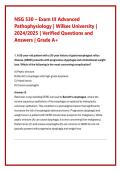
NSG 530 – Exam III Advanced
Pathophysiology | Wilkes University |
2024/2025 | Verified Questions and
Answers | Grade A+
1. A 55-year-old patient with a 20-year history of gastroesophageal reflux
disease (GERD) presents with progressive dysphagia and unintentional weight
loss. Which of the following is the most concerning complication?
A) Peptic stricture
B) Barrett's esophagus with high-grade dysplasia
C) Hiatal hernia
D) Erosive esophagitis
Answer: B
Rationale: Long-standing GERD can lead to Barrett's esophagus, where the
normal squamous epithelium of the esophagus is replaced by metaplastic
columnar epithelium. This condition is a premalignant lesion that significantly
increases the risk of esophageal adenocarcinoma. Progressive dysphagia and
weight loss in a patient with GERD should raise suspicion for malignancy. While
peptic stricture (A) can cause dysphagia, it is less concerning than malignancy.
Hiatal hernia (C) and erosive esophagitis (D) are common in GERD but do not
typically present with progressive dysphagia and weight loss.
,2. A 45-year-old patient with cirrhosis presents with ascites, jaundice, and
confusion. Laboratory studies reveal an elevated ammonia level. Which of the
following best explains the pathophysiology of this patient's confusion?
A) Accumulation of bilirubin in the brain
B) Impaired urea cycle function leading to ammonia toxicity
C) Decreased cerebral blood flow due to portal hypertension
D) Direct hepatocyte injury from alcohol metabolites
Answer: B
Rationale: In cirrhosis, the liver's ability to convert ammonia to urea via the urea
cycle is impaired. Ammonia, a neurotoxin, accumulates in the blood and crosses
the blood-brain barrier, where it is converted to glutamine in astrocytes. This leads
to cerebral edema and hepatic encephalopathy, manifesting as confusion, altered
mental status, and asterixis. Bilirubin (A) causes jaundice but does not directly
cause confusion. Portal hypertension (C) contributes to ascites but not directly to
encephalopathy.
3. A patient with acute pancreatitis develops hypocalcemia. Which of the
following mechanisms best explains this finding?
A) Decreased intestinal calcium absorption
B) Impaired vitamin D activation
C) Saponification of calcium by free fatty acids
D) Increased renal calcium excretion
Answer: C
Rationale: In acute pancreatitis, pancreatic lipase is released into the
retroperitoneal space, where it breaks down triglycerides into free fatty acids.
These free fatty acids bind with calcium ions to form insoluble calcium soaps
,(saponification), leading to hypocalcemia. This is known as the "saponification
hypothesis." Decreased absorption (A), impaired vitamin D activation (B), and
increased renal excretion (D) are not the primary mechanisms in acute pancreatitis.
4. A 60-year-old patient with chronic pancreatitis presents with steatorrhea
and weight loss. Which of the following is the most likely underlying
mechanism?
A) Biliary obstruction
B) Pancreatic enzyme insufficiency
C) Gastric hyperacidity
D) Small intestinal bacterial overgrowth
Answer: B
Rationale: Chronic pancreatitis destroys pancreatic acinar cells, leading
to exocrine pancreatic insufficiency. Without adequate pancreatic lipase, dietary
fats cannot be digested, resulting in steatorrhea (fatty, foul-smelling stools) and
subsequent weight loss and fat-soluble vitamin deficiencies. Biliary obstruction (A)
is more common in pancreatic head tumors. Gastric hyperacidity (C) and bacterial
overgrowth (D) are not primary mechanisms.
5. A newborn presents with bilious vomiting, abdominal distension, and failure
to pass meconium within the first 24 hours of life. Which of the following is the
most likely diagnosis?
A) Pyloric stenosis
B) Meconium ileus
, C) Intussusception
D) Hirschsprung disease
Answer: D
Rationale: Hirschsprung disease (congenital aganglionic megacolon) is caused
by the failure of neural crest cells to migrate into the distal colon during fetal
development. The resulting absence of ganglion cells in the myenteric (Auerbach's)
and submucosal (Meissner's) plexuses leads to functional intestinal obstruction.
The classic presentation includes bilious vomiting, abdominal distension,
and failure to pass meconium within 24-48 hours of life. Pyloric stenosis (A)
presents with non-bilious projectile vomiting. Meconium ileus (B) is associated with
cystic fibrosis. Intussusception (C) typically presents later in infancy with "currant
jelly" stools.
6. Which of the following laboratory findings is most consistent with
cholestatic liver disease?
A) Elevated AST and ALT with normal alkaline phosphatase
B) Elevated alkaline phosphatase and conjugated bilirubin
C) Elevated unconjugated bilirubin with normal liver enzymes
D) Decreased serum albumin and prolonged PT/INR
Answer: B
Rationale: Cholestatic liver disease (e.g., biliary obstruction, primary biliary
cholangitis) is characterized by impaired bile flow. This leads to elevation
of alkaline phosphatase (a marker of biliary obstruction) and conjugated (direct)
bilirubin (which is water-soluble and excreted in urine, causing dark urine).
Elevated AST/ALT with normal alkaline phosphatase (A) suggests hepatocellular
injury. Elevated unconjugated bilirubin (C) suggests hemolysis or Gilbert syndrome.
Pathophysiology | Wilkes University |
2024/2025 | Verified Questions and
Answers | Grade A+
1. A 55-year-old patient with a 20-year history of gastroesophageal reflux
disease (GERD) presents with progressive dysphagia and unintentional weight
loss. Which of the following is the most concerning complication?
A) Peptic stricture
B) Barrett's esophagus with high-grade dysplasia
C) Hiatal hernia
D) Erosive esophagitis
Answer: B
Rationale: Long-standing GERD can lead to Barrett's esophagus, where the
normal squamous epithelium of the esophagus is replaced by metaplastic
columnar epithelium. This condition is a premalignant lesion that significantly
increases the risk of esophageal adenocarcinoma. Progressive dysphagia and
weight loss in a patient with GERD should raise suspicion for malignancy. While
peptic stricture (A) can cause dysphagia, it is less concerning than malignancy.
Hiatal hernia (C) and erosive esophagitis (D) are common in GERD but do not
typically present with progressive dysphagia and weight loss.
,2. A 45-year-old patient with cirrhosis presents with ascites, jaundice, and
confusion. Laboratory studies reveal an elevated ammonia level. Which of the
following best explains the pathophysiology of this patient's confusion?
A) Accumulation of bilirubin in the brain
B) Impaired urea cycle function leading to ammonia toxicity
C) Decreased cerebral blood flow due to portal hypertension
D) Direct hepatocyte injury from alcohol metabolites
Answer: B
Rationale: In cirrhosis, the liver's ability to convert ammonia to urea via the urea
cycle is impaired. Ammonia, a neurotoxin, accumulates in the blood and crosses
the blood-brain barrier, where it is converted to glutamine in astrocytes. This leads
to cerebral edema and hepatic encephalopathy, manifesting as confusion, altered
mental status, and asterixis. Bilirubin (A) causes jaundice but does not directly
cause confusion. Portal hypertension (C) contributes to ascites but not directly to
encephalopathy.
3. A patient with acute pancreatitis develops hypocalcemia. Which of the
following mechanisms best explains this finding?
A) Decreased intestinal calcium absorption
B) Impaired vitamin D activation
C) Saponification of calcium by free fatty acids
D) Increased renal calcium excretion
Answer: C
Rationale: In acute pancreatitis, pancreatic lipase is released into the
retroperitoneal space, where it breaks down triglycerides into free fatty acids.
These free fatty acids bind with calcium ions to form insoluble calcium soaps
,(saponification), leading to hypocalcemia. This is known as the "saponification
hypothesis." Decreased absorption (A), impaired vitamin D activation (B), and
increased renal excretion (D) are not the primary mechanisms in acute pancreatitis.
4. A 60-year-old patient with chronic pancreatitis presents with steatorrhea
and weight loss. Which of the following is the most likely underlying
mechanism?
A) Biliary obstruction
B) Pancreatic enzyme insufficiency
C) Gastric hyperacidity
D) Small intestinal bacterial overgrowth
Answer: B
Rationale: Chronic pancreatitis destroys pancreatic acinar cells, leading
to exocrine pancreatic insufficiency. Without adequate pancreatic lipase, dietary
fats cannot be digested, resulting in steatorrhea (fatty, foul-smelling stools) and
subsequent weight loss and fat-soluble vitamin deficiencies. Biliary obstruction (A)
is more common in pancreatic head tumors. Gastric hyperacidity (C) and bacterial
overgrowth (D) are not primary mechanisms.
5. A newborn presents with bilious vomiting, abdominal distension, and failure
to pass meconium within the first 24 hours of life. Which of the following is the
most likely diagnosis?
A) Pyloric stenosis
B) Meconium ileus
, C) Intussusception
D) Hirschsprung disease
Answer: D
Rationale: Hirschsprung disease (congenital aganglionic megacolon) is caused
by the failure of neural crest cells to migrate into the distal colon during fetal
development. The resulting absence of ganglion cells in the myenteric (Auerbach's)
and submucosal (Meissner's) plexuses leads to functional intestinal obstruction.
The classic presentation includes bilious vomiting, abdominal distension,
and failure to pass meconium within 24-48 hours of life. Pyloric stenosis (A)
presents with non-bilious projectile vomiting. Meconium ileus (B) is associated with
cystic fibrosis. Intussusception (C) typically presents later in infancy with "currant
jelly" stools.
6. Which of the following laboratory findings is most consistent with
cholestatic liver disease?
A) Elevated AST and ALT with normal alkaline phosphatase
B) Elevated alkaline phosphatase and conjugated bilirubin
C) Elevated unconjugated bilirubin with normal liver enzymes
D) Decreased serum albumin and prolonged PT/INR
Answer: B
Rationale: Cholestatic liver disease (e.g., biliary obstruction, primary biliary
cholangitis) is characterized by impaired bile flow. This leads to elevation
of alkaline phosphatase (a marker of biliary obstruction) and conjugated (direct)
bilirubin (which is water-soluble and excreted in urine, causing dark urine).
Elevated AST/ALT with normal alkaline phosphatase (A) suggests hepatocellular
injury. Elevated unconjugated bilirubin (C) suggests hemolysis or Gilbert syndrome.


