

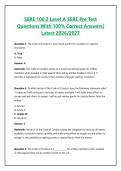
SERE 100.2 Level A SERE Pre Test
Questions With 100% Correct Answers|
Latest 2026/2027
Question 1: The Code of Conduct is your moral guide from isolation to captivity
resolution.
A. True
B. False
Answer: A
Rationale: The Code of Conduct serves as a moral and ethical guide for military
members when isolated or held against their will by entities hostile to the U.S. It
provides a framework for conduct from isolation through captivity resolution .
Question 2: To which article of the Code of Conduct does the following statement refer?
"If captured I will continue to resist by all means available. I will make every effort to
escape and aid others to escape. I will accept neither parole nor special favors from the
enemy."
A. Article I
B. Article II
C. Article III
D. Article IV
Answer: C
Rationale: Article III of the Code of Conduct states the obligation to resist by all means
available, continue to resist captivity, and make every effort to escape and aid others to
escape. It also prohibits accepting parole or special favors from the enemy .
Question 3: The Code of Conduct is a ____________ for military members when isolated
or held against their will by entities hostile to the U.S.
,A. legal requirement
B. moral guide
C. tactical manual
D. administrative form
Answer: B
Rationale: The Code of Conduct serves as a moral guide for military members,
providing principles and standards of behavior when isolated or in captivity .
Question 4: Identify elements of Article II of the Code of Conduct. (Select all that apply)
A. Military members are never authorized to surrender
B. During military operations outside declared hostilities you may delay contact
with local authorities
C. Prisoners may accept special favors from the enemy
D. Military members may surrender when outnumbered
Answer: A, B
Rationale: Article II of the Code of Conduct establishes that military members are never
authorized to surrender. During operations outside declared hostilities, personnel may
delay contact with local authorities until they have gained situational awareness and
contacted friendly forces .
Question 5: Identify some posture and resistance constants of an effective resistance
posture. (Select all that apply)
A. Stall
B. Control emotions
C. Bounce back
D. Accept special favors
Answer: A, B, C
,Rationale: Effective resistance posture involves stalling to buy time, controlling
emotions to maintain composure, and bouncing back from setbacks. These constants
help maintain psychological resilience during captivity .
Question 6: Resistance to exploitation is a BATTLE OF WITS with your captor.
A. True
B. False
Answer: B
Rationale: Resistance to exploitation is a battle of wits, requiring intelligence, strategic
thinking, and psychological resilience. It is not a physical battle but rather a mental
contest of strategy against captors .
Question 7: To which article of the Code of Conduct does the following statement refer?
"When questioned, should I become a prisoner of war, I am required to give name, rank,
service number and date of birth. I will evade answering further questions to the utmost
of my ability."
A. Article II
B. Article III
C. Article IV
D. Article V
Answer: C
Rationale: Article IV of the Code of Conduct addresses the information a prisoner of
war is required to provide (name, rank, service number, and date of birth) and requires
evading further questions to the utmost ability .
Question 8: To which article of the Code of Conduct does the following statement refer?
"When questioned, should I become a prisoner of war, I am required to give name, rank,
service number and date of birth. I will make no oral or written statements disloyal to
my country."
, A. Article III
B. Article IV
C. Article V
D. Article I
Answer: C
Rationale: Article V of the Code of Conduct addresses the limitations on what a
prisoner may disclose. While name, rank, service number, and date of birth may be
given, no disloyal statements should be made. This article also covers communication
with captors and providing proof of life .
Question 9: If captured, you must give no information or take part in any action which
might be harmful to your comrades. This is an example of __________ under Article IV of
the Code of Conduct.
A. moral guide
B. keeping faith
C. situational awareness
D. exploitation
Answer: B
Rationale: "Keeping faith" is the term used in Article IV of the Code of Conduct to
describe the obligation to give no information or take part in any action that might be
harmful to comrades. This includes not accepting special favors from the enemy .
Question 10: What is the weakened state of the captives' __________ that reduces their
capacity to collectively resist adversary exploitation efforts?
A. physical health
B. emotional state
C. organization
D. communication
Answer: C
Questions With 100% Correct Answers|
Latest 2026/2027
Question 1: The Code of Conduct is your moral guide from isolation to captivity
resolution.
A. True
B. False
Answer: A
Rationale: The Code of Conduct serves as a moral and ethical guide for military
members when isolated or held against their will by entities hostile to the U.S. It
provides a framework for conduct from isolation through captivity resolution .
Question 2: To which article of the Code of Conduct does the following statement refer?
"If captured I will continue to resist by all means available. I will make every effort to
escape and aid others to escape. I will accept neither parole nor special favors from the
enemy."
A. Article I
B. Article II
C. Article III
D. Article IV
Answer: C
Rationale: Article III of the Code of Conduct states the obligation to resist by all means
available, continue to resist captivity, and make every effort to escape and aid others to
escape. It also prohibits accepting parole or special favors from the enemy .
Question 3: The Code of Conduct is a ____________ for military members when isolated
or held against their will by entities hostile to the U.S.
,A. legal requirement
B. moral guide
C. tactical manual
D. administrative form
Answer: B
Rationale: The Code of Conduct serves as a moral guide for military members,
providing principles and standards of behavior when isolated or in captivity .
Question 4: Identify elements of Article II of the Code of Conduct. (Select all that apply)
A. Military members are never authorized to surrender
B. During military operations outside declared hostilities you may delay contact
with local authorities
C. Prisoners may accept special favors from the enemy
D. Military members may surrender when outnumbered
Answer: A, B
Rationale: Article II of the Code of Conduct establishes that military members are never
authorized to surrender. During operations outside declared hostilities, personnel may
delay contact with local authorities until they have gained situational awareness and
contacted friendly forces .
Question 5: Identify some posture and resistance constants of an effective resistance
posture. (Select all that apply)
A. Stall
B. Control emotions
C. Bounce back
D. Accept special favors
Answer: A, B, C
,Rationale: Effective resistance posture involves stalling to buy time, controlling
emotions to maintain composure, and bouncing back from setbacks. These constants
help maintain psychological resilience during captivity .
Question 6: Resistance to exploitation is a BATTLE OF WITS with your captor.
A. True
B. False
Answer: B
Rationale: Resistance to exploitation is a battle of wits, requiring intelligence, strategic
thinking, and psychological resilience. It is not a physical battle but rather a mental
contest of strategy against captors .
Question 7: To which article of the Code of Conduct does the following statement refer?
"When questioned, should I become a prisoner of war, I am required to give name, rank,
service number and date of birth. I will evade answering further questions to the utmost
of my ability."
A. Article II
B. Article III
C. Article IV
D. Article V
Answer: C
Rationale: Article IV of the Code of Conduct addresses the information a prisoner of
war is required to provide (name, rank, service number, and date of birth) and requires
evading further questions to the utmost ability .
Question 8: To which article of the Code of Conduct does the following statement refer?
"When questioned, should I become a prisoner of war, I am required to give name, rank,
service number and date of birth. I will make no oral or written statements disloyal to
my country."
, A. Article III
B. Article IV
C. Article V
D. Article I
Answer: C
Rationale: Article V of the Code of Conduct addresses the limitations on what a
prisoner may disclose. While name, rank, service number, and date of birth may be
given, no disloyal statements should be made. This article also covers communication
with captors and providing proof of life .
Question 9: If captured, you must give no information or take part in any action which
might be harmful to your comrades. This is an example of __________ under Article IV of
the Code of Conduct.
A. moral guide
B. keeping faith
C. situational awareness
D. exploitation
Answer: B
Rationale: "Keeping faith" is the term used in Article IV of the Code of Conduct to
describe the obligation to give no information or take part in any action that might be
harmful to comrades. This includes not accepting special favors from the enemy .
Question 10: What is the weakened state of the captives' __________ that reduces their
capacity to collectively resist adversary exploitation efforts?
A. physical health
B. emotional state
C. organization
D. communication
Answer: C


