

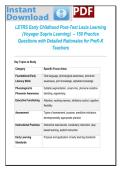
LETRS Early Childhood Post-Test Lexia Learning
(Voyager Sopris Learning) – 150 Practice
Questions with Detailed Rationales for PreK-K
Teachers
Key Topics to Study
Category Specific Focus Areas
Foundational Early Oral language, phonological awareness, phonemic
Literacy Skills awareness, print knowledge, alphabet knowledge
Phonological & Syllable segmentation, onset-rime, phoneme isolation,
Phonemic Awareness blending, segmenting
Executive Functioning Attention, working memory, inhibitory control, cognitive
flexibility
Assessment Types of assessment, purpose, predictive indicators,
developmentally appropriate practice
Instructional Practices Interactive read-alouds, vocabulary instruction, play-
based learning, explicit instruction
Early Learning Purpose and application of early learning standards
Standards
, Print Knowledge & Letter names, letter-sound correspondence, concepts
Alphabet Learning of print, stages of alphabet learning
Oral Language Vocabulary, narrative skills, conversational skills,
Development language exposure
Social-Emotional Self-regulation, peer interactions, emotional
Development expression
SECTION 1: FOUNDATIONAL EARLY LITERACY SKILLS (Questions 1-30)
1. The National Early Literacy Panel identified three foundational areas of early
literacy. These include:
A) Oral language, phonological processing, and print knowledge
B) Reading comprehension, vocabulary, and fluency
C) Writing, spelling, and grammar
D) Listening, speaking, and viewing
Answer: A. The National Early Literacy Panel identified oral language, phonological
processing, and print knowledge as the three foundational areas of early literacy.
2. Which skill is expected for a child in the early literacy level but NOT at the early
reading and writing level?
A) Reading simple sentences
B) Learning the names of several alphabet letters
C) Writing their first name
D) Identifying rhyming words
,Answer: B. Learning the names of several alphabet letters is a skill expected at the early
literacy level but not yet at the early reading and writing level.
3. Which statement best describes the relationship between reading comprehension
and word decoding in a beginning reader's development?
A) Decoding must come before comprehension can develop
B) Comprehension must come before decoding can develop
C) Decoding and comprehension develop simultaneously and interdependently
D) Decoding and comprehension are unrelated skills
Answer: C. Accurate decoding is necessary for comprehension, but both skills develop
simultaneously and interdependently in beginning readers.
4. Which of the following is NOT an executive functioning skill?
A) Attention
B) Working memory
C) Phonemic awareness
D) Inhibitory control
Answer: C. Phonemic awareness is a foundational literacy skill, not an executive
functioning skill. Executive functioning includes attention, working memory, inhibitory
control, and cognitive flexibility.
5. The primary purpose of early learning standards is to:
A) Provide a framework for what children should know and be able to do
B) Mandate specific instructional materials
, C) Evaluate teacher performance
D) Assess program quality
Answer: A. Early learning standards provide a framework for what children should know
and be able to do.
6. Predictive indicators for academic learning in early childhood include:
A) Letter knowledge and phonological awareness
B) Social skills only
C) Physical development only
D) Artistic ability
Answer: A. Letter knowledge and phonological awareness are predictive indicators for
academic learning across developmental domains.
7. When preparing to read a children's storybook, which vocabulary words should a
teacher select and prepare specifically to teach?
A) Every word in the book
B) Words that are essential to understanding the story
C) Only words the children already know
D) Words with three or more syllables
Answer: B. Teachers should select and prepare vocabulary words that are essential to
understanding the story.
8. Which skill is expected for a child in the early reading and writing level?
A) Learning letter names
(Voyager Sopris Learning) – 150 Practice
Questions with Detailed Rationales for PreK-K
Teachers
Key Topics to Study
Category Specific Focus Areas
Foundational Early Oral language, phonological awareness, phonemic
Literacy Skills awareness, print knowledge, alphabet knowledge
Phonological & Syllable segmentation, onset-rime, phoneme isolation,
Phonemic Awareness blending, segmenting
Executive Functioning Attention, working memory, inhibitory control, cognitive
flexibility
Assessment Types of assessment, purpose, predictive indicators,
developmentally appropriate practice
Instructional Practices Interactive read-alouds, vocabulary instruction, play-
based learning, explicit instruction
Early Learning Purpose and application of early learning standards
Standards
, Print Knowledge & Letter names, letter-sound correspondence, concepts
Alphabet Learning of print, stages of alphabet learning
Oral Language Vocabulary, narrative skills, conversational skills,
Development language exposure
Social-Emotional Self-regulation, peer interactions, emotional
Development expression
SECTION 1: FOUNDATIONAL EARLY LITERACY SKILLS (Questions 1-30)
1. The National Early Literacy Panel identified three foundational areas of early
literacy. These include:
A) Oral language, phonological processing, and print knowledge
B) Reading comprehension, vocabulary, and fluency
C) Writing, spelling, and grammar
D) Listening, speaking, and viewing
Answer: A. The National Early Literacy Panel identified oral language, phonological
processing, and print knowledge as the three foundational areas of early literacy.
2. Which skill is expected for a child in the early literacy level but NOT at the early
reading and writing level?
A) Reading simple sentences
B) Learning the names of several alphabet letters
C) Writing their first name
D) Identifying rhyming words
,Answer: B. Learning the names of several alphabet letters is a skill expected at the early
literacy level but not yet at the early reading and writing level.
3. Which statement best describes the relationship between reading comprehension
and word decoding in a beginning reader's development?
A) Decoding must come before comprehension can develop
B) Comprehension must come before decoding can develop
C) Decoding and comprehension develop simultaneously and interdependently
D) Decoding and comprehension are unrelated skills
Answer: C. Accurate decoding is necessary for comprehension, but both skills develop
simultaneously and interdependently in beginning readers.
4. Which of the following is NOT an executive functioning skill?
A) Attention
B) Working memory
C) Phonemic awareness
D) Inhibitory control
Answer: C. Phonemic awareness is a foundational literacy skill, not an executive
functioning skill. Executive functioning includes attention, working memory, inhibitory
control, and cognitive flexibility.
5. The primary purpose of early learning standards is to:
A) Provide a framework for what children should know and be able to do
B) Mandate specific instructional materials
, C) Evaluate teacher performance
D) Assess program quality
Answer: A. Early learning standards provide a framework for what children should know
and be able to do.
6. Predictive indicators for academic learning in early childhood include:
A) Letter knowledge and phonological awareness
B) Social skills only
C) Physical development only
D) Artistic ability
Answer: A. Letter knowledge and phonological awareness are predictive indicators for
academic learning across developmental domains.
7. When preparing to read a children's storybook, which vocabulary words should a
teacher select and prepare specifically to teach?
A) Every word in the book
B) Words that are essential to understanding the story
C) Only words the children already know
D) Words with three or more syllables
Answer: B. Teachers should select and prepare vocabulary words that are essential to
understanding the story.
8. Which skill is expected for a child in the early reading and writing level?
A) Learning letter names


