
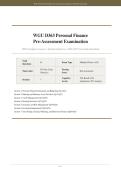
WGU D363 Personal Finance Pre-Assessment Examination | 2026-2027 Curriculum
WGU D363 Personal Finance
Pre-Assessment Examination
100% Complete Answers | Already Graded A+ | 2026-2027 Curriculum Standards
Total
61 Exam Type Multiple Choice (A-D)
Questions
No Time Limit Passing
Time Limit Self-Assessment
(Practice) Score
Cognitive 30% Recall, 50%
Sections 7
Levels Application, 20% Analysis
Section 1: Personal Financial Statements and Budgeting (Q1-Q12)
Section 2: Banking and Monetary Asset Providers (Q13-Q22)
Section 3: Credit Management (Q23-Q30)
Section 4: Housing Decisions (Q31-Q38)
Section 5: Insurance and Risk Management (Q39-Q48)
Section 6: Investing Fundamentals (Q49-Q55)
Section 7: Goal Setting, Financial Planning, and Behavioral Finance (Q56-Q61)
Page 1
, WGU D363 Personal Finance Pre-Assessment Examination | 2026-2027 Curriculum
Section 1: Personal Financial Statements and Budgeting
Cash-Flow Statements, Balance Sheets, Net Worth, and Budgeting Ratios
Q1: Marcus is reviewing his personal finances for the month of June. He lists his salary of $4,500, freelance
income of $800, rent of $1,200, groceries of $400, utility bills of $150, entertainment of $250, and credit card
payment of $350. Which financial statement should Marcus use to organize these inflows and outflows for the
month?
A. Balance Sheet
B. Cash-Flow Statement [CORRECT]
C. Net Worth Statement
D. Tax Return
Correct Answer: B
Rationale: A Cash-Flow Statement lists all income and expenses for a given period, providing a snapshot of cash inflows
and outflows. Marcus needs this statement to track his monthly income ($4,500 + $800) against his expenses ($1,200 +
$400 + $150 + $250 + $350). A Balance Sheet provides assets, liabilities, and net worth at a point in time, not periodic
income and expenses. A Net Worth Statement is a summary derived from the Balance Sheet, not a cash tracking tool. A Tax
Return is an annual filing for tax purposes.
Q2: Sarah owns a home valued at $280,000 with a mortgage balance of $195,000. She has $12,000 in a savings
account, $5,000 in a retirement account, a car worth $18,000 with a $10,000 auto loan, and $3,000 in credit card
debt. What is Sarah's net worth?
A. $102,000
B. $107,000 [CORRECT]
C. $115,000
D. $98,000
Correct Answer: B
Rationale: Net worth is calculated by subtracting total liabilities from total assets. Sarah's total assets are $315,000
($280,000 home + $12,000 savings + $5,000 retirement + $18,000 car). Her total liabilities are $208,000 ($195,000
mortgage + $10,000 auto loan + $3,000 credit card). Net worth = $315,000 - $208,000 = $107,000. Option A incorrectly
subtracts only the mortgage from the home value. Option C miscalculates the sum. Option D omits one of the asset
categories.
Q3: David has total assets of $185,000 and total debts of $72,000. What is his asset-to-debt ratio, and what does
this ratio indicate about his financial position?
A. 0.39; David has more debt than assets, indicating financial distress
B. 2.57; David has a strong financial position with sufficient assets to cover his
debts [CORRECT]
C. 1.39; David's assets barely exceed his debts, indicating a risky position
D. 0.61; David's debt level is unsustainable relative to his income
Correct Answer: B
Page 2
, WGU D363 Personal Finance Pre-Assessment Examination | 2026-2027 Curriculum
Rationale: The Asset-to-Debt Ratio is calculated by dividing total assets by total debt: $185,000 / $72,000 = 2.57. A high
ratio is desirable because it indicates the individual owns enough monetary value to meet debt obligations. A ratio above 2.0
is generally considered strong. Option A inverts the formula (debt/assets). Option C subtracts rather than divides. Option D
uses an incorrect formula and conflates the ratio with income-based metrics.
Q4: Lisa is trying to reduce her monthly spending. She currently pays $1,400 for rent, $300 for a car payment,
$180 for auto insurance, $250 for groceries, and $350 for dining out and entertainment. Which of these expenses
should Lisa target first to save money each month?
A. Rent, because it is the largest expense
B. Car payment, because transportation is unnecessary
C. Dining out and entertainment, because these are variable expenses she can
control [CORRECT]
D. Auto insurance, because it is a recurring monthly bill
Correct Answer: C
Rationale: Variable expenses are expenses which an individual has control over and where one can look to save money each
month. Dining out and entertainment ($350) are discretionary variable expenses that Lisa can reduce or eliminate without
affecting essential needs. Rent, car payments, and auto insurance are generally fixed or committed expenses that are harder
to adjust in the short term. While rent is the largest expense, it is a fixed commitment under a lease agreement.
Q5: James has a credit card balance of $4,500, a medical bill of $800 due in 6 months, a 30-year mortgage of
$210,000, and a student loan of $35,000 with 10 years remaining. Which of these debts is classified as a
short-term liability?
A. The mortgage, because it has the highest balance
B. The student loan, because it will be paid off within 10 years
C. The credit card balance and the medical bill, because they can be paid off
within one year [CORRECT]
D. The mortgage and student loan, because they are installment debts
Correct Answer: C
Rationale: Short-term liabilities are debts that can be paid off within one year. The credit card balance of $4,500 and the
medical bill of $800 (due in 6 months) both qualify as short-term liabilities because they can be settled within 12 months.
The mortgage ($210,000 over 30 years) and student loan ($35,000 over 10 years) are long-term liabilities. Classification
depends on the repayment timeline, not the type of debt or the size of the balance.
Q6: Jennifer wants to turn her bad financial habits into good ones. She frequently misses payment deadlines and
incurs late fees and interest charges. What is the most effective single suggestion to help Jennifer improve her
financial habits?
A. Open a new credit card with a lower interest rate
B. Pay all monthly bills on time to avoid late fees or interest [CORRECT]
C. Consolidate all debts into a single loan
D. Hire a financial advisor to manage her money
Correct Answer: B
Rationale: Paying all monthly bills on time is the primary suggestion for turning bad financial habits into good ones
because it directly addresses the problem of late fees and interest charges. The WGU D363 curriculum identifies on-time
bill payment as the foundational habit from which all other positive financial behaviors flow. Opening a new credit card
does not address the underlying habit. Consolidation may help structurally but does not change behavior.
Page 3
WGU D363 Personal Finance
Pre-Assessment Examination
100% Complete Answers | Already Graded A+ | 2026-2027 Curriculum Standards
Total
61 Exam Type Multiple Choice (A-D)
Questions
No Time Limit Passing
Time Limit Self-Assessment
(Practice) Score
Cognitive 30% Recall, 50%
Sections 7
Levels Application, 20% Analysis
Section 1: Personal Financial Statements and Budgeting (Q1-Q12)
Section 2: Banking and Monetary Asset Providers (Q13-Q22)
Section 3: Credit Management (Q23-Q30)
Section 4: Housing Decisions (Q31-Q38)
Section 5: Insurance and Risk Management (Q39-Q48)
Section 6: Investing Fundamentals (Q49-Q55)
Section 7: Goal Setting, Financial Planning, and Behavioral Finance (Q56-Q61)
Page 1
, WGU D363 Personal Finance Pre-Assessment Examination | 2026-2027 Curriculum
Section 1: Personal Financial Statements and Budgeting
Cash-Flow Statements, Balance Sheets, Net Worth, and Budgeting Ratios
Q1: Marcus is reviewing his personal finances for the month of June. He lists his salary of $4,500, freelance
income of $800, rent of $1,200, groceries of $400, utility bills of $150, entertainment of $250, and credit card
payment of $350. Which financial statement should Marcus use to organize these inflows and outflows for the
month?
A. Balance Sheet
B. Cash-Flow Statement [CORRECT]
C. Net Worth Statement
D. Tax Return
Correct Answer: B
Rationale: A Cash-Flow Statement lists all income and expenses for a given period, providing a snapshot of cash inflows
and outflows. Marcus needs this statement to track his monthly income ($4,500 + $800) against his expenses ($1,200 +
$400 + $150 + $250 + $350). A Balance Sheet provides assets, liabilities, and net worth at a point in time, not periodic
income and expenses. A Net Worth Statement is a summary derived from the Balance Sheet, not a cash tracking tool. A Tax
Return is an annual filing for tax purposes.
Q2: Sarah owns a home valued at $280,000 with a mortgage balance of $195,000. She has $12,000 in a savings
account, $5,000 in a retirement account, a car worth $18,000 with a $10,000 auto loan, and $3,000 in credit card
debt. What is Sarah's net worth?
A. $102,000
B. $107,000 [CORRECT]
C. $115,000
D. $98,000
Correct Answer: B
Rationale: Net worth is calculated by subtracting total liabilities from total assets. Sarah's total assets are $315,000
($280,000 home + $12,000 savings + $5,000 retirement + $18,000 car). Her total liabilities are $208,000 ($195,000
mortgage + $10,000 auto loan + $3,000 credit card). Net worth = $315,000 - $208,000 = $107,000. Option A incorrectly
subtracts only the mortgage from the home value. Option C miscalculates the sum. Option D omits one of the asset
categories.
Q3: David has total assets of $185,000 and total debts of $72,000. What is his asset-to-debt ratio, and what does
this ratio indicate about his financial position?
A. 0.39; David has more debt than assets, indicating financial distress
B. 2.57; David has a strong financial position with sufficient assets to cover his
debts [CORRECT]
C. 1.39; David's assets barely exceed his debts, indicating a risky position
D. 0.61; David's debt level is unsustainable relative to his income
Correct Answer: B
Page 2
, WGU D363 Personal Finance Pre-Assessment Examination | 2026-2027 Curriculum
Rationale: The Asset-to-Debt Ratio is calculated by dividing total assets by total debt: $185,000 / $72,000 = 2.57. A high
ratio is desirable because it indicates the individual owns enough monetary value to meet debt obligations. A ratio above 2.0
is generally considered strong. Option A inverts the formula (debt/assets). Option C subtracts rather than divides. Option D
uses an incorrect formula and conflates the ratio with income-based metrics.
Q4: Lisa is trying to reduce her monthly spending. She currently pays $1,400 for rent, $300 for a car payment,
$180 for auto insurance, $250 for groceries, and $350 for dining out and entertainment. Which of these expenses
should Lisa target first to save money each month?
A. Rent, because it is the largest expense
B. Car payment, because transportation is unnecessary
C. Dining out and entertainment, because these are variable expenses she can
control [CORRECT]
D. Auto insurance, because it is a recurring monthly bill
Correct Answer: C
Rationale: Variable expenses are expenses which an individual has control over and where one can look to save money each
month. Dining out and entertainment ($350) are discretionary variable expenses that Lisa can reduce or eliminate without
affecting essential needs. Rent, car payments, and auto insurance are generally fixed or committed expenses that are harder
to adjust in the short term. While rent is the largest expense, it is a fixed commitment under a lease agreement.
Q5: James has a credit card balance of $4,500, a medical bill of $800 due in 6 months, a 30-year mortgage of
$210,000, and a student loan of $35,000 with 10 years remaining. Which of these debts is classified as a
short-term liability?
A. The mortgage, because it has the highest balance
B. The student loan, because it will be paid off within 10 years
C. The credit card balance and the medical bill, because they can be paid off
within one year [CORRECT]
D. The mortgage and student loan, because they are installment debts
Correct Answer: C
Rationale: Short-term liabilities are debts that can be paid off within one year. The credit card balance of $4,500 and the
medical bill of $800 (due in 6 months) both qualify as short-term liabilities because they can be settled within 12 months.
The mortgage ($210,000 over 30 years) and student loan ($35,000 over 10 years) are long-term liabilities. Classification
depends on the repayment timeline, not the type of debt or the size of the balance.
Q6: Jennifer wants to turn her bad financial habits into good ones. She frequently misses payment deadlines and
incurs late fees and interest charges. What is the most effective single suggestion to help Jennifer improve her
financial habits?
A. Open a new credit card with a lower interest rate
B. Pay all monthly bills on time to avoid late fees or interest [CORRECT]
C. Consolidate all debts into a single loan
D. Hire a financial advisor to manage her money
Correct Answer: B
Rationale: Paying all monthly bills on time is the primary suggestion for turning bad financial habits into good ones
because it directly addresses the problem of late fees and interest charges. The WGU D363 curriculum identifies on-time
bill payment as the foundational habit from which all other positive financial behaviors flow. Opening a new credit card
does not address the underlying habit. Consolidation may help structurally but does not change behavior.
Page 3


