

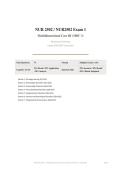
NUR 2502 / NUR2502 Exam 1
Multidimensional Care III (MDC 3)
Rasmussen University
Latest 2026/2027 Curriculum
Total Questions 75 Format Multiple Choice (A-D)
25% Recall / 55% Application 70% Scenario / 20% Recall /
Cognitive Levels Question Style
/ 20% Analysis 10% Clinical Judgment
Section 1: Oncology Nursing (Q1-Q15)
Section 2: Hematologic Disorders (Q16-Q25)
Section 3: Immunologic Disorders (Q26-Q35)
Section 4: Musculoskeletal Disorders (Q36-Q45)
Section 5: Integumentary Disorders (Q46-Q55)
Section 6: Sensory and Neurological Disorders (Q56-Q65)
Section 7: Integrated Clinical Scenarios (Q66-Q75)
NUR 2502 Exam 1 | Multidimensional Care III | Rasmussen University | 2026/2027 Page 1
,Section 1: Oncology Nursing (Cancer Pathophysiology, Staging, Treatment
Modalities, and Nursing Care) - Q1-Q15
1. A nurse educator is teaching student nurses about the three stages of carcinogenesis. Which of the following
sequences correctly describes the carcinogenesis process from initiation to progression?
A. Initiation, Promotion, Progression
B. Promotion, Initiation, Progression
C. Progression, Initiation, Promotion
D. Initiation, Progression, Promotion
Correct Answer: A
Rationale: Carcinogenesis occurs in three stages: initiation involves an irreversible genetic mutation from a carcinogen;
promotion involves reversible stimulation of mutated cells to proliferate through promoting agents; and progression
involves additional mutations leading to malignant transformation with invasive and metastatic capabilities. This sequence
is foundational to understanding cancer biology in the Rasmussen MDC 3 curriculum. Options B and C reverse the
correct order, and option D omits the promotion stage entirely.
2. A patient diagnosed with colon cancer is found to have a 3 cm primary tumor, regional lymph node
involvement with 3 positive nodes, and no distant metastasis on imaging. According to the TNM staging system,
how should the nurse interpret these findings?
A. T1, N1, M0
B. T2, N2, M0
C. T2, N1, M0
D. T3, N1, M0
Correct Answer: D
Rationale: The TNM staging system evaluates tumor size/extension (T), regional lymph node involvement (N), and
distant metastasis (M). A 3 cm colon tumor that extends through the muscularis propria but not into adjacent structures is
classified as T3. Regional lymph node involvement with 1-3 positive nodes is N1. No distant metastasis is M0. This
patient is staged as T3, N1, M0, indicating locally advanced disease requiring comprehensive oncologic treatment
planning per Rasmussen MDC 3 protocols.
3. A pathology report reveals a well-differentiated, encapsulated tumor that has not invaded surrounding tissue.
The nurse understands that this tumor is most likely:
A. Malignant because it is well-differentiated
B. Benign because it is encapsulated and non-invasive
C. Malignant because it is growing slowly
D. Benign because it has rapid growth
Correct Answer: B
Rationale: Benign tumors are characterized by being well-differentiated, encapsulated, non-invasive, and having slow
growth patterns. They remain localized and do not metastasize. Malignant tumors, in contrast, are poorly differentiated,
invasive, non-encapsulated, and have rapid growth with metastatic potential. Option A is incorrect because
well-differentiation is a characteristic of benign tumors. Options C and D are incorrect because rapid growth is associated
NUR 2502 Exam 1 | Multidimensional Care III | Rasmussen University | 2026/2027 Page 2
, with malignancy, not benignancy.
4. A patient receiving doxorubicin (Adriamycin) for breast cancer reports increasing fatigue, shortness of breath,
and peripheral edema. The nurse recognizes these findings as potential signs of which serious adverse effect?
A. Nephrotoxicity
B. Hemorrhagic cystitis
C. Cardiotoxicity
D. Neurotoxicity
Correct Answer: C
Rationale: Doxorubicin is an anthracycline chemotherapeutic agent well known for its dose-dependent cardiotoxicity,
which can lead to cardiomyopathy and congestive heart failure. Clinical manifestations include fatigue, dyspnea,
peripheral edema, and decreased ejection fraction. Nephrotoxicity is associated with cisplatin, hemorrhagic cystitis with
cyclophosphamide, and neurotoxicity with vincristine. Understanding medication-specific toxicities is essential for safe
oncology nursing practice per Rasmussen MDC 3 standards.
5. Which tumor suppressor gene is most commonly mutated in human cancers and plays a critical role in
regulating cell cycle arrest and apoptosis?
A. HER2/neu
B. p53
C. RAS
D. BRCA2
Correct Answer: B
Rationale: The p53 gene is the most commonly mutated tumor suppressor gene in human cancers, found in
approximately 50% of all malignancies. It functions as a guardian of the genome by regulating cell cycle arrest, DNA
repair, and apoptosis in response to cellular damage. HER2/neu and RAS are oncogenes that promote cell growth when
mutated. BRCA2 is a tumor suppressor gene specifically associated with hereditary breast and ovarian cancer, not the
most commonly mutated across all cancers.
6. A patient undergoing external beam radiation therapy for lung cancer develops dry cough, low-grade fever,
and dyspnea two weeks after completing treatment. The nurse anticipates that these symptoms are most
consistent with:
A. Radiation pneumonitis
B. Superior vena cava syndrome
C. Pulmonary embolism
D. Tumor lysis syndrome
Correct Answer: A
Rationale: Radiation pneumonitis is an inflammatory response of lung tissue to radiation exposure, typically occurring
1-3 months after treatment. Manifestations include dry cough, low-grade fever, dyspnea, and pleuritic chest pain. It is a
common complication when radiation fields include lung tissue. Superior vena cava syndrome presents with facial edema
and JVD; pulmonary embolism presents acutely with sharp chest pain; tumor lysis syndrome involves metabolic
abnormalities from rapid cell destruction.
NUR 2502 Exam 1 | Multidimensional Care III | Rasmussen University | 2026/2027 Page 3
Multidimensional Care III (MDC 3)
Rasmussen University
Latest 2026/2027 Curriculum
Total Questions 75 Format Multiple Choice (A-D)
25% Recall / 55% Application 70% Scenario / 20% Recall /
Cognitive Levels Question Style
/ 20% Analysis 10% Clinical Judgment
Section 1: Oncology Nursing (Q1-Q15)
Section 2: Hematologic Disorders (Q16-Q25)
Section 3: Immunologic Disorders (Q26-Q35)
Section 4: Musculoskeletal Disorders (Q36-Q45)
Section 5: Integumentary Disorders (Q46-Q55)
Section 6: Sensory and Neurological Disorders (Q56-Q65)
Section 7: Integrated Clinical Scenarios (Q66-Q75)
NUR 2502 Exam 1 | Multidimensional Care III | Rasmussen University | 2026/2027 Page 1
,Section 1: Oncology Nursing (Cancer Pathophysiology, Staging, Treatment
Modalities, and Nursing Care) - Q1-Q15
1. A nurse educator is teaching student nurses about the three stages of carcinogenesis. Which of the following
sequences correctly describes the carcinogenesis process from initiation to progression?
A. Initiation, Promotion, Progression
B. Promotion, Initiation, Progression
C. Progression, Initiation, Promotion
D. Initiation, Progression, Promotion
Correct Answer: A
Rationale: Carcinogenesis occurs in three stages: initiation involves an irreversible genetic mutation from a carcinogen;
promotion involves reversible stimulation of mutated cells to proliferate through promoting agents; and progression
involves additional mutations leading to malignant transformation with invasive and metastatic capabilities. This sequence
is foundational to understanding cancer biology in the Rasmussen MDC 3 curriculum. Options B and C reverse the
correct order, and option D omits the promotion stage entirely.
2. A patient diagnosed with colon cancer is found to have a 3 cm primary tumor, regional lymph node
involvement with 3 positive nodes, and no distant metastasis on imaging. According to the TNM staging system,
how should the nurse interpret these findings?
A. T1, N1, M0
B. T2, N2, M0
C. T2, N1, M0
D. T3, N1, M0
Correct Answer: D
Rationale: The TNM staging system evaluates tumor size/extension (T), regional lymph node involvement (N), and
distant metastasis (M). A 3 cm colon tumor that extends through the muscularis propria but not into adjacent structures is
classified as T3. Regional lymph node involvement with 1-3 positive nodes is N1. No distant metastasis is M0. This
patient is staged as T3, N1, M0, indicating locally advanced disease requiring comprehensive oncologic treatment
planning per Rasmussen MDC 3 protocols.
3. A pathology report reveals a well-differentiated, encapsulated tumor that has not invaded surrounding tissue.
The nurse understands that this tumor is most likely:
A. Malignant because it is well-differentiated
B. Benign because it is encapsulated and non-invasive
C. Malignant because it is growing slowly
D. Benign because it has rapid growth
Correct Answer: B
Rationale: Benign tumors are characterized by being well-differentiated, encapsulated, non-invasive, and having slow
growth patterns. They remain localized and do not metastasize. Malignant tumors, in contrast, are poorly differentiated,
invasive, non-encapsulated, and have rapid growth with metastatic potential. Option A is incorrect because
well-differentiation is a characteristic of benign tumors. Options C and D are incorrect because rapid growth is associated
NUR 2502 Exam 1 | Multidimensional Care III | Rasmussen University | 2026/2027 Page 2
, with malignancy, not benignancy.
4. A patient receiving doxorubicin (Adriamycin) for breast cancer reports increasing fatigue, shortness of breath,
and peripheral edema. The nurse recognizes these findings as potential signs of which serious adverse effect?
A. Nephrotoxicity
B. Hemorrhagic cystitis
C. Cardiotoxicity
D. Neurotoxicity
Correct Answer: C
Rationale: Doxorubicin is an anthracycline chemotherapeutic agent well known for its dose-dependent cardiotoxicity,
which can lead to cardiomyopathy and congestive heart failure. Clinical manifestations include fatigue, dyspnea,
peripheral edema, and decreased ejection fraction. Nephrotoxicity is associated with cisplatin, hemorrhagic cystitis with
cyclophosphamide, and neurotoxicity with vincristine. Understanding medication-specific toxicities is essential for safe
oncology nursing practice per Rasmussen MDC 3 standards.
5. Which tumor suppressor gene is most commonly mutated in human cancers and plays a critical role in
regulating cell cycle arrest and apoptosis?
A. HER2/neu
B. p53
C. RAS
D. BRCA2
Correct Answer: B
Rationale: The p53 gene is the most commonly mutated tumor suppressor gene in human cancers, found in
approximately 50% of all malignancies. It functions as a guardian of the genome by regulating cell cycle arrest, DNA
repair, and apoptosis in response to cellular damage. HER2/neu and RAS are oncogenes that promote cell growth when
mutated. BRCA2 is a tumor suppressor gene specifically associated with hereditary breast and ovarian cancer, not the
most commonly mutated across all cancers.
6. A patient undergoing external beam radiation therapy for lung cancer develops dry cough, low-grade fever,
and dyspnea two weeks after completing treatment. The nurse anticipates that these symptoms are most
consistent with:
A. Radiation pneumonitis
B. Superior vena cava syndrome
C. Pulmonary embolism
D. Tumor lysis syndrome
Correct Answer: A
Rationale: Radiation pneumonitis is an inflammatory response of lung tissue to radiation exposure, typically occurring
1-3 months after treatment. Manifestations include dry cough, low-grade fever, dyspnea, and pleuritic chest pain. It is a
common complication when radiation fields include lung tissue. Superior vena cava syndrome presents with facial edema
and JVD; pulmonary embolism presents acutely with sharp chest pain; tumor lysis syndrome involves metabolic
abnormalities from rapid cell destruction.
NUR 2502 Exam 1 | Multidimensional Care III | Rasmussen University | 2026/2027 Page 3


