
QUIZ 1 LAB QUIZ : Hemodynamic disorders
PRELIMS
QUIZ 1 LAB QUIZ : Hemodynamic disorders
1. 1. The most common site of origin for venous thrombi leading to pulmonary
embolism is:
a) Ascending aorta
b) Portal vein
c) Deep leg veins
d) Right atrium
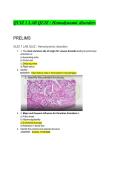
2. Identify
ANSWER : Heart failure cells or hemosiderin-macrophages
3. 3. Major and frequent influence for thrombus formation is:
a) Fatty streak
b) Hypercoagulability
c) Endothelial damage
d) Alteration in blood flow
4. Identify the pointed and asterisk structure
ANSWER : MURAL THROMBI
, 5. ANSWER: B. Arterial occlusion
QUIZ 2 : POST QUIZ : NEOPLASIA
1.A hallmark of this defect is microsatellite instability as encountered in hereditary nonpolyposis
colon cancer (HNPCC) syndrome (also known as Lynch syndrome).
a. Apoptosis
b. DNA excision repair
c. Homologous recombination repair
d. Mismatch repair
e. Translocation repair
2. A 69-year-old man, who is a chain-smoker, has had a cough and a 5-kg weight loss the past
3 months. He is afebrile. A chest radiograph is positive for hilar and mediastinal
lymphadenopathy. Laboratory studies show high serum calcium. Bronchoscopy shows a lesion
almost occluding the right main bronchus.
A surgical biopsy is attempted. Biopsy shows the microscopic image shown below.
,Which of the following routes of tumor metastasis accounts for these findings?
a. Direct tumor extension
b. Hematogenous spread
c. Lymphatic spread
d. Seeding of body cavity
3. A 44-year-old sexually active woman undergoes a routine physical examination. There are no
abnormal findings. A Pap smear is obtained as part of the pelvic examination. Cytologically, the
cells obtained on the smear from the cervix show marked epithelial dysplasia, as shown below
Which of the following therapeutic options is most appropriate for this woman?
a. Antimicrobial therapy
b. Excision
c. Removal of affected ovary
d. Screening of family members
e. Watchful waiting and close clinical follow-up
4. a 10-year-old, previously healthy boy has had pain in the right leg for the past month. There is
no history of trauma or recent illness. On physical examination, there is warmth and tenderness
to palpation of the right lower thigh anteriorly, and the circumference of the right thigh is slightly
larger than that of the left. His temperature is 36.5° C.
A radiograph of the right leg shows a 6-cm expansile mass in the diaphyseal region of the right
lower femur that extends into the soft tissue and is covered by layers of reactive bone. A biopsy
of the mass is done and shown below
Which of the following translocations is associated with this condition?
a. (8;14)
b. (8;21)
c. (9;22)
, d. (11;14)
e. (11;22)
5. Name the malignant tumor derived from skeletal muscle
ANSWER : Rhabdomyosarcoma
QUIZ 3 : POST QUIZ : 4- CSF
1. Which among the CSF specimens below is highly diagnostic for a traumatic tap?
a. A CSF specimen where the blood is uniform throughout all three tubes
b. A CSF specimen where the blood is abundant in tube #1 and gradually diminishes
in tube #2 and #3.
2. Which is the correct order of collection of the three CSF tubes?
a. Chemistry/serology, hematology, microbiology
b. Microbiology, hematology, chemistry/serology
c. Chemistry/serology, microbiology, hematology
d. Microbiology, chemistry/serology, hematology
3. Which among the CSF specimen below is highly diagnostic of a cerebral haemorrhage?
a. a CSF specimen where the blood is uniform throughout all three tubes
b. a CSF specimen where the blood is abundant in tube #1 and gradually
diminishes in tube #2 and #3.
4. What stain is used to stain Cryptococcus neoformans?
a. Giemsa stain
b. Congo red
c. Hematoxylin and eosin
d. India ink
5. What is the most common test done on CSF?
a. Reticulocyte count
b. Platelet count
PRELIMS
QUIZ 1 LAB QUIZ : Hemodynamic disorders
1. 1. The most common site of origin for venous thrombi leading to pulmonary
embolism is:
a) Ascending aorta
b) Portal vein
c) Deep leg veins
d) Right atrium
2. Identify
ANSWER : Heart failure cells or hemosiderin-macrophages
3. 3. Major and frequent influence for thrombus formation is:
a) Fatty streak
b) Hypercoagulability
c) Endothelial damage
d) Alteration in blood flow
4. Identify the pointed and asterisk structure
ANSWER : MURAL THROMBI
, 5. ANSWER: B. Arterial occlusion
QUIZ 2 : POST QUIZ : NEOPLASIA
1.A hallmark of this defect is microsatellite instability as encountered in hereditary nonpolyposis
colon cancer (HNPCC) syndrome (also known as Lynch syndrome).
a. Apoptosis
b. DNA excision repair
c. Homologous recombination repair
d. Mismatch repair
e. Translocation repair
2. A 69-year-old man, who is a chain-smoker, has had a cough and a 5-kg weight loss the past
3 months. He is afebrile. A chest radiograph is positive for hilar and mediastinal
lymphadenopathy. Laboratory studies show high serum calcium. Bronchoscopy shows a lesion
almost occluding the right main bronchus.
A surgical biopsy is attempted. Biopsy shows the microscopic image shown below.
,Which of the following routes of tumor metastasis accounts for these findings?
a. Direct tumor extension
b. Hematogenous spread
c. Lymphatic spread
d. Seeding of body cavity
3. A 44-year-old sexually active woman undergoes a routine physical examination. There are no
abnormal findings. A Pap smear is obtained as part of the pelvic examination. Cytologically, the
cells obtained on the smear from the cervix show marked epithelial dysplasia, as shown below
Which of the following therapeutic options is most appropriate for this woman?
a. Antimicrobial therapy
b. Excision
c. Removal of affected ovary
d. Screening of family members
e. Watchful waiting and close clinical follow-up
4. a 10-year-old, previously healthy boy has had pain in the right leg for the past month. There is
no history of trauma or recent illness. On physical examination, there is warmth and tenderness
to palpation of the right lower thigh anteriorly, and the circumference of the right thigh is slightly
larger than that of the left. His temperature is 36.5° C.
A radiograph of the right leg shows a 6-cm expansile mass in the diaphyseal region of the right
lower femur that extends into the soft tissue and is covered by layers of reactive bone. A biopsy
of the mass is done and shown below
Which of the following translocations is associated with this condition?
a. (8;14)
b. (8;21)
c. (9;22)
, d. (11;14)
e. (11;22)
5. Name the malignant tumor derived from skeletal muscle
ANSWER : Rhabdomyosarcoma
QUIZ 3 : POST QUIZ : 4- CSF
1. Which among the CSF specimens below is highly diagnostic for a traumatic tap?
a. A CSF specimen where the blood is uniform throughout all three tubes
b. A CSF specimen where the blood is abundant in tube #1 and gradually diminishes
in tube #2 and #3.
2. Which is the correct order of collection of the three CSF tubes?
a. Chemistry/serology, hematology, microbiology
b. Microbiology, hematology, chemistry/serology
c. Chemistry/serology, microbiology, hematology
d. Microbiology, chemistry/serology, hematology
3. Which among the CSF specimen below is highly diagnostic of a cerebral haemorrhage?
a. a CSF specimen where the blood is uniform throughout all three tubes
b. a CSF specimen where the blood is abundant in tube #1 and gradually
diminishes in tube #2 and #3.
4. What stain is used to stain Cryptococcus neoformans?
a. Giemsa stain
b. Congo red
c. Hematoxylin and eosin
d. India ink
5. What is the most common test done on CSF?
a. Reticulocyte count
b. Platelet count


