Test Bank For An Introduction to Genetic Analysis, 11th Edition By
Anthony Griffiths Susan Wessler Sean Carroll John Doebley (All
Chapters 1-20, 100% Original Verified, A+ Grade)
This is The Only Test Bank For An Introduction to Genetic Analysis,
11th Edition By Anthony Griffiths Susan Wessler Sean Carroll John
Doebley All Other Files in The Market are Fake/Old/Wrong Edition.
The Textbook This Document Fully Covers
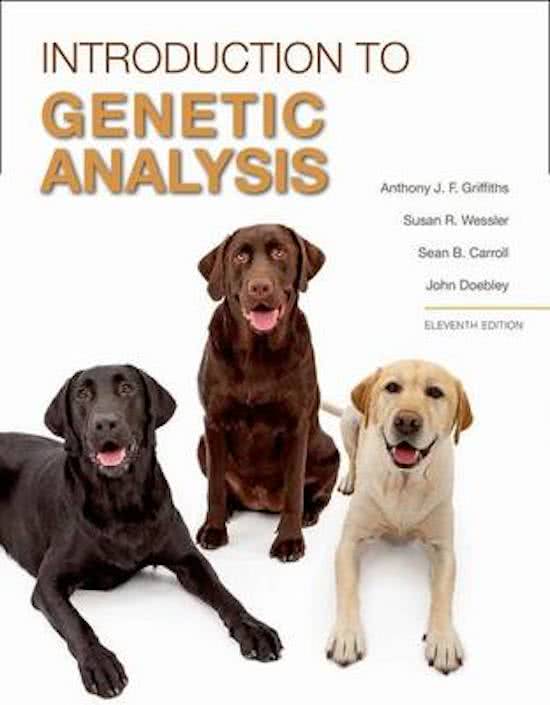
An Introduction to Genetic Analysis, 11e Anthony Griffiths Susan
Wessler Sean Carroll John Doebley
• Publisher : W. H. Freeman
• Publication date : January 12, 2015
• Edition : 11th ed.
• Language : English
• Print length : 896 pages
• ISBN-10 : 1464109486
• ISBN-13 : 978-1464109485
, Test Bank for An Introduction to Genetic
Analysis 11e Anthony Griffiths Susan Wessler
Sean Carroll John Doebley
Test Bank for An Introduction to Genetic
Analysis 11e Anthony Griffiths Susan Wessler
Sean Carroll John Doebley (All Chapters)
Chapter 1
The Genetics Revolution
MULTIPLE-CHOICE QUESTIONS
Section 1.1 (The birth of genetics)
1. The early 1900s was an important period for genetics due to which of the following
major events?
A) the rediscovery of Gregor Mendel’s scientific findings
B) Watson and Crick solving the structure of DNA
C) Walter Sutton and Theodore Boveri hypothesizing that chromosomes are the
hereditary elements
D) All of the answer options are correct.
E) the rediscovery of Gregor Mendel’s scientific findings and Walter Sutton and
Theodore Boveri hypothesizing that chromosomes are the hereditary elements
Answer: E
2. A sample of normal double-stranded DNA was found to have a guanine content of
18%. What is the expected proportion of adenine?
A) 9%
B) 32%
C) 36%
D) 68%
E) 82%
Answer: B
3. In one strand of DNA the nucleotide sequence is 5'-ATGC-3'. The complementary
sequence in the other strand must be:
A) 3'-ATGC-5'.
B) 3'-TACG-5'.
C) 5'-ATCG-3'.
D) 5'-CGTA-3'.
Test Bank for An Introduction to Genetic
Analysis 11e Anthony Griffiths Susan Wessler
Sean Carroll John Doebley
,
, Test Bank for An Introduction to Genetic
Analysis 11e Anthony Griffiths Susan Wessler
Sean Carroll John Doebley
E) 5'-TACG-3'.
Answer: B
4. How many different DNA molecules that are eight-nucleotide pairs long are
theoretically possible?
A) 24
B) 32
C) 64
D) 256
E) 65,536
Answer: E
5. Which of the following is/are FALSE about genes?
A) Genes are located on chromosomes.
B) Genes come in variants known as alleles.
C) Genes always encode protein products.
D) All of the answer options are correct.
E) None of the answer options are correct.
Answer: C
6. Wild cats (Felis silvestris) and common mice (Mus musculus) are diploid. In wild cats
2n = 38, while in common mice 2n = 40. Based on this information, we can conclude that
wild cat cells have:
A) less DNA than common mouse cells.
B) smaller genomes than common mouse cells.
C) fewer DNA molecules than common mouse cells.
D) fewer genes than common mouse cells.
E) fewer sets of chromosomes than common mouse cells.
Answer: C
7. Which of the following is a component of DNA?
A) alanine
B) arginine
C) cysteine
D) guanidine
E) tyrosine
Answer: D
Test Bank for An Introduction to Genetic
Analysis 11e Anthony Griffiths Susan Wessler
Sean Carroll John Doebley
Anthony Griffiths Susan Wessler Sean Carroll John Doebley (All
Chapters 1-20, 100% Original Verified, A+ Grade)
This is The Only Test Bank For An Introduction to Genetic Analysis,
11th Edition By Anthony Griffiths Susan Wessler Sean Carroll John
Doebley All Other Files in The Market are Fake/Old/Wrong Edition.
The Textbook This Document Fully Covers
An Introduction to Genetic Analysis, 11e Anthony Griffiths Susan
Wessler Sean Carroll John Doebley
• Publisher : W. H. Freeman
• Publication date : January 12, 2015
• Edition : 11th ed.
• Language : English
• Print length : 896 pages
• ISBN-10 : 1464109486
• ISBN-13 : 978-1464109485
, Test Bank for An Introduction to Genetic
Analysis 11e Anthony Griffiths Susan Wessler
Sean Carroll John Doebley
Test Bank for An Introduction to Genetic
Analysis 11e Anthony Griffiths Susan Wessler
Sean Carroll John Doebley (All Chapters)
Chapter 1
The Genetics Revolution
MULTIPLE-CHOICE QUESTIONS
Section 1.1 (The birth of genetics)
1. The early 1900s was an important period for genetics due to which of the following
major events?
A) the rediscovery of Gregor Mendel’s scientific findings
B) Watson and Crick solving the structure of DNA
C) Walter Sutton and Theodore Boveri hypothesizing that chromosomes are the
hereditary elements
D) All of the answer options are correct.
E) the rediscovery of Gregor Mendel’s scientific findings and Walter Sutton and
Theodore Boveri hypothesizing that chromosomes are the hereditary elements
Answer: E
2. A sample of normal double-stranded DNA was found to have a guanine content of
18%. What is the expected proportion of adenine?
A) 9%
B) 32%
C) 36%
D) 68%
E) 82%
Answer: B
3. In one strand of DNA the nucleotide sequence is 5'-ATGC-3'. The complementary
sequence in the other strand must be:
A) 3'-ATGC-5'.
B) 3'-TACG-5'.
C) 5'-ATCG-3'.
D) 5'-CGTA-3'.
Test Bank for An Introduction to Genetic
Analysis 11e Anthony Griffiths Susan Wessler
Sean Carroll John Doebley
,
, Test Bank for An Introduction to Genetic
Analysis 11e Anthony Griffiths Susan Wessler
Sean Carroll John Doebley
E) 5'-TACG-3'.
Answer: B
4. How many different DNA molecules that are eight-nucleotide pairs long are
theoretically possible?
A) 24
B) 32
C) 64
D) 256
E) 65,536
Answer: E
5. Which of the following is/are FALSE about genes?
A) Genes are located on chromosomes.
B) Genes come in variants known as alleles.
C) Genes always encode protein products.
D) All of the answer options are correct.
E) None of the answer options are correct.
Answer: C
6. Wild cats (Felis silvestris) and common mice (Mus musculus) are diploid. In wild cats
2n = 38, while in common mice 2n = 40. Based on this information, we can conclude that
wild cat cells have:
A) less DNA than common mouse cells.
B) smaller genomes than common mouse cells.
C) fewer DNA molecules than common mouse cells.
D) fewer genes than common mouse cells.
E) fewer sets of chromosomes than common mouse cells.
Answer: C
7. Which of the following is a component of DNA?
A) alanine
B) arginine
C) cysteine
D) guanidine
E) tyrosine
Answer: D
Test Bank for An Introduction to Genetic
Analysis 11e Anthony Griffiths Susan Wessler
Sean Carroll John Doebley