
1
ORGANIC CHEMISTRY II (2302)
Exam 4
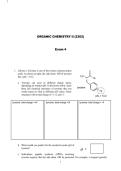
1. (28 pts) L-Tyrosine is one of the twenty common amino
acids. As shown at right, the side-chain -OH of tyrosine
has a pKa = 10.2.
a. Tyrosine can exist in different charge states,
depending on solution pH. In the boxes below, draw
three full chemical structures of tyrosine that you tyrosine
would expect to find at different pH values. Draw
structures with a total charge of +1, 0, and -1. pKa = 10.2
tyrosine, total charge = +1 tyrosine, total charge = 0 tyrosine, total charge = -1
b. What would you predict for the isoelectric point (pI) of
tyrosine? pI =
c. Solid-phase peptide synthesis (SPPS) involving
tyrosine requires that the side-chain -OH be protected. For example, a reagent typically
1
, 2
used in tBoc-based SPPS is tBoc-Tyr(Br-Z) (shown on the next page). This reagent bears
a bromobenzyloxycarbonyl (Br-Z) protecting group on the tyrosine -OH that is stable to
acids and bases, but is cleaved by hydrofluoric acid (HF).
2
ORGANIC CHEMISTRY II (2302)
Exam 4
1. (28 pts) L-Tyrosine is one of the twenty common amino
acids. As shown at right, the side-chain -OH of tyrosine
has a pKa = 10.2.
a. Tyrosine can exist in different charge states,
depending on solution pH. In the boxes below, draw
three full chemical structures of tyrosine that you tyrosine
would expect to find at different pH values. Draw
structures with a total charge of +1, 0, and -1. pKa = 10.2
tyrosine, total charge = +1 tyrosine, total charge = 0 tyrosine, total charge = -1
b. What would you predict for the isoelectric point (pI) of
tyrosine? pI =
c. Solid-phase peptide synthesis (SPPS) involving
tyrosine requires that the side-chain -OH be protected. For example, a reagent typically
1
, 2
used in tBoc-based SPPS is tBoc-Tyr(Br-Z) (shown on the next page). This reagent bears
a bromobenzyloxycarbonyl (Br-Z) protecting group on the tyrosine -OH that is stable to
acids and bases, but is cleaved by hydrofluoric acid (HF).
2


