

Written by students who passed Immediately available after payment Read online or as PDF Wrong document? Swap it for free 4.6 TrustPilot
logo-home
Document preview thumbnail
Preview 2 out of 14 pages
Exam (elaborations)

NUR 280 The Cell, Immobility & Obesity Exam 1 Study Guide | 180+ Exam Questions & 100% Verified Answers | Cellular Injury, Cell Adaptation, Immobility, Obesity & Pathophysiology

Document preview thumbnail
Preview 2 out of 14 pages

Prepare for NUR 280 The Cell, Immobility & Obesity Exam 1 with this comprehensive study guide featuring 180+ exam questions and 100% verified answers covering the essential concepts of cell biology, cellular adaptation, cellular injury, immobility, obesity, and evidence-based nursing care. This resource provides in-depth coverage of plasma membrane structure and function, glycoproteins, sodium-potassium pump, mitochondria, rough endoplasmic reticulum, ribosomes, nucleus, DNA transcription, mRNA, tRNA, rRNA, cellular homeostasis, etiologic agents of cellular injury, hypoxia, free radical injury, adaptive cellular changes (atrophy, hypertrophy, hyperplasia, metaplasia), maladaptive cellular changes (dysplasia and neoplasia), apoptosis, necrosis, infarction, gangrene, effects of immobility on the musculoskeletal, cardiovascular, respiratory, urinary, gastrointestinal, integumentary, metabolic, and psychosocial systems, adipocytes, adipokines, adiponectin, leptin, resistin, obesity risk factors, and obesity management strategies. The guide also reinforces clinical manifestations, pathophysiology, nursing assessment, prevention strategies, patient education, and high-yield concepts commonly tested in NUR 280, ATI, HESI, and NCLEX-RN examinations. Presented in a structured question-and-answer format, this study guide is designed to strengthen critical thinking and improve performance on NUR 280 examinations, Foundations of Nursing, Pathophysiology courses, ATI assessments, HESI examinations, and NCLEX-RN preparation. Students will reinforce their understanding of cellular function, mechanisms of injury, adaptive and maladaptive cellular responses, obesity pathophysiology, metabolic regulation, complications of prolonged immobility, pressure injury prevention, venous thromboembolism, pulmonary complications, and evidence-based nursing interventions. With comprehensive coverage of fundamental cellular biology and pathophysiology concepts, this resource serves as an essential review tool for mastering foundational nursing knowledge, improving clinical reasoning, and building confidence for nursing school examinations and clinical practice. Relevant Students: NUR 280 students Associate Degree in Nursing (ADN) students Bachelor of Science in Nursing (BSN) students Foundations of Nursing students Pathophysiology students Medical-Surgical Nursing students Registered Nurse (RN) students Practical Nursing (LPN/LVN) students Pre-licensure nursing students ATI examination candidates HESI examination candidates NCLEX-RN candidates Allied Health students Healthcare professionals reviewing cellular physiology and pathophysiology APA References McCance, K. L., & Huether, S. E. (2023). Pathophysiology: The Biologic Basis for Disease in Adults and Children (9th ed.). Elsevier. Porth, C. M. (2022). Essentials of Pathophysiology: Concepts of Altered Health States (5th ed.). Wolters Kluwer. Hinkle, J. L., & Cheever, K. H. (2021). Brunner & Suddarth's Textbook of Medical-Surgical Nursing (15th ed.). Wolters Kluwer. Lewis, S. L., Bucher, L., Heitkemper, M. M., Harding, M. M., Kwong, J., & Roberts, D. (2023). Lewis's Medical-Surgical Nursing: Assessment and Management of Clinical Problems (12th ed.). Elsevier. National Council of State Boards of Nursing. (2023). NCLEX-RN Test Plan. National Council of State Boards of Nursing. Keywords NUR 280, NUR 280 Exam 1, The Cell, cellular physiology, cell biology, plasma membrane, glycoproteins, sodium potassium pump, mitochondria, ribosomes, rough endoplasmic reticulum, nucleus, DNA transcription, mRNA, tRNA, rRNA, cellular homeostasis, cellular injury, hypoxia, free radicals, apoptosis, necrosis, infarction, gangrene, atrophy, hypertrophy, hyperplasia, metaplasia, dysplasia, neoplasia, benign tumors, malignant tumors, immobility, pressure injuries, pressure ulcers, venous thromboembolism, pulmonary embolism, atelectasis, urinary stasis, constipation, muscle atrophy, obesity, adipocytes, adipokines, adiponectin, leptin, resistin, insulin resistance, pathophysiology, nursing interventions, ATI, HESI, NCLEX, exam questions, verified answers, study guide

Content preview

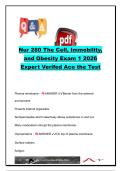
Nur 280 The Cell, Immobility,
and Obesity Exam 1 2026
Expert Verifed Ace the Test


Plasma membrane - ANSWER ✔✔Barrier from the external

environment

Protects internal organelles

Semipermeable which selectively allows substances in and out.

Many medications disrupt the plasma membrane.


Glycoproteins - ANSWER ✔✔On top of plasma membrane.


Surface makers

Antigen

, sodium-potassium pump - ANSWER ✔✔Within the wall of the plasma

membrane

Pushes sodium and potassium in and out of cell.

Need to have energy for pump to work.


Pump working= Sodium ions in higher concentrations outside

Pump working=Potassium ions higher concentrations inside the cell

Switch when the pump isn't working


Sodium potassium pump broken.... - ANSWER ✔✔Does not allow for

contraction of muscles which can cause heart attack.


Sodium ions when pump working - ANSWER ✔✔Sodium ions higher

concentration outside of cell


Potassium ions when pump is working - ANSWER ✔✔Potassium

ions higher concentration inside the cell


Mitochondria - ANSWER ✔✔Cells energy producer


Aerobic metabolism requires oxygen

Cellular hypoxia= anaerobic metabolism (glycolysis)

Unique distinctive DNA

Document information

Uploaded on
July 29, 2026
Number of pages
14
Written in
2025/2026
Type
Exam (elaborations)
Contains
Questions & answers
$18.99

Wrong document? Swap it for free Within 14 days of purchase and before downloading, you can choose a different document. You can simply spend the amount again.
Written by students who passed
Immediately available after payment
Read online or as PDF

Seller avatar
Reputation scores are based on the amount of documents a seller has sold for a fee and the reviews they have received for those documents. There are three levels: Bronze, Silver and Gold. The better the reputation, the more your can rely on the quality of the sellers work.
NinjaNerd
3.4
(76)
Sold
396
Followers
6
Items
15309
Last sold
1 day ago


Why students choose Stuvia

Created by fellow students, verified by reviews

Quality you can trust: written by students who passed their tests and reviewed by others who've used these notes.

Didn't get what you expected? Choose another document

No worries! You can instantly pick a different document that better fits what you're looking for.

Pay as you like, start learning right away

No subscription, no commitments. Pay the way you're used to via credit card and download your PDF document instantly.

Student with book image

“Bought, downloaded, and aced it. It really can be that simple.”

Alisha Student

Working on your references?

Create accurate citations in APA, MLA and Harvard with our free citation generator.

Working on your references?

Frequently asked questions

