

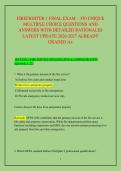
FIREFIGHTER 1 FINAL EXAM – 350 UNIQUE
MULTIPLE CHOICE QUESTIONS AND
ANSWERS WITH DETAILED RATIONALES
LATEST UPDATE 2026-2027 ALREADY
GRADED A+
SECTION 1: FIRE SERVICE ORGANIZATION & ADMINISTRATION
(Questions 1–25)
1. What is the primary mission of the fire service?
A) Enforce fire codes and conduct inspections
B) Save lives and protect property
C) Respond exclusively to fire emergencies
D) Provide emergency medical services only
Correct Answer: B) Save lives and protect property
Rationale: NFPA 1001 establishes that the primary mission of the fire service is
life safety and property conservation. While fire departments perform many
functions including inspections and EMS, the core mission remains protecting lives
and property from fire and other emergencies.
2. Which NFPA standard defines Firefighter I professional qualifications?
1
,A) NFPA 1002
B) NFPA 1001
C) NFPA 1500
D) NFPA 472
Correct Answer: B) NFPA 1001
Rationale: NFPA 1001 is the Standard for Fire Fighter Professional Qualifications.
NFPA 1002 covers driver/operator qualifications, NFPA 1500 covers fire
department occupational safety and health, and NFPA 472 covers hazardous
materials competencies.
3. A(an) ______ is a guide to decision making in an organization.
A) Policy
B) Standard
C) Procedure
D) Code
Correct Answer: A) Policy
Rationale: A policy is a guide to decision making within an organization. Policies
provide broad direction and establish parameters for actions and decisions.
2
,4. A(an) ______ is a set of principles or procedures developed by consensus.
A) Policy
B) Standard
C) Procedure
D) Ordinance
Correct Answer: B) Standard
Rationale: A standard is a set of principles or procedures developed by consensus
that provides guidelines for performance or practice. Standards are often developed
by organizations like NFPA.
5. A(an) ________ is a written step by step plan of action.
A) Policy
B) Standard
C) Procedure
D) Guideline
Correct Answer: C) Procedure
Rationale: A procedure is a written step by step plan of action that describes how
to perform specific tasks. Procedures ensure consistency and safety in operations.
3
, 6. A department type is determined by how:
A) The chief is selected
B) An organization is funded
C) Many personnel are employed
D) Many stations are operated
Correct Answer: B) An organization is funded
Rationale: Fire department types (career, volunteer, combination) are determined
by how the organization is funded. Career departments are funded through tax
revenue with paid personnel, while volunteer departments rely on volunteers.
7. A(an) ______ is a collection of rules enacted by law in a particular jurisdiction.
A) Policy
B) Standard
C) Procedure
D) Code
Correct Answer: D) Code
Rationale: A code is a collection of rules enacted by law in a particular jurisdiction.
Fire codes are legally enforceable regulations that govern building construction,
fire protection systems, and fire safety.
4
MULTIPLE CHOICE QUESTIONS AND
ANSWERS WITH DETAILED RATIONALES
LATEST UPDATE 2026-2027 ALREADY
GRADED A+
SECTION 1: FIRE SERVICE ORGANIZATION & ADMINISTRATION
(Questions 1–25)
1. What is the primary mission of the fire service?
A) Enforce fire codes and conduct inspections
B) Save lives and protect property
C) Respond exclusively to fire emergencies
D) Provide emergency medical services only
Correct Answer: B) Save lives and protect property
Rationale: NFPA 1001 establishes that the primary mission of the fire service is
life safety and property conservation. While fire departments perform many
functions including inspections and EMS, the core mission remains protecting lives
and property from fire and other emergencies.
2. Which NFPA standard defines Firefighter I professional qualifications?
1
,A) NFPA 1002
B) NFPA 1001
C) NFPA 1500
D) NFPA 472
Correct Answer: B) NFPA 1001
Rationale: NFPA 1001 is the Standard for Fire Fighter Professional Qualifications.
NFPA 1002 covers driver/operator qualifications, NFPA 1500 covers fire
department occupational safety and health, and NFPA 472 covers hazardous
materials competencies.
3. A(an) ______ is a guide to decision making in an organization.
A) Policy
B) Standard
C) Procedure
D) Code
Correct Answer: A) Policy
Rationale: A policy is a guide to decision making within an organization. Policies
provide broad direction and establish parameters for actions and decisions.
2
,4. A(an) ______ is a set of principles or procedures developed by consensus.
A) Policy
B) Standard
C) Procedure
D) Ordinance
Correct Answer: B) Standard
Rationale: A standard is a set of principles or procedures developed by consensus
that provides guidelines for performance or practice. Standards are often developed
by organizations like NFPA.
5. A(an) ________ is a written step by step plan of action.
A) Policy
B) Standard
C) Procedure
D) Guideline
Correct Answer: C) Procedure
Rationale: A procedure is a written step by step plan of action that describes how
to perform specific tasks. Procedures ensure consistency and safety in operations.
3
, 6. A department type is determined by how:
A) The chief is selected
B) An organization is funded
C) Many personnel are employed
D) Many stations are operated
Correct Answer: B) An organization is funded
Rationale: Fire department types (career, volunteer, combination) are determined
by how the organization is funded. Career departments are funded through tax
revenue with paid personnel, while volunteer departments rely on volunteers.
7. A(an) ______ is a collection of rules enacted by law in a particular jurisdiction.
A) Policy
B) Standard
C) Procedure
D) Code
Correct Answer: D) Code
Rationale: A code is a collection of rules enacted by law in a particular jurisdiction.
Fire codes are legally enforceable regulations that govern building construction,
fire protection systems, and fire safety.
4


