
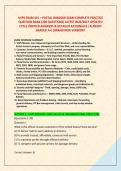
USPS EXAM 421 – POSTAL WINDOW EXAM COMPLETE PRACTICE
QUESTION BANK (300 QUESTIONS) LATEST 2026/2027 UPDATED
CYCLE VERIFIED ANSWERS & DETAILED RATIONALES |ALREADY
GRADED A+||BRAND NEW VERSION!!
EXAM COVERAGE SUMMARY
1. USPS Mission, Core Values & Organizational Structure – Understanding the
Postal Service's purpose, monopoly on First-Class Mail, and core responsibilities.
2. Customer Service Excellence – G.I.S.T. method, perception, active listening,
non-verbal communication, and building customer relationships.
3. Postal Products and Services – First-Class Mail, Priority Mail, Priority Mail
Express, Media Mail, Marketing Mail, Parcel Select, EDDM, and extra services.
4. Postal Forms and Documentation – PS Forms 3575, 3849, 1093, 3811, 1003, 3533,
3822, 1583, 3800, and proper form usage.
5. Financial Accountability and Payment Methods – Cash, credit/debit cards,
checks, money orders, PCI DSS compliance, Bank Secrecy Act (BSA), and SIA.
6. Mail Classes and Shipping Regulations – Weight limits, dimensional weight,
delivery timeframes, and class determination.
7. Hazardous Materials (HAZMAT) and Shipping Restrictions – Identifying
prohibited items, restricted materials, and dangerous goods per Publication 52.
8. Security and Mail Integrity – Theft, opening, damage, delay; USPIS role;
anonymous mail procedures.
9. Postal Manuals and Resources – DMM, IMM, ASM, POM, ELM, PolicyNet, Postal
Bulletin.
10. Retail Operations and Problem-Solving – Refunds, intercepts, forwarding,
general delivery, PO Box management, caller service, and day-to-day window
operations.
SECTION 1 – USPS MISSION, CORE VALUES & ORGANIZATIONAL STRUCTURE
(Questions 1-30)
Question 1
What is the official mission statement of the United States Postal Service?
A) To deliver mail to every address in America
B) To provide trusted, affordable, universal mail service
C) To maximize profits through efficient delivery
D) To compete with private carriers for package delivery
Correct Answer: B
1
,Rationale: The USPS mission is "To provide trusted, affordable, universal mail
service." This reflects the Postal Service's commitment to serving every American
with reliable and cost-effective mail delivery. The USPS is not profit-driven but
service-driven, and while it delivers to every address (A) and competes with
private carriers (D), these are aspects of the mission rather than the complete
statement.
Question 2
The USPS has a monopoly on which class of mail?
A) Priority Mail
B) First-Class Mail letters
C) Media Mail
D) Parcel Select
Correct Answer: B
Rationale: The USPS holds a legal monopoly on the delivery of First-Class Mail
letters. This means private carriers cannot deliver regular letters for a price
less than the USPS rate. This monopoly helps ensure universal service and
affordable mail delivery for all Americans. The other classes (A, C, D) are
open to competition.
Question 3
What is the 24-Hour Clock concept in USPS operations?
A) A system for tracking employee work hours
B) An end-to-end process to ensure mail is Collected, Distributed, and Delivered
C) A schedule for retail window hours
D) A method for calculating overtime pay
Correct Answer: B
Rationale: The 24-Hour Clock refers to the continuous end-to-end process of mail
2
,handling: Collection (from mailboxes, businesses, and retail counters),
Distribution (sorting and transportation), and Delivery (to the final address).
The USPS operates on a 24-hour cycle to ensure mail moves efficiently from
origin to destination. The other options are not accurate descriptions.
Question 4
What does the USPS abbreviation "FCM" stand for?
A) Federal Customer Mail
B) First-Class Mail
C) Final Carrier Manifest
D) Forwarded Commercial Mail
Correct Answer: B
Rationale: FCM stands for First-Class Mail. This is the primary class of mail
for letters, bills, and personal correspondence. It is the class over which the
USPS has a monopoly for letters under 13 ounces.
Question 5
Which of the following is a core responsibility of the USPS regarding mail in
its custody?
A) To open and inspect all mail for security purposes
B) To ensure the sanctity of the mail and preserve customer trust
C) To deliver mail only to verified addresses
D) To return all undeliverable mail to the sender
Correct Answer: B
Rationale: The USPS has a fundamental responsibility to protect the sanctity of
the mail and preserve customer trust. This means mail placed in USPS custody
must be protected from theft, opening, damage, or delay. Opening mail (A) is
not a routine function; it is only done under specific legal circumstances.
3
, Question 6
What are the four violations of mail security according to USPS policy?
A) Loss, Damage, Delay, and Misrouting
B) Theft, Opening, Damage, and Delay
C) Theft, Loss, Misdelivery, and Fraud
D) Opening, Copying, Delaying, and Discarding
Correct Answer: B
Rationale: The four violations of mail security are Theft, Opening, Damage, and
Delay. These are the primary ways mail integrity can be compromised. Any
suspected violation should be reported immediately to the USPS Inspection
Service. The other options include related but not the specific four violations.
Question 7
Which USPS division is responsible for investigating crimes involving the mail?
A) USPS Human Resources
B) USPS Office of Inspector General
C) USPS Postal Inspection Service (USPIS)
D) USPS Consumer Affairs
Correct Answer: C
Rationale: The United States Postal Inspection Service (USPIS) is the federal
law enforcement agency responsible for investigating crimes that involve the
mail, including mail fraud, theft, identity theft, and dangerous mail. The OIG
(B) focuses on internal audits and investigations of USPS employees and
contractors.
Question 8
What is the USPS's stance on "Perception" in customer service?
A) Perception is secondary to actual service quality
B) Perception is reality
4
QUESTION BANK (300 QUESTIONS) LATEST 2026/2027 UPDATED
CYCLE VERIFIED ANSWERS & DETAILED RATIONALES |ALREADY
GRADED A+||BRAND NEW VERSION!!
EXAM COVERAGE SUMMARY
1. USPS Mission, Core Values & Organizational Structure – Understanding the
Postal Service's purpose, monopoly on First-Class Mail, and core responsibilities.
2. Customer Service Excellence – G.I.S.T. method, perception, active listening,
non-verbal communication, and building customer relationships.
3. Postal Products and Services – First-Class Mail, Priority Mail, Priority Mail
Express, Media Mail, Marketing Mail, Parcel Select, EDDM, and extra services.
4. Postal Forms and Documentation – PS Forms 3575, 3849, 1093, 3811, 1003, 3533,
3822, 1583, 3800, and proper form usage.
5. Financial Accountability and Payment Methods – Cash, credit/debit cards,
checks, money orders, PCI DSS compliance, Bank Secrecy Act (BSA), and SIA.
6. Mail Classes and Shipping Regulations – Weight limits, dimensional weight,
delivery timeframes, and class determination.
7. Hazardous Materials (HAZMAT) and Shipping Restrictions – Identifying
prohibited items, restricted materials, and dangerous goods per Publication 52.
8. Security and Mail Integrity – Theft, opening, damage, delay; USPIS role;
anonymous mail procedures.
9. Postal Manuals and Resources – DMM, IMM, ASM, POM, ELM, PolicyNet, Postal
Bulletin.
10. Retail Operations and Problem-Solving – Refunds, intercepts, forwarding,
general delivery, PO Box management, caller service, and day-to-day window
operations.
SECTION 1 – USPS MISSION, CORE VALUES & ORGANIZATIONAL STRUCTURE
(Questions 1-30)
Question 1
What is the official mission statement of the United States Postal Service?
A) To deliver mail to every address in America
B) To provide trusted, affordable, universal mail service
C) To maximize profits through efficient delivery
D) To compete with private carriers for package delivery
Correct Answer: B
1
,Rationale: The USPS mission is "To provide trusted, affordable, universal mail
service." This reflects the Postal Service's commitment to serving every American
with reliable and cost-effective mail delivery. The USPS is not profit-driven but
service-driven, and while it delivers to every address (A) and competes with
private carriers (D), these are aspects of the mission rather than the complete
statement.
Question 2
The USPS has a monopoly on which class of mail?
A) Priority Mail
B) First-Class Mail letters
C) Media Mail
D) Parcel Select
Correct Answer: B
Rationale: The USPS holds a legal monopoly on the delivery of First-Class Mail
letters. This means private carriers cannot deliver regular letters for a price
less than the USPS rate. This monopoly helps ensure universal service and
affordable mail delivery for all Americans. The other classes (A, C, D) are
open to competition.
Question 3
What is the 24-Hour Clock concept in USPS operations?
A) A system for tracking employee work hours
B) An end-to-end process to ensure mail is Collected, Distributed, and Delivered
C) A schedule for retail window hours
D) A method for calculating overtime pay
Correct Answer: B
Rationale: The 24-Hour Clock refers to the continuous end-to-end process of mail
2
,handling: Collection (from mailboxes, businesses, and retail counters),
Distribution (sorting and transportation), and Delivery (to the final address).
The USPS operates on a 24-hour cycle to ensure mail moves efficiently from
origin to destination. The other options are not accurate descriptions.
Question 4
What does the USPS abbreviation "FCM" stand for?
A) Federal Customer Mail
B) First-Class Mail
C) Final Carrier Manifest
D) Forwarded Commercial Mail
Correct Answer: B
Rationale: FCM stands for First-Class Mail. This is the primary class of mail
for letters, bills, and personal correspondence. It is the class over which the
USPS has a monopoly for letters under 13 ounces.
Question 5
Which of the following is a core responsibility of the USPS regarding mail in
its custody?
A) To open and inspect all mail for security purposes
B) To ensure the sanctity of the mail and preserve customer trust
C) To deliver mail only to verified addresses
D) To return all undeliverable mail to the sender
Correct Answer: B
Rationale: The USPS has a fundamental responsibility to protect the sanctity of
the mail and preserve customer trust. This means mail placed in USPS custody
must be protected from theft, opening, damage, or delay. Opening mail (A) is
not a routine function; it is only done under specific legal circumstances.
3
, Question 6
What are the four violations of mail security according to USPS policy?
A) Loss, Damage, Delay, and Misrouting
B) Theft, Opening, Damage, and Delay
C) Theft, Loss, Misdelivery, and Fraud
D) Opening, Copying, Delaying, and Discarding
Correct Answer: B
Rationale: The four violations of mail security are Theft, Opening, Damage, and
Delay. These are the primary ways mail integrity can be compromised. Any
suspected violation should be reported immediately to the USPS Inspection
Service. The other options include related but not the specific four violations.
Question 7
Which USPS division is responsible for investigating crimes involving the mail?
A) USPS Human Resources
B) USPS Office of Inspector General
C) USPS Postal Inspection Service (USPIS)
D) USPS Consumer Affairs
Correct Answer: C
Rationale: The United States Postal Inspection Service (USPIS) is the federal
law enforcement agency responsible for investigating crimes that involve the
mail, including mail fraud, theft, identity theft, and dangerous mail. The OIG
(B) focuses on internal audits and investigations of USPS employees and
contractors.
Question 8
What is the USPS's stance on "Perception" in customer service?
A) Perception is secondary to actual service quality
B) Perception is reality
4


