

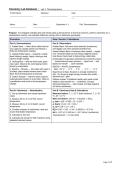
Chemistry Lab Notebook | Lab 1: Thermodynamics
Printed Name: Signature: Date:
_______________________ ___________________________ _____________________________
___
Name: Date: Experiment #: 1 Title: Thermodynamics
________________ _________________
Purpose: To investigate enthalpy (ΔH) and entropy (ΔS) as driving forces of chemical reactions, perform calorimetry on a
neutralization reaction, and calculate Gibbs free energy (ΔG) to determine spontaneity.
Procedure Data / Results / Calculations
Part A: Demonstrations Part A: Observations
1. Rubber Band — Hold a thick rubber band to Rubber Band: Felt warm when stretched (exothermic)
your upper lip. Quickly stretch and release it. and slightly cool when released (endothermic).
Note any temperature changes. Heated Rubber Band: Contracted when heated — weight
2. Heated Rubber Band — Suspend a rubber rose. Stretched state has low entropy (aligned chains);
band holding a weight. Apply a heat gun and heat drives chains back to high-entropy coiled state.
observe length change. Drinking Bird: Evaporation (endothermic) cooled the head
3. Drinking Bird — Wet the bird's head, place → lowered internal vapor pressure → liquid rose → bird
near water. Observe the cyclic tipping motion tipped and "drank" → cycle repeated.
driven by evaporation. Ba(OH)₂ + NH₄NO₃ temperatures:
4. Ba(OH)₂ + NH₄NO₃ — Mix solids with water in Start: ~22 °C → 8 °C → 2 °C → −4 °C → −8 °C
a beaker; place wetted wooden board under Board froze to flask. Reaction is strongly endothermic
flask. Record temperatures at intervals. (ΔH > 0), driven by large entropy increase (two solids →
5. Sodium Acetate — Add one seed crystal to aqueous ions + gas).
supersaturated solution in a test tube. Observe Sodium Acetate: Crystallized rapidly upon seed crystal
crystallization and touch to feel temperature addition; tube became hot → exothermic. Entropy
change. decreased (aqueous → solid crystal), but large negative
ΔH drives spontaneity.
Part B: Calorimetry — Neutralization Part B: Calorimetry Data & Calculations
1. Set up calorimeter (two nested styrofoam Measured values: T_i = 22 °C (both solutions), T_f = 35
cups). °C, ΔT = 13 °C
2. Measure 50 mL of 1.0 M HCl; record Mass of solution: 100 mL × 1.06 g/mL = 106 g
temperature. q_soln = 106 × 3.895 × 13 = 5,367 J
3. Measure 50 mL of 1.0 M NaOH; record q_therm = 0.04 × 13 = 0.52 J
temperature. q_cal = 0.08 × 13 = 1.04 J
4. Combine solutions in calorimeter; swirl and RQ = 5,367 + 0.52 + 1.04 = 5,368.56 J = 5.37 kJ
record final stable temperature. ΔH = −5.37 kJ / 0.100 mol = −53.7 kJ/mol (exothermic)
5. Calculate Q, then ΔH. Theoretical ΔH = −57.46 kJ/mol
6. Calculate ΔS and ΔG for both reactions using
tabulated standard values.
Page 1 of 2
Printed Name: Signature: Date:
_______________________ ___________________________ _____________________________
___
Name: Date: Experiment #: 1 Title: Thermodynamics
________________ _________________
Purpose: To investigate enthalpy (ΔH) and entropy (ΔS) as driving forces of chemical reactions, perform calorimetry on a
neutralization reaction, and calculate Gibbs free energy (ΔG) to determine spontaneity.
Procedure Data / Results / Calculations
Part A: Demonstrations Part A: Observations
1. Rubber Band — Hold a thick rubber band to Rubber Band: Felt warm when stretched (exothermic)
your upper lip. Quickly stretch and release it. and slightly cool when released (endothermic).
Note any temperature changes. Heated Rubber Band: Contracted when heated — weight
2. Heated Rubber Band — Suspend a rubber rose. Stretched state has low entropy (aligned chains);
band holding a weight. Apply a heat gun and heat drives chains back to high-entropy coiled state.
observe length change. Drinking Bird: Evaporation (endothermic) cooled the head
3. Drinking Bird — Wet the bird's head, place → lowered internal vapor pressure → liquid rose → bird
near water. Observe the cyclic tipping motion tipped and "drank" → cycle repeated.
driven by evaporation. Ba(OH)₂ + NH₄NO₃ temperatures:
4. Ba(OH)₂ + NH₄NO₃ — Mix solids with water in Start: ~22 °C → 8 °C → 2 °C → −4 °C → −8 °C
a beaker; place wetted wooden board under Board froze to flask. Reaction is strongly endothermic
flask. Record temperatures at intervals. (ΔH > 0), driven by large entropy increase (two solids →
5. Sodium Acetate — Add one seed crystal to aqueous ions + gas).
supersaturated solution in a test tube. Observe Sodium Acetate: Crystallized rapidly upon seed crystal
crystallization and touch to feel temperature addition; tube became hot → exothermic. Entropy
change. decreased (aqueous → solid crystal), but large negative
ΔH drives spontaneity.
Part B: Calorimetry — Neutralization Part B: Calorimetry Data & Calculations
1. Set up calorimeter (two nested styrofoam Measured values: T_i = 22 °C (both solutions), T_f = 35
cups). °C, ΔT = 13 °C
2. Measure 50 mL of 1.0 M HCl; record Mass of solution: 100 mL × 1.06 g/mL = 106 g
temperature. q_soln = 106 × 3.895 × 13 = 5,367 J
3. Measure 50 mL of 1.0 M NaOH; record q_therm = 0.04 × 13 = 0.52 J
temperature. q_cal = 0.08 × 13 = 1.04 J
4. Combine solutions in calorimeter; swirl and RQ = 5,367 + 0.52 + 1.04 = 5,368.56 J = 5.37 kJ
record final stable temperature. ΔH = −5.37 kJ / 0.100 mol = −53.7 kJ/mol (exothermic)
5. Calculate Q, then ΔH. Theoretical ΔH = −57.46 kJ/mol
6. Calculate ΔS and ΔG for both reactions using
tabulated standard values.
Page 1 of 2


