Prepare confidently for NR 283 Pathophysiology Exam 1 with this comprehensive study guide featuring 120+ expertly verified practice questions and correct answers covering the core concepts of nursing pathophysiology. This resource provides an in-depth review of disease etiology and pathogenesis, cellular adaptations, cellular injury, genetic disorders, chromosomal abnormalities, fluid and electrolyte balance, acid-base regulation, innate and adaptive immunity, immunoglobulins, and immune responses. Organized in a structured question-and-answer format, the guide reinforces foundational pathophysiology principles essential for nursing examinations, classroom success, and NCLEX-style clinical reasoning.
The study material thoroughly reviews essential topics including atrophy, hypertrophy, hyperplasia, metaplasia, dysplasia, neoplasia, apoptosis, ischemia, hypoxia, iatrogenic disorders, autosomal dominant and recessive inheritance, X-linked disorders, chromosomal syndromes, intracellular and extracellular fluid compartments, hydrostatic and osmotic pressure, isotonic, hypotonic, and hypertonic solutions, electrolyte imbalances, acid-base disorders, arterial blood gas interpretation, innate and adaptive immune defenses, B-cell and T-cell function, immunoglobulin classes (IgG, IgM, IgA, IgE, and IgD), and active versus passive immunity. The concise question-and-answer format makes this an excellent revision tool for course exams, nursing school assessments, and comprehensive review.
The concepts presented correspond with evidence-based nursing and pathophysiology education found in leading academic references, including McCance, K. L., & Huether, S. E. Pathophysiology: The Biologic Basis for Disease in Adults and Children (9th ed., Elsevier), Porth, C. M. Essentials of Pathophysiology: Concepts of Altered Health States (5th ed., Wolters Kluwer), Lewis, S. L., et al. Medical-Surgical Nursing: Assessment and Management of Clinical Problems (12th ed., Elsevier), and the National Council of State Boards of Nursing (NCSBN) NCLEX-RN® Test Plan. These authoritative references provide the scientific and clinical foundation for undergraduate nursing education. The questions and answers contained within this uploaded document are derived from the study guide itself and are not reproduced from these publications.
Relevant Students:
NR 283 Nursing students
Pre-Licensure BSN students
ADN Nursing students
Practical Nursing (LPN/LVN) students
Registered Nursing (RN) students
Pre-Nursing students
Pathophysiology students
Medical-Surgical Nursing students
Health Sciences students
Allied Health students
NCLEX-RN candidates
Nursing bridge program students
Accelerated BSN students
Healthcare professional students preparing for nursing examinations
Keywords
NR 283, NR 283 Pathophysiology, Pathophysiology Exam 1, Nursing Pathophysiology, Pathophysiology Study Guide, Cellular Adaptation, Cellular Injury, Etiology, Pathogenesis, Atrophy, Hypertrophy, Hyperplasia, Metaplasia, Dysplasia, Neoplasia, Apoptosis, Ischemia, Hypoxia, Genetics, Autosomal Dominant Disorders, Autosomal Recessive Disorders, X-Linked Disorders, Chromosomal Disorders, Down Syndrome, Turner Syndrome, Klinefelter Syndrome, Fluid and Electrolyte Balance, Intracellular Fluid, Extracellular Fluid, Osmotic Pressure, Hydrostatic Pressure, Sodium Disorders, Potassium Disorders, Calcium Disorders, Magnesium Disorders, Acid-Base Balance, Respiratory Acidosis, Respiratory Alkalosis, Metabolic Acidosis, Metabolic Alkalosis, Immunity, Innate Immunity, Adaptive Immunity, B Cells, T Cells, Immunoglobulins, IgG, IgM, IgA, IgE, NCLEX Review, Nursing Exam Questions, Nursing Practice Questions
Content preview
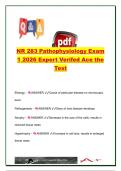
NR 283 Pathophysiology Exam
1 2026 Expert Verifed Ace the
Test
Etiology - ANSWER ✔✔Cause of particular disease on microscopic
level
Pathogenesis - ANSWER ✔✔Story of how disease develops
Atrophy - ANSWER ✔✔Decrease in the size of the cells, results in
reduced tissue mass
Hypertrophy - ANSWER ✔✔Increase in cell size, results in enlarged
tissue mass
, Hyperplasia - ANSWER ✔✔Increased number of cells, results in
enlarged tissue mass
Metaplasia - ANSWER ✔✔Mature cell type is replaced by a different
mature cell type, Ex: chronic smokers, cells lose cilia
Dysplasia - ANSWER ✔✔Cells are different looking varying in size
and shape
Neoplasia - ANSWER ✔✔New growth, commonly a tumor. May be
malignant or benign
Apoptosis - ANSWER ✔✔Programmed cell death, normal occurrence
in the body
Ischemia - ANSWER ✔✔Deficit of oxygen in the cells
Hypoxia - ANSWER ✔✔Reduced oxygen in the tissues
Iatrogenic - ANSWER ✔✔illness or disease process because a
medical process was done ex: CAUTI
Autosomal Recessive Disorders - ANSWER ✔✔Has to have two
recessive genes to have disease, only one recessive gene to be carrier
ex: Cystic fibrosis, PKU (phenylketonuria), Tay-Sachs