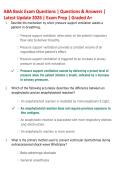
ABA Basic Exam Questions | Questions & Answers |
Latest Update 2026 | Exam Prep | Graded A+
1. Describe the mechanism by which pressure support ventilation assists a
patient in breathing.
Pressure support ventilation relies solely on the patient's inspiratory
flow rate to deliver breaths.
Pressure support ventilation provides a constant volume of air
regardless of the patient's effort.
Pressure support ventilation is triggered by an increase in airway
pressure to assist with exhalation.
Pressure support ventilation assists by delivering a preset level of
pressure when the patient initiates a breath, indicated by a decrease
in airway pressure.
2. Which of the following accurately describes the difference between an
anaphylactic and an anaphylactoid reaction?
An anaphylactoid reaction is mediated by immunoglobulin E (IgE).
An anaphylactoid reaction does not require previous exposure to
the antigen.
An anaphylactic reaction is associated with more respiratory distress
and obstruction.
An anaphylactic reaction is more severe.
3. What is the primary method used to prevent ventricular dysrhythmias during
extracorporeal shock wave lithotripsy?
Beta-adrenergic blockade
General anesthesia
, ECG synchronization
Epidural blockade to T4
4. In a patient receiving pressure support ventilation, pressure support breaths
are triggered by achieving which of the following preset milestones?
An inspired volume
An inspiratory flow rate
A decrease in airway pressure
An increase in airway pressure
5. In a patient with pre-existing cardiovascular issues, which anesthetic agent
would be the most appropriate choice to minimize the risk of hypotension
during induction?
Methohexital
Etomidate
Propofol
Midazolam
6. In a clinical scenario, if a patient is administered a new anesthetic agent with a
large volume of distribution, what implications might this have for dosing and
monitoring?
The drug will have minimal effects and require no monitoring.
Dosing may need to be adjusted due to the drug's extensive
distribution in body tissues.
The drug's effects will be short-lived and require frequent re-dosing.
The drug will primarily affect the central nervous system only.
,7. Describe the rationale for using positive-pressure ventilation in a patient with
pulmonary edema and low oxygen saturation.
Positive-pressure ventilation is primarily for patients with airway
obstruction only.
Positive-pressure ventilation is not effective in managing pulmonary
edema.
Positive-pressure ventilation is used to decrease heart rate in patients
with pulmonary edema.
Positive-pressure ventilation helps to improve oxygenation and
reduce pulmonary edema by increasing intrathoracic pressure and
aiding in alveolar recruitment.
8. What is the most likely cause of nausea, diaphoresis, and sharp pain in the left
shoulder in a patient who received spinal anesthesia for TURP?
Hyponatremia
Bladder perforation
Angina pectoris
Inadequate spinal sensory level
9. Myocardial oxygen demand increases, if.....
HR incr.
diastolic filling time incr.
preload incr.
all of the above
10. An adult patient with mild hypothermia is anesthetized with 1 MAC of
isoflurane. Which of the following is the most effective physiologic
, mechanism for maintaining body temperature in this patient?
Vasoconstriction
Nonshivering thermogenesis
Redistribution of heat from the core to the periphery
Shivering thermogenesis
11. Which of the following describes the mechanism by which the duration of
action of rocuronium is prolonged when desflurane is used?
Blocked release of acetylcholine at the motor end plate
Reduced reuptake of acetylcholine at the motor end plate
Decreased sensitivity of the postjunctional membrane to
depolarization
Reduced skeletal muscle blood flow
12. Which of the following would have the GREATEST effect on the level of
sensory blockade after a subarachnoid injection of hyperbaric 0.75%
bupivacaine?
Patient weight
Patient position
Patient age
Addition of epinephrine to the local anesthetic solution
13. In a clinical scenario where a patient with renal failure requires reversal of
neuromuscular blockade, which drug would be the most appropriate choice
and why?
Latest Update 2026 | Exam Prep | Graded A+
1. Describe the mechanism by which pressure support ventilation assists a
patient in breathing.
Pressure support ventilation relies solely on the patient's inspiratory
flow rate to deliver breaths.
Pressure support ventilation provides a constant volume of air
regardless of the patient's effort.
Pressure support ventilation is triggered by an increase in airway
pressure to assist with exhalation.
Pressure support ventilation assists by delivering a preset level of
pressure when the patient initiates a breath, indicated by a decrease
in airway pressure.
2. Which of the following accurately describes the difference between an
anaphylactic and an anaphylactoid reaction?
An anaphylactoid reaction is mediated by immunoglobulin E (IgE).
An anaphylactoid reaction does not require previous exposure to
the antigen.
An anaphylactic reaction is associated with more respiratory distress
and obstruction.
An anaphylactic reaction is more severe.
3. What is the primary method used to prevent ventricular dysrhythmias during
extracorporeal shock wave lithotripsy?
Beta-adrenergic blockade
General anesthesia
, ECG synchronization
Epidural blockade to T4
4. In a patient receiving pressure support ventilation, pressure support breaths
are triggered by achieving which of the following preset milestones?
An inspired volume
An inspiratory flow rate
A decrease in airway pressure
An increase in airway pressure
5. In a patient with pre-existing cardiovascular issues, which anesthetic agent
would be the most appropriate choice to minimize the risk of hypotension
during induction?
Methohexital
Etomidate
Propofol
Midazolam
6. In a clinical scenario, if a patient is administered a new anesthetic agent with a
large volume of distribution, what implications might this have for dosing and
monitoring?
The drug will have minimal effects and require no monitoring.
Dosing may need to be adjusted due to the drug's extensive
distribution in body tissues.
The drug's effects will be short-lived and require frequent re-dosing.
The drug will primarily affect the central nervous system only.
,7. Describe the rationale for using positive-pressure ventilation in a patient with
pulmonary edema and low oxygen saturation.
Positive-pressure ventilation is primarily for patients with airway
obstruction only.
Positive-pressure ventilation is not effective in managing pulmonary
edema.
Positive-pressure ventilation is used to decrease heart rate in patients
with pulmonary edema.
Positive-pressure ventilation helps to improve oxygenation and
reduce pulmonary edema by increasing intrathoracic pressure and
aiding in alveolar recruitment.
8. What is the most likely cause of nausea, diaphoresis, and sharp pain in the left
shoulder in a patient who received spinal anesthesia for TURP?
Hyponatremia
Bladder perforation
Angina pectoris
Inadequate spinal sensory level
9. Myocardial oxygen demand increases, if.....
HR incr.
diastolic filling time incr.
preload incr.
all of the above
10. An adult patient with mild hypothermia is anesthetized with 1 MAC of
isoflurane. Which of the following is the most effective physiologic
, mechanism for maintaining body temperature in this patient?
Vasoconstriction
Nonshivering thermogenesis
Redistribution of heat from the core to the periphery
Shivering thermogenesis
11. Which of the following describes the mechanism by which the duration of
action of rocuronium is prolonged when desflurane is used?
Blocked release of acetylcholine at the motor end plate
Reduced reuptake of acetylcholine at the motor end plate
Decreased sensitivity of the postjunctional membrane to
depolarization
Reduced skeletal muscle blood flow
12. Which of the following would have the GREATEST effect on the level of
sensory blockade after a subarachnoid injection of hyperbaric 0.75%
bupivacaine?
Patient weight
Patient position
Patient age
Addition of epinephrine to the local anesthetic solution
13. In a clinical scenario where a patient with renal failure requires reversal of
neuromuscular blockade, which drug would be the most appropriate choice
and why?